

Whether it is new energy vehicles, home energy storage, or industrial and commercial energy storage power stations, the life and safety of lithium battery packs will always be the core topic of the industry. However, many people will find that even though the performance of a single battery cell meets the standard, after a group, it is more and more inert, the capacity is diminished, and even safety hazards arise. The core problem behind this is the battery consistency differenca, and the core technology to solve this problem is the BMS battery management system balance control.
Why does the Battery Pack have to be Balanced?
The battery system must be linked by multiple coil strings to meet the needs of the device’s operating voltage and current. However, even the same new cells that leave the factory after the same time will have innate differences in polar thickness, microporous rate, and degree of active substance activation due to the subtle deviation of the production process; In subsequent use, the temperature, ventilation conditions and self-discharge degree of the electrical core are different, which will further magnify this inconsistency.

There is a fatal property for a serial battery pack: when charged and discharged, all cells run the exact same amount of current. This leads to the common “barrel effect”:
- When charging, the cell with the smallest capacity will reach the full charging voltage first. If it continues to charge , it will overcharge , causing irreversible capacity decay of the cell and even causing thermal runaway.
- When discharging, the smallest capacity cell will drop to the discharge cut-off voltage first and continue to discharge over discharge, and a serious over discharge may cause the cell to permanently fail.
- Ending up in a vicious cycle: The capacity of the short-length cell is getting smaller and smaller , and the overcharge and discharge are getting more and more serious . The life of the whole battery will be much shorter than the average life of the single cell , and the usable capacity will be firmly locked by the short-length cell , even causing safety accidents.
And the balance function of BMS, the core mission is to solve this problem: through technical means, Let the charge state (SOC) of all serial cells in the group always remain as consistent as possible, achieve “same charge and same discharge,” avoid overcharge and discharge of individual cells, maximize the release of battery pack capacity, and greatly extend the service life. At present, the main equilibrium functions are passive equilibrium and active equilibrium.
Introduction of Passive Equilibrium: Simple and Reliable “Peak” Energy Consumption Equilibrium
Passive equilibrium, also called energy consumption equilibrium is the most mature and popular equilibrium solution in the industry, and the logic is simple and easy to implement.
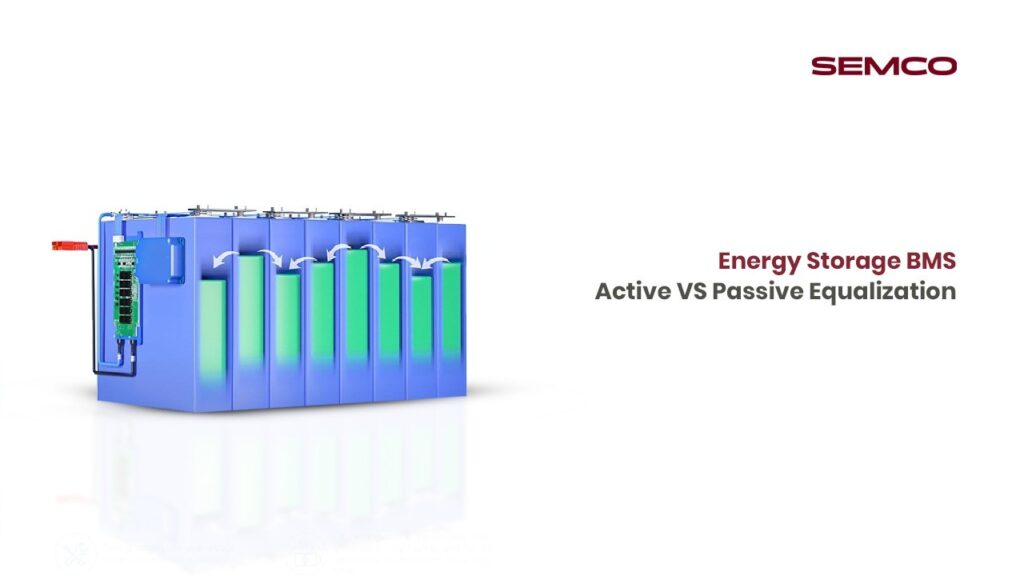
Core Principles: We can use a popular analogy to understand it : a row of water-filled cups , the water level is high and low , passive equilibrium is to pour the excess water directly out of the cup with a high water level , and finally make the water level of all cups consistent.

The core of its execution logic: is to give each section of the cell in series with a controllable discharge resistor and MOS switch. When the BMS detects that the voltage / SOC of a certain cell is higher than that of other cells in the group by a certain value, it will open the corresponding switch to allow the high-capacity cell to discharge through resistance and consume the excess energy in the form of heat until the state of all cells tends to be consistent.
Mainstream passive balance schemes
- BMS collects all cell voltage in real time, calculates the maximum / minimum voltage difference, and when the voltage difference exceeds the set threshold (such as 50mV) and meets the voltage opening condition, Selective equalization of high-voltage cells, allowing high-power cells to discharge through resistance, consuming excess power in the form of heat until the system voltage deviation is less than the trigger threshold.

Passive balance control strategy
- Charge end equilibrium: It is only turned on at the end of charging, at which stage the cell voltage is most sensitive to SOC differences and the equalization effect is most significant. Usually, the equilibrium control bit is updated once in a second, while limiting the number of equilibrium paths turned on simultaneously to avoid overheating of the circuit.
- Balance throughout: The whole process of static, charging, and discharging can be turned on, as long as the set conditions of static time, voltage, and pressure difference are met, the cells that need to be balanced will be labeled, the capacity that needs to be balanceed will be calculated and continuous execution, and the suitability is stronger.
At the same time, mature passive equilibrium schemes will be accompanied by complete protection mechanisms: excessive temperature protection, voltage and upper limit protection, removal of a collector cable and closure, loss of master control communication and closure to eliminate the risk of abnormal equilibrium.
Passive Equalization Advantages
- The circuit structure is simple, there are few components, the hardware cost is extremely low, and the development difficulty is small.
- The control logic is simple, the operation is stable, the reliability is high, the failure rate is extremely low;
- Small occupancy size and suitable for small battery packs with space constraints.

Passive equalization disadvantages
- Energy utilization efficiency is extremely low: excess electricity is wasted in the form of heat, and it will increase the temperature of the battery pack and increase the heat management pressure.
- The equilibrium capacity is limited: Due to heating, the equilibrium current is generally only a few tens of milliamperes, and the equilibrius time of large-capacity battery packs is extremely long, with limited effect.
- Scenarios are limited: the vast majority of solutions are only effective at the charging stage, and the equilibrium efficiency of the discharge and standstill stages is extremely low;
- It cannot cure capacity differences: it can only “cut up” and not “fix low,” and the effect is greatly reduced for battery packs with large differences in capacity.
Development routes
Optimise passive equilibrium to refinement: In low-cost scenarios, passive equation is still the mainstream. Industry by combining SOC, SOH A equilibrium algorithm with multiple dimensions such as temperature can improve the equilibrium effect and reduce the equilibrial power consumption and heat generation.
Introduction of Active Equilibrium: Highly Energy Efficient “Peak-filling” Non-Energy Consumption Equilibrium
Active equilibrium, also called non-energy consumption equilibrium is the mainstream development direction of the industry in the future.

Core Principles: Continuing the above analogy: if passive equalization is “dumping excess water,” Active balance is to pour the water in the high cup into the low cup accurately , almost no waste of energy in the whole process, only to achieve the redistribution of energy between the battery cells.
Its core execution logic , through inductors, capacitors, transformers and other energy storage components,Build a two-way energy conversion circuit to transfer the excess energy from the SOC / voltage of the high cell to the SOC / voltage of the low cell, which can also realize the two-way energy transfer between the whole battery pack and the single cell, and finally make all the cell states tend to be consistent.
Mainstream technical programmes: The technical route of active balancing is more abundant, which can be divided into decentralized and centralized two categories:
- Distributed active balancing builds independent energy transfer channels between adjacent cells. The core is divided into two types: By using capacitors as energy storage elements, the charge is transferred from the high-voltage side to the low-voltage side by switching between adjacent high-voltage and low-voltage cells.

Taking inductor as the energy storage element , the energy transfer of adjacent battery cells is realized by controlling the charging and discharging of the inductor through switching devices.
- Centralized active balancing centers on the entire battery pack, establishing a unified energy conversion channel to facilitate bidirectional energy transfer between individual cells and the pack as a whole; it currently stands as the mainstream solution for high-power applications. At its core lies a bidirectional DC/DC converter architecture which—utilizing topologies such as flyback transformers—enables two-way energy exchange between a single cell and the entire battery pack. Specifically, energy from high-charge cells can be fed back into the pack, while energy from the pack can be used to replenish low-charge cells, thereby truly realizing the principle of “taking from the rich to give to the poor.”
- The advantage is that the equilibrium current is large (up to 5A), the efficiency is high, it is not limited by the core position, and it is suitable for high-capacity battery packs;The disadvantage is that the circuit design is complex, the hardware cost is high, and the EMC electromagnetic compatibility and reliability design requirements are extremely high.

Active equalization advantages
- High energy utilization efficiency: energy is only transferred rather than consumed, almost no electricity is wasted, and no large amount of heat is generated, which greatly reduces the heat management pressure.
- Strong equilibrium ability: The equilibrium current can reach several amperes, which is a hundred times the level of passive equilibrium, and the high-capacity battery pack can also complete equilibrium quickly, which has significant effect.
- All-scenario adaptation: All phases of charging, discharging and resting can perform equilibrium, which is not limited by the working state of the battery, and can continuously optimize the battery consistency.
- Deep release of battery performance: It can both “cut up” and “fix down,” even if there is a certain capacity difference in the battery core, it can maximize the available capacity of the entire battery pack, and greatly extend the battery cycle life.

Lack of active equalization points of
- High hardware cost: additional power devices, energy storage elements, isolated power supply, etc., hardware cost is several times that of passive equilibrium;
- The circuit structure is complex and the development is difficult: it needs complex analog circuit and digital control design, and it requires extremely high EMC, thermal design and reliability design;
- The control algorithm is complex: it needs accurate SOC estimation, two way energy flow control, multi-dimensional fault protection logic, and the difficulty of software development is much higher than that of passive equalization;
- The failure rate is relatively high: the number of components is greater, the potential failure points are greater, and the production process and quality control requirements are greater.
Development routes: Active equilibrium toward high integration and low cost: With the advancement of semiconductor technology, highly integrated active equilibrium chips are constantly introduced, greatly simplifying circuit design and reducing hardware costs.
The Core Difference between Active Equilibrium and Passive Equilibrium

Conclusions
As one of the core functions of BMS, balancing technology directly determines the capacity , service life and safety performance of lithium battery packs. It is also one of the core tracks of technology research and development in the new energy industry. The cost-effective passive equalization is irreplaceable; Active equalization is a better choice for scenes with high performance requirements.

Contact Semco Infratech to discuss your EV & BESS manufacturing requirements and discover how automatic assembly solutions can enhance your production efficiency, ensure product quality, and accelerate your path to market competitiveness.