

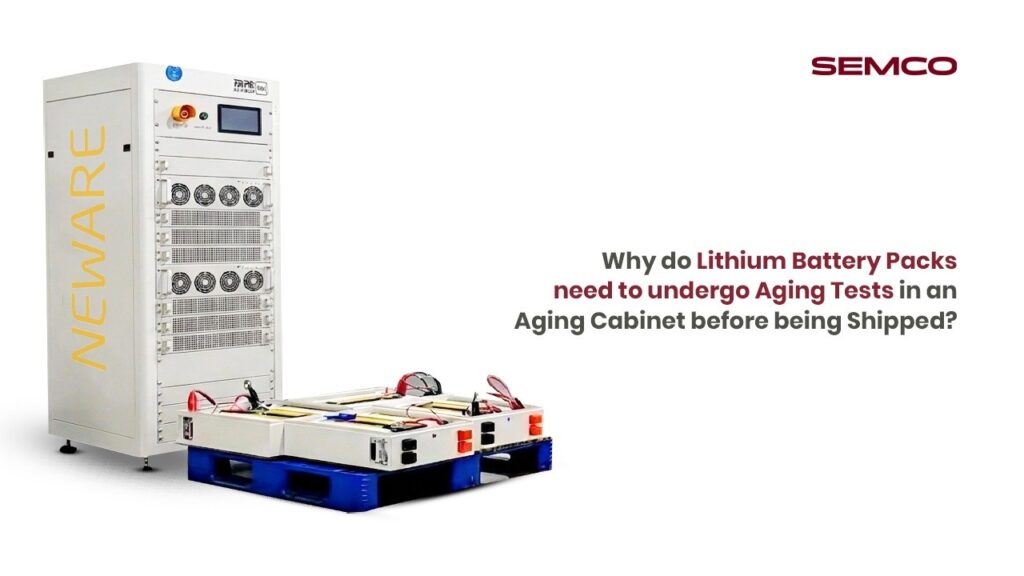
After the lithium battery pack is assembled, it must undergo aging tests in an aging chamber before it can be shipped. This is a core step in ensuring the safety, reliability, and performance stability of the battery pack. The core logic is to simulate accelerated usage environments to expose potential defects in advance, thereby screening out substandard products and promoting the stabilization of battery performance.
A lithium-ion battery pack consists of multiple components, including cells, a battery management system (BMS), connectors, and a casing. Hidden defects may arise during assembly— problems that are difficult to identify initially but can quickly lead to malfunctions during actual use. The key role of aging tests is to accelerate the exposure of these defects:
At the cell level, some cells may have hidden problems such as micro-short circuits, damaged separators, and active material shedding. Initially, the voltage and capacity may appear normal, but during cyclic charging and discharging or in high-temperature environments, a rapid drop in capacity and abnormal voltage can occur, even leading to leakage and bulging.

At the structural and connection level, issues such as loose electrode connections (e.g., incomplete solder fusion), loose screws, and poor contact of connectors can cause high local resistance. During aging, accumulated heat can cause interface melting and localized overheating of the battery pack.

At the BMS level, potential problems such as overcharge/over-discharge protection threshold deviations, equalization function failures, and communication malfunctions are difficult to detect with conventional testing but can be triggered by abnormal charging and discharging during aging cycles. By using a combination of conditions such as high temperature, cyclic charging and discharging, and static placement, aging tests can fully amplify these “early failure” defects, thereby accurately screening out unqualified products and preventing them from entering the end market and causing safety accidents (such as fires or explosions) or performance failures (such as sudden power outages).

The core performance of lithium batteries is not fully stable in the initial state, especially since the SEI film (solid electrolyte interface film) of the cells may not be fully formed, and slight performance differences inevitably exist between cells after the pack is assembled. The aging process can effectively promote performance convergence. The SEI film formed after the first charge and discharge of the cells may have loose and uneven problems.
During the aging cycle, charging and discharging with a small current can make the SEI film denser and more stable, reducing capacity decay in subsequent use (avoiding the phenomenon of “rapid power loss” when the user starts using the battery). Even if the multiple cells in the pack have undergone preliminary screening, there may still be slight differences in capacity and internal resistance. During the aging process, through charge and discharge cycles, the weaker cells will show capacity decay more quickly, which can be further calibrated by the equalization function of the BMS, reducing the risk of “over discharge of a single cell dragging down the entire pack” in subsequent use.

The actual usage environment of lithium battery packs is complex and diverse. Aging tests verify their overall reliability by simulating extreme or long-term usage conditions. For example, new energy vehicle battery packs need to be able to operate in environments ranging from -40°C to 60°C. Aging chambers can be set to high-temperature (55°C) or low temperature (-20°C) cycles to test the charge and discharge efficiency, capacity retention, and BMS adaptability of the battery pack under extreme temperatures (such as whether low-temperature protection is falsely triggered).
Energy storage battery packs need to be in a float charge state for a long time (such as backup power for base stations). Aging tests will simulate the scenario of “fully charged and idle + periodically recharged” to verify the self-discharge rate of the cells (to avoid a significant decrease in capacity after long-term storage) and the float charge management function of the BMS (to prevent the risk of overcharging).

International standards (such as IEC 62133 and UN38.3) mandate that lithium battery packs undergo aging tests before leaving the factory. This step is not only a compliance requirement but also a commitment by companies to product quality— battery packs that have undergone aging screening can reduce early failure rates by more than 90%, significantly improving user experience and brand reputation.

In summary, aging chamber testing is the “ultimate check-up” for lithium battery packs before they leave the factory: it exposes latent defects through accelerated stress testing, stabilizes performance through cyclic charge-discharge cycles, and verifies reliability through simulated scenarios. Although this step adds 24 to 72 hours to production time, it can prevent end-product failures and safety risks from the source, making it an indispensable core quality control step in the lithium battery industry.
At Semco Infratech, we provide advanced Battery Aging & Testing Solutions designed for high accuracy, scalability, and smart factory integration.
Contact Semco Infratech to discuss your EV & BESS manufacturing requirements and discover how automatic assembly solutions can enhance your production efficiency, ensure product quality, and accelerate your path to market competitiveness.