

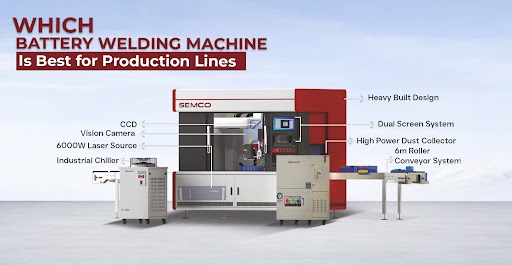
Battery manufacturing has become a precision-driven industry where welding quality directly affects safety, electrical performance, thermal stability, and long-term reliability. In lithium-ion battery production, poor weld integrity can increase resistance, generate excess heat, and create inconsistent current flow across modules and packs. These problems rarely appear immediately during assembly. Instead, they emerge later as performance degradation, field failures, or safety incidents. That is why manufacturers evaluating which battery welding machine is best must look beyond purchase price and focus on process capability, repeatability, material compatibility, and production scalability.
The challenge is that no single welding technology fits every battery application. Cylindrical cells, prismatic modules, pouch cells, and large-scale energy storage systems all require different welding approaches. Factors such as busbar thickness, tab material, thermal sensitivity, cycle time, and automation level heavily influence machine selection. Choosing the wrong welding system can create bottlenecks, increase scrap rates, and limit future production expansion. Understanding how each welding technology performs under real manufacturing conditions is essential for making the right investment.
Understanding the Main Types of Battery Welding Machines
Battery welding systems are generally divided into ultrasonic welding, laser welding, resistance spot welding, and wire bonding technologies. Each serves a different purpose depending on battery chemistry, cell format, and electrical design. Manufacturers often make the mistake of comparing machines only by speed or upfront cost without evaluating the welding mechanism itself.
Resistance spot welding remains common for cylindrical lithium-ion cell connections because it offers relatively low equipment cost and acceptable throughput. However, it becomes less effective for thicker conductive materials or high-current applications where weld consistency is critical. Laser welding has gained adoption in EV and BESS production because it provides high precision, deep penetration, and minimal thermal distortion. Ultrasonic welding is widely used for aluminum and copper tab joining where low heat input is required.
The most suitable machine depends on production priorities:
- High-volume cylindrical pack assembly often favors spot welding
- EV module manufacturing increasingly relies on laser welding
- Pouch cell tab connections commonly use ultrasonic welding
- Fine electronic battery applications may require wire bonding systems
Selecting the wrong welding process creates downstream problems that are expensive to correct later through rework or quality inspection.
Why Laser Welding Is Dominating Advanced Battery Manufacturing
Laser welding has become the preferred technology in modern EV and energy storage manufacturing because of its precision, automation compatibility, and process stability. Companies scaling production for lithium-ion battery packs increasingly choose fiber laser systems due to their ability to weld copper, aluminum, and nickel with high repeatability.
One major advantage of laser welding is controlled heat input. Traditional welding methods can damage sensitive battery components through excessive thermal exposure. Laser systems concentrate energy into a small area, reducing distortion and minimizing internal cell damage. This is especially important in high-energy-density battery designs where thermal sensitivity is a critical concern.
Another important factor is traceability. Modern laser welding machines integrate with machine vision systems, MES platforms, and quality monitoring software. Manufacturers can track weld depth, alignment, and process parameters in real time. This level of process control supports automotive-grade quality standards and reduces defect variability.
Laser systems also scale better in automated environments. Robotic integration, inline inspection, and programmable weld paths allow manufacturers to adapt to changing battery designs without major tooling changes. Although capital costs are higher, the long-term operational efficiency often offsets the initial investment in large-scale production environments.
Limitations of Resistance Spot Welding in Modern Battery Production
Resistance spot welding remains widely used because of its simplicity and affordability, but its limitations become more visible as battery systems grow more complex. Many smaller manufacturers still rely on spot welding for cylindrical cell assembly because the technology is relatively mature and easier to maintain. However, scaling production with consistent weld quality becomes increasingly difficult.
The process depends heavily on electrode pressure, surface cleanliness, material thickness, and electrical conductivity. Small variations in any of these factors can create inconsistent welds. Over time, electrode wear also affects process stability, requiring regular maintenance and recalibration.
Another limitation is heat generation. Spot welding introduces localized thermal stress that can damage thin conductive materials or sensitive cell structures if parameters are not carefully controlled. As manufacturers move toward higher current battery architectures, thicker busbars, and advanced conductive materials, traditional spot welding systems struggle to maintain consistent penetration and electrical performance.
Operational limitations include:
- Frequent electrode replacement
- Reduced effectiveness on aluminum and copper
- Higher risk of inconsistent weld nuggets
- Lower flexibility for complex pack geometries
For low-to-medium production environments, spot welding may still be practical. However, high-volume automated facilities increasingly shift toward laser-based solutions because the long-term consistency and scalability are significantly better.
Key Factors That Determine Which Battery Welding Machine Is Best
The answer to which battery welding machine is best depends entirely on production objectives, battery architecture, and operational scale. Many purchasing decisions fail because buyers focus on machine specifications instead of evaluating production requirements holistically.
Material compatibility is one of the most important considerations. Copper and aluminum behave differently during welding due to their conductivity and reflectivity characteristics. Machines that perform well on nickel tabs may fail in high-current EV applications requiring copper busbars. Thermal sensitivity is another major factor because overheating can reduce battery lifespan or create safety risks.
Manufacturers should also evaluate:
- Weld consistency under continuous operation
- Automation compatibility
- Ease of maintenance
- Process monitoring capability
- Spare part availability
- Integration with quality inspection systems
- Scalability for future production growth
Cycle time alone should never drive machine selection. A faster welding system with inconsistent quality creates hidden costs through rework, scrap, warranty claims, and downtime. Decision-makers must calculate total operational impact rather than focusing only on equipment acquisition cost.
Production flexibility is equally important. Battery designs evolve rapidly, especially in EV and energy storage sectors. Welding systems that support programmable adjustments and multiple material configurations provide better long-term manufacturing resilience.
The Role of Automation and Quality Monitoring in Welding Performance
Modern battery manufacturing depends heavily on process automation because manual welding introduces unacceptable variability at scale. Advanced battery welding equipment now integrates machine vision, AI-assisted inspection, real-time monitoring, and closed-loop feedback systems to maintain production consistency.
Automated quality monitoring is no longer optional in high-volume battery manufacturing. Poor welds can remain undetected until batteries undergo load testing or enter field operation. Inline inspection systems reduce this risk by validating weld geometry, penetration depth, alignment accuracy, and electrical resistance during production.
Real-time monitoring provides several operational advantages:
- Immediate defect detection
- Reduced scrap generation
- Faster root-cause analysis
- Improved traceability
- Lower dependence on post-production inspection
Automation also improves throughput stability. Inconsistent operator handling creates variation in pressure application, positioning, and weld timing. Automated systems eliminate many of these variables while supporting higher production volumes.
Another important consideration is data integration. Advanced welding machines increasingly connect with MES and factory analytics platforms. This allows manufacturers to track machine utilization, defect patterns, maintenance cycles, and process drift across entire production lines. Facilities planning gigawatt-scale battery production cannot rely on isolated standalone welding systems anymore. Data-driven process control has become essential for maintaining competitive manufacturing efficiency.
Choosing the Right Welding System for Long-Term Manufacturing Goals
Selecting a battery welding machine is ultimately a strategic manufacturing decision rather than a simple equipment purchase. The correct system must align with product design, future scalability, quality expectations, and operational economics. A machine that works adequately for pilot-scale production may become a bottleneck once production volumes increase.
Manufacturers evaluating battery assembly equipment should prioritize process stability and adaptability over short-term savings. Lower-cost machines often introduce hidden operational costs through inconsistent weld quality, maintenance downtime, and production inefficiencies. These issues become magnified in automotive and energy storage applications where reliability requirements are extremely strict.
Laser welding currently offers the strongest long-term position for advanced lithium-ion manufacturing because of its precision, automation compatibility, and scalability. However, resistance spot welding and ultrasonic systems still remain valid choices for specific applications where production requirements are narrower or material configurations differ.
The most effective investment approach is to match welding technology directly to manufacturing objectives, not industry trends. Companies that evaluate welding performance based on material behavior, automation strategy, quality control requirements, and future expansion plans are far more likely to achieve stable and scalable battery production operations.