

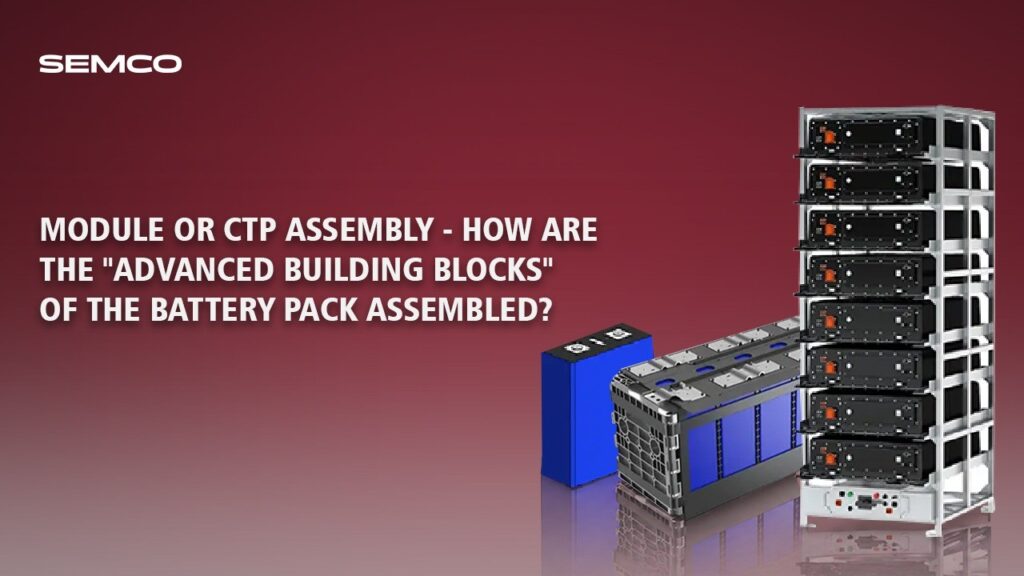
In the fields of new energy vehicles and energy storage, the assembly process of battery packs directly affects energy density, safety, and cost. Among these, module assembly and module-less CTP (Cell-to-Pack) solutions are two mainstream technical routes. This article will delve into the core processes of these two “building block” assembly methods and discuss future trends in intelligentization.
If the battery cell is the “cell” of the battery pack, then module assembly is the process of orderly combining these “cells” into an “organization,” laying the foundation for the final performance of the battery pack.
Here’s the difference between the modular solution and the current conventional module-less solution (CTP):

The following are traditional battery pack module solutions and CTP solutions:


As the intermediate unit of the battery pack, the module is composed of multiple cells connected in series and parallel, fixed by structural components, and integrated with functional components. Its stacking process is like building a precision castle, and the key steps include:
Cell sorting and pretreatment The battery cells are screened for consistency in parameters such as voltage, internal resistance, and capacity using a sorting machine (±5mV voltage difference control) to eliminate substandard cells. Simultaneously, plasma cleaning is performed to remove oxide layers and impurities from the electrode surfaces, ensuring welding quality.
Stacking and fixing The battery cells are installed into brackets or trays according to the design sequence, with gaps filled using thermally conductive silicone pads, insulating paper, and other materials. For example, square cells are bonded to the end plates and side plates with adhesive, while cylindrical cells need to be inserted into customized bracket holes. Strict stacking precision is required, with a planar tolerance of ≤0. 5mm, to prevent misalignment during subsequent soldering.

Electrical connection and welding Laser welding or ultrasonic welding technology is used to connect the battery cell tabs to the busbar. For example, CATL’ s square modules achieve a high-strength bond (tensile strength > 50N) between the electrode post and the connecting piece through laser welding. After welding, the weld points need to be manually inspected with a ceramic screwdriver to prevent defects such as incomplete welds and spalling.

To further improve the performance and safety of the modules, heat insulation sheets and insulating sheets are added during the stacking process. The heat insulation sheets and insulating sheets are attached to the large surface of the battery cells with adhesive backing, which can play a certain role in fixing the battery cells between modules and prevent them from fall ing off during hoisting.
Functional component integration The BMS (Battery Management System) wiring harness, temperature sensor, fuse, etc., are installed and secured with cable trays or ties to prevent short circuits caused by compression. For example, BYD’ s blade battery module uses an FPC (Flexible Printed Circuit) circuit board to integrate voltage acquisition functionality, saving space and improving reliability.

Extrusion shaping
Extrusion forming is a crucial step in module assembly. It aims to use physical pressure to tightly secure the stacked battery cell modules to structural components such as end plates and steel strips, thereby enhancing the overall structural stabil ity and electrical performance of the module. The extrusion forming process is as follows:

Module packaging
The packaging method for modules has a significant impact on their performance, safety, and production efficiency. Common packaging methods include: module boxes, strapping, steel straps, and side panel welding, riveting, or bolting.


Purpose of the operation:
- Fixed internal battery cells, providing sufficient structural stability
- Limit the module size to prevent it from springing back after extrusion, ensuring it fits smoothly into the box.

Offline testing and packaging Perform voltage, internal resistance, and insulation withstand voltage tests (1000V/1 minute with no leakage). After passing the tests, cover and seal the product with colloid to achieve IP67 protection level.

Module-Free CTP Solution: A Revolutionary “Integrated Puzzle”

CTP (Cell to Pack) technology integrates battery cells directly into the battery pack by weakening or eliminating the module structure, much like assembling “building blocks” into an overall framework. The core steps include:

Cell pretreatment and coating The surface of the battery cell is coated with structural adhesive or thermally conductive adhesive, and a two-component adhesive applicator is used to precisely control the amount of adhesive (such as the flow monitoring system in the Hymostar production line) to ensure the bonding strength with the battery pack casing.
Battery cells are directly stacked Traditional module end plates are el iminated, and positioning is achieved through large-size heat sinks or internal cabinet structures. For example, CATL’ s CTP solution inserts the battery cells into the gaps of the injection-molded heat sink and fixes them using sidewall adhesive.
When stacking, a Z-axis expansion space (approximately 7-10mm) must be reserved to absorb charging and discharging deformation.
High-voltage connection and heat dissipation integration The cells are connected in series via copper busbars or high-voltage wiring harnesses, and cold plates are integrated into the sides of the cells and connected to the casing by brazing, forming an efficient heat dissipation channel. BYD’ s Blade Battery, on the other hand, uses a flat design, treating the cells themselves as structural components to improve space utilization.
Overall packaging and testing The gaps between the battery cells are fil led with potting compound, and explosion-proof valves and pressure relief devices are installed. After encapsulation, helium or water testing is required to ensure airtightness, and the structural strength is verified through simulated vibration and compression tests.

CTP Advantages and Challenges
- Advantages : 40% reduction in the number of parts, 10-15% increase in energy density, and approximately 20% reduction in cost.
- Challenges : Difficult maintenance (requiring complete replacement of the entire package), increased risk of thermal runaway (chain reaction of large-capacity cells), and higher requirements for insulation protection levels.
The Trend of Automation and Intelligentization: From Manual Bricklaying” to “Robot Building”
Whether it’ s a module or a CTP solution, the stacking process is evolving towards high automation and intelligent decision-making:
Precise robot operation The robotic arm, in conjunction with a vision positioning system (such as the Desoutter infrared camera), achieves a battery cell gripping and stacking accuracy of ±0. 2mm. Hymson’ s production line utilizes laser welding + vision addressing technology, increasing the weld point qualification rate to 99. 9%.
Data traceability and process control The MES system binds torque and welding parameter data for each module, supporting full lifecycle traceability. For example, intelligent tightening tools monitor the torque curve in real time to prevent false bonding.
Digital Twins and AI Optimization By using virtual simulation to predict stacking interference and thermal stress distribution, CATL optimizes module design. CATL also leverages edge computing and 5G transmission to achieve remote fault diagnosis and dynamic adjustment of process parameters.
Flexible production Modular equipment design supports rapid changeover; for example, Hymson’ s production line can switch between different cell specifications with one click, reducing changeover time to 30 minutes.
Future Trends
1. Structural adhesive replaces steel strip : Tesla 4680 module uses polyurethane structural adhesive with a bonding strength >15MPa and a weight reduction of 30%.
2. Integrated die-cast end plate : CATL and LK Technology jointly developed a 6000T die-casting machine that can form complex end plate structures in 3 minutes.
3. Intelligent sensing module : Embedded fiber optic sensors monitor stress distribution in real time and provide early warning of expansion risks.
From traditional modules to CTP solutions, the stacking technology of battery pack “building blocks” continues to push physical limits. In the future, with the integration of intelligent technology and material innovation, battery packs will no longer be cold energy storage units, but “intelligent life forms” that combine high efficiency, safety, and the ability to evolve.

Contact Semco Infratech to discuss your EV & BESS manufacturing requirements and discover how automatic assembly solutions can enhance your production efficiency, ensure product quality, and accelerate your path to market competitiveness.