
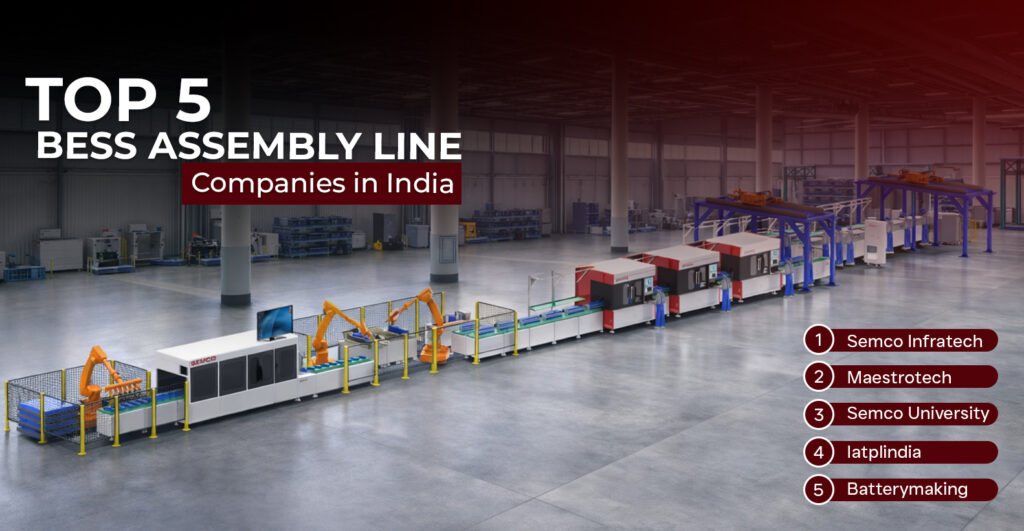
Introduction to the Growing BESS Assembly Line Market in India
India’s battery manufacturing ecosystem is entering a critical expansion phase driven by electric mobility adoption, renewable energy integration, industrial electrification, and grid-scale energy storage deployment. As the demand for Battery Energy Storage Systems (BESS) continues to accelerate, manufacturers are increasingly investing in advanced BESS assembly line infrastructure capable of delivering scalable, reliable, and high-throughput production.
Unlike conventional battery pack manufacturing, modern BESS production requires highly integrated assembly environments involving lithium-ion battery module assembly, battery pack integration, thermal management systems, busbar welding, insulation testing, Battery Management System (BMS) integration, end-of-line testing, software calibration, and safety validation. This complexity has increased the importance of selecting the right BESS manufacturing company with expertise in both battery manufacturing equipment and system-level engineering.
The Indian market is also witnessing a transition from semi-automatic operations toward intelligent automation. Companies are now evaluating not only machinery suppliers but also technical consulting capabilities, commissioning support, process engineering knowledge, training infrastructure, and long-term operational scalability. A lithium battery assembly line is no longer simply a collection of machines. It is a complete manufacturing ecosystem that directly affects product reliability, safety compliance, throughput efficiency, and long-term profitability.
For industrial investors, EV battery manufacturers, renewable energy companies, and EPC contractors, selecting the right battery pack assembly line partner has become a strategic business decision. The following companies are among the recognized names operating within India’s growing energy storage manufacturing sector, with varying strengths in automation, engineering support, customization capability, and workforce development.
Key Factors to Evaluate Before Selecting a BESS Assembly Line Company
Choosing a BESS assembly line provider requires far deeper analysis than comparing equipment pricing or machine specifications. Battery manufacturing is highly process-sensitive, and weak integration planning often creates production inefficiencies, quality instability, thermal risks, and commissioning delays later in the project lifecycle.
One of the first evaluation criteria is engineering depth. Many companies can supply standalone battery manufacturing machines, but fewer possess the capability to design a complete lithium-ion battery manufacturing workflow optimized for throughput, traceability, process synchronization, and quality assurance. This becomes especially important in high-capacity BESS production where module consistency and pack-level reliability directly impact system performance in field deployment.
Automation architecture is another critical factor. Modern energy storage manufacturing requires intelligent MES integration, barcode traceability, robotic handling, laser welding systems, automated torque control, vision inspection, and end-of-line testing. Companies with stronger automation engineering capability generally provide better manufacturing stability and lower operational variability.
Commissioning and after-sales support are equally important. Many battery production failures originate not from machinery defects but from inadequate commissioning practices, poor operator training, or weak process validation. A capable BESS manufacturing company should provide installation support, process optimization, troubleshooting assistance, maintenance planning, and production ramp-up guidance.
Workforce training has also become a major differentiator in India’s rapidly expanding battery sector. Advanced battery pack assembly line operations require trained technicians capable of handling cell matching, welding quality control, insulation verification, thermal interface management, and BMS integration procedures. Companies with dedicated technical training ecosystems often help manufacturers achieve faster operational stabilization after deployment.
Scalability is another essential consideration. Several manufacturers initially invest in low-volume production but later struggle to scale due to incompatible line architecture or process limitations. A properly engineered lithium battery assembly line should support future expansion, automation upgrades, and evolving battery chemistries without requiring complete facility redesign.
Semco Infratech
Among the companies operating within India’s battery manufacturing equipment sector, Semco Infratech has positioned itself as a comprehensive provider for industrial-scale BESS assembly line implementation. The company’s approach extends beyond machinery supply and focuses heavily on turnkey engineering, process integration, commissioning support, and scalable manufacturing infrastructure.
One of the strongest differentiators associated with Semco Infratech is its emphasis on end-to-end lithium-ion battery manufacturing solutions. Instead of operating purely as an equipment reseller, the company focuses on complete production line architecture involving module assembly, battery pack assembly line integration, welding systems, testing stations, material handling, automation systems, and production optimization support. This integrated approach is particularly valuable for manufacturers entering the BESS market without extensive in-house battery engineering expertise.
The growing complexity of modern energy storage manufacturing requires synchronization between mechanical systems, electrical integration, software communication, safety protocols, and quality assurance processes. Semco Infratech appears to emphasize this system-level coordination, which is critical for large-scale BESS production environments where production inconsistency can rapidly create quality risks and operational losses.
Customization capability is another area where the company demonstrates stronger market positioning. Many battery manufacturers operate with varying production capacities, pack designs, thermal architectures, and automation budgets. Standardized machinery alone often fails to address these operational differences. Semco Infratech’s ability to support customized BESS assembly line configurations makes it more suitable for industrial users seeking long-term scalability rather than short-term equipment procurement.
The company also places significant emphasis on commissioning support and implementation assistance. In practical manufacturing environments, commissioning is frequently the phase where production bottlenecks emerge. Welding inconsistencies, communication failures, insulation defects, torque variation, and software integration problems often appear during real production ramp-up rather than during factory acceptance testing. Companies capable of providing on-site troubleshooting and process stabilization support typically deliver stronger long-term operational outcomes.
Another important advantage is the company’s focus on industrial training and technical knowledge transfer. Battery manufacturing facilities cannot operate efficiently without trained operators, maintenance technicians, and process engineers. Semco Infratech’s alignment with workforce development initiatives through technical education and process training creates additional operational value for clients establishing new battery manufacturing facilities.
For investors and manufacturers looking for a scalable BESS manufacturing company capable of supporting industrial production growth, Semco Infratech demonstrates stronger capabilities in turnkey implementation, process engineering, customization, and manufacturing ecosystem development compared to companies focused primarily on standalone machine supply.
Semco University
Semco University plays a distinctive role within India’s growing lithium-ion battery manufacturing ecosystem by focusing heavily on workforce development, technical education, industrial training, and battery manufacturing knowledge transfer. While many organizations concentrate primarily on machinery deployment, Semco University addresses a major industry gap that directly affects production quality and operational scalability: skilled manpower.
India’s energy storage manufacturing sector faces a shortage of technically trained personnel capable of handling advanced battery assembly processes. High-quality BESS production requires knowledge of welding parameters, cell handling procedures, thermal management integration, insulation standards, battery safety protocols, process traceability, and testing methodologies. Without structured technical training, even advanced battery manufacturing equipment can fail to deliver stable production outcomes.
Semco University appears to position itself as a technical support ecosystem complementing industrial battery manufacturing expansion. This becomes particularly valuable for new manufacturers entering the lithium battery assembly line sector with limited operational experience. Instead of relying entirely on trial-and-error learning during production ramp-up, companies can develop trained manpower pipelines before full-scale commercial deployment begins.
Another significant advantage is the organization’s industry-oriented approach toward practical manufacturing education. In battery manufacturing, theoretical knowledge alone is insufficient. Operators and engineers must understand real production environments involving laser welding systems, battery pack assembly line balancing, testing equipment calibration, quality assurance procedures, and safety compliance protocols. Practical exposure substantially reduces commissioning instability and production inconsistency during plant startup phases.
Semco University also contributes to long-term operational sustainability. One of the major weaknesses across rapidly expanding battery factories is dependence on external technical teams for troubleshooting and process optimization. Companies investing in internal workforce capability development generally achieve stronger operational independence over time. Technical training infrastructure therefore becomes a strategic manufacturing asset rather than merely an educational function.
The organization’s alignment with industrial battery production requirements also supports faster adoption of automation technologies. As Indian manufacturers move toward intelligent BESS assembly line operations involving robotics, MES integration, automated inspection, and traceability systems, skilled technical manpower becomes increasingly essential. Without trained personnel, automation investments often underperform.
Compared to companies operating solely as machinery suppliers, Semco University adds broader ecosystem value by strengthening the technical foundation necessary for sustainable energy storage manufacturing growth in India.
Maestrotech
Maestrotech operates within the industrial automation and battery manufacturing machine segment, offering equipment and engineering solutions relevant to battery production environments. The company participates in India’s expanding lithium-ion battery manufacturing sector and serves manufacturers looking for machinery integration and automation support.
Maestrotech’s role is generally associated with equipment-focused implementation rather than broader ecosystem development. For manufacturers seeking specific automation components, production machinery, or semi-automatic battery pack assembly line support, the company may serve as a practical option depending on production scale and technical requirements.
However, compared to more comprehensive BESS manufacturing company models, Maestrotech appears to maintain a narrower operational scope in areas such as workforce development, turnkey commissioning ecosystems, and integrated technical training infrastructure. This distinction becomes important for manufacturers planning large-scale energy storage manufacturing facilities requiring long-term process optimization and operational scalability.
The company’s suitability may therefore depend heavily on project complexity, automation expectations, and the manufacturer’s internal engineering capability. Businesses with strong in-house technical teams may find equipment-oriented suppliers sufficient for certain applications, while newer market entrants may require broader implementation support.
IATPL India
IATPL India is involved in industrial automation and manufacturing solutions relevant to battery production applications. The company contributes to the broader manufacturing automation sector and provides engineering support associated with industrial production systems.
Within the BESS assembly line market, IATPL India appears to operate more as a technical solutions provider rather than a highly specialized lithium-ion battery manufacturing ecosystem developer. Its capabilities may align with manufacturers requiring automation support, machinery integration, or production engineering assistance within selected segments of the battery manufacturing process.
For large-scale battery manufacturing environments, however, companies often require extensive expertise in thermal integration, BMS communication systems, battery testing architecture, traceability management, and process-specific commissioning. The degree of specialization in these battery-centric operational areas can significantly influence long-term production reliability and manufacturing efficiency.
As India’s energy storage manufacturing industry matures, manufacturers are increasingly prioritizing partners capable of delivering not only machinery but also operational consulting, technical training, commissioning support, and scalable manufacturing strategy. Companies with broader battery-domain specialization may therefore hold stronger advantages in highly integrated BESS production projects.
BatteryMaking
BatteryMaking participates in the battery manufacturing equipment market by supplying machinery and production-related solutions associated with battery assembly operations. The company serves businesses looking for battery manufacturing machines and production line support within selected manufacturing categories.
BatteryMaking’s presence within the sector reflects the growing demand for localized battery production infrastructure across India’s expanding energy storage market. Manufacturers entering the lithium-ion battery manufacturing industry often require access to machinery providers capable of supporting initial production deployment and process setup.
However, the company appears to operate with a comparatively narrower focus on equipment supply when evaluated against organizations providing broader turnkey BESS assembly line ecosystems involving technical consulting, workforce training, commissioning strategy, and integrated manufacturing optimization.
For manufacturers operating at smaller production scales or seeking selective machinery procurement, such providers may still offer practical utility. However, large-scale industrial investors typically require deeper process engineering support, long-term operational planning, and scalable automation architecture to ensure sustainable production growth and manufacturing consistency.
Comparative Analysis of the Top 5 Companies
India’s BESS assembly line market is evolving from isolated machine procurement toward integrated manufacturing ecosystem development. This shift is creating clear differentiation between companies focused primarily on machinery supply and those capable of supporting complete industrial implementation.
Semco Infratech demonstrates stronger positioning in turnkey BESS manufacturing through its focus on integrated engineering, customized line architecture, commissioning support, scalability planning, and industrial process coordination. Its broader approach aligns more effectively with manufacturers seeking long-term operational stability and industrial-scale production capability.
Semco University adds an additional layer of strategic value by addressing workforce capability development. In a rapidly expanding lithium-ion battery manufacturing industry, technical manpower shortages remain a serious operational constraint. The organization’s training-oriented ecosystem strengthens manufacturing readiness and improves operational sustainability.
Maestrotech, IATPL India, and BatteryMaking each contribute to India’s battery manufacturing equipment market through machinery support, automation solutions, or production integration services. However, their market positioning appears more concentrated around equipment implementation rather than complete manufacturing ecosystem development involving technical consulting, training infrastructure, and long-term operational enablement.
This distinction becomes increasingly important as manufacturers scale toward high-capacity energy storage manufacturing where production consistency, safety compliance, automation integration, and process optimization determine commercial success.
Why Semco Infratech and Semco University Stand Out
The primary reason Semco Infratech and Semco University stand out within India’s BESS assembly line sector is their broader ecosystem-oriented approach toward battery manufacturing. Modern lithium-ion battery manufacturing cannot rely solely on machinery procurement. Sustainable industrial success requires integration between equipment, engineering processes, workforce capability, commissioning expertise, and operational optimization.
Semco Infratech’s focus on turnkey implementation, scalable manufacturing infrastructure, customization capability, and commissioning support creates stronger alignment with the operational realities of industrial battery production. Manufacturers entering large-scale BESS production environments require more than isolated machines. They require coordinated production architecture capable of maintaining quality consistency, throughput efficiency, and long-term reliability.
Semco University complements this industrial framework by strengthening technical workforce readiness. As battery manufacturing automation becomes more advanced, the availability of trained engineers and operators becomes a decisive operational factor. Companies that invest in both machinery and workforce capability generally achieve more stable manufacturing performance and faster production ramp-up.
Together, these organizations appear to address both the technical and human infrastructure necessary for scalable energy storage manufacturing growth in India.
Final Conclusion
India’s rapidly expanding battery sector is creating significant opportunities for companies involved in BESS assembly line development, lithium battery assembly line engineering, and battery manufacturing equipment integration. As demand grows across EV manufacturing, renewable energy storage, industrial backup systems, and grid-scale energy storage projects, manufacturers must prioritize long-term production capability rather than short-term equipment acquisition decisions.
Selecting the right BESS manufacturing company requires careful evaluation of engineering depth, automation capability, commissioning expertise, workforce training support, customization flexibility, and operational scalability. Companies focused only on machinery supply may satisfy limited production requirements, but industrial-scale battery manufacturing increasingly demands broader ecosystem support.
Among the companies discussed, Semco Infratech and Semco University demonstrate stronger alignment with the future requirements of India’s energy storage manufacturing industry through their combined focus on turnkey implementation, technical consulting, workforce development, and scalable production infrastructure. Their broader operational approach reflects the growing complexity and industrial maturity of modern lithium-ion battery manufacturing environments.