

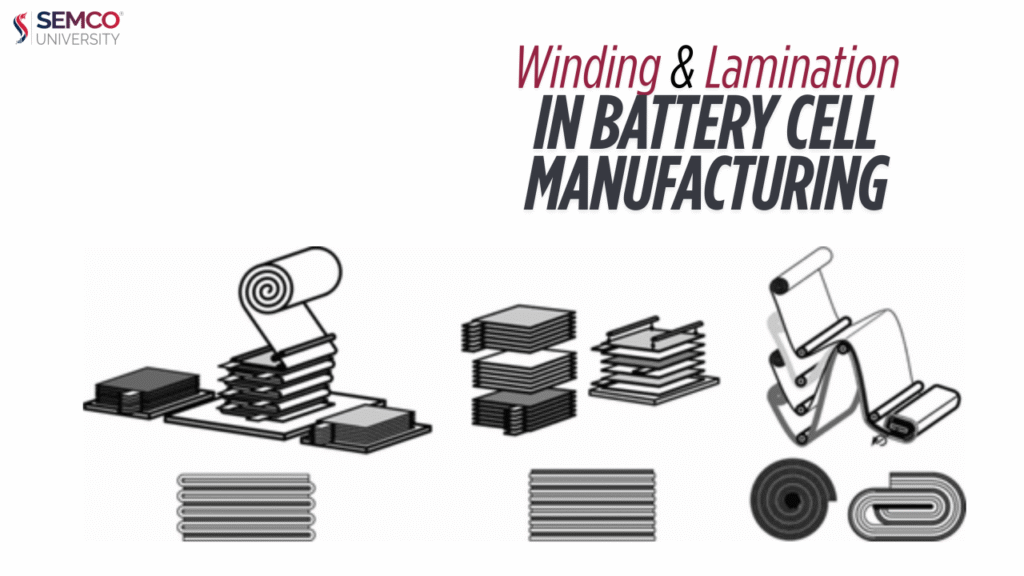
The creation of a functional battery cell, the fundamental unit of a power source, relies on the precise assembly of its core components: the positive electrode, the negative electrode, and the separator. Two primary techniques dominate this crucial stage: winding and lamination. Each method, based on distinct principles and processes, caters to specific battery designs and performance requirements.
The Winding Process: A Continuous Spiral of Energy
Principle and Process:
The winding process involves precisely layering and coiling the processed electrode sheets and separator films around a fixed winding needle. This continuous winding creates a tightly packed cylindrical or elliptical core.
The automated process begins with the unwinding of the positive and negative electrode sheets and the separator films, each undergoing automatic alignment correction and tension control. Guided by a clamp feeding mechanism, the electrode sheets and separator are introduced to the winding station and spirally wound together according to pre-defined specifications.
Once the winding is complete, the station automatically indexes, the separator is cut, and termination tape is applied to secure the coil. The resulting bare battery cells are then automatically unloaded, pre-pressed to maintain their shape, and conveyed to the next stage.
Application Scenarios:
Winding is predominantly employed in the battery cell manufacturing of cylindrical and prismatic (square).
Key Parameter Control:
Achieving optimal battery cell quality through winding necessitates meticulous control of several key parameters:
- Tension: Precise tension control is vital for ensuring the structural integrity of the wound cell and the stability of the electrode interfaces during subsequent formation. Insufficient tension leads to loose cells and potential electrode movement during handling, while excessive tension can cause unwanted electrode wrinkling.
- Diaphragm Cutting Knife Temperature: The temperature of the diaphragm cutting knife is critical for clean and accurate separation of the separator film. The optimal temperature, determined empirically, must remain within the heat-resistant limits of the specific diaphragm material to prevent excessive shrinkage that could compromise electrode coating dimensions and even block the separator’s pores.
- Winding Needle Circumference: The circumference of the winding needle, derived from the cell’s design specifications, dictates the initial shape of the wound core. Adjustments to the theoretical value are often necessary to accommodate material thickness fluctuations and the non-ideal, more trapezoidal than semicircular, shape of the cell corners after pressing.
- Negative Electrode Cutter Life: The lifespan of the negative electrode cutter is often less critical due to the negative electrode’s position as the outermost layer at both the start and end of the winding. Any burrs are typically enveloped by subsequent layers of the negative electrode, minimizing the risk of separator damage.
- Diaphragm Idle Turns: The number of idle turns of the diaphragm at the beginning and end of the winding, initially based on design drawings, requires empirical validation. The initial turns are assessed for their impact on core removal and overall cell thickness, while the final turns are adjusted to accommodate tail adhesive application and the positioning and scanning of the cell’s identification code, often influenced by the subsequent assembly welding method.

Equipment and Technical Requirements:
- Automated Equipment: The winding process is almost exclusively performed on highly automated machinery to guarantee uniformity and consistency across large production volumes. These systems are characterized by their precision, speed, and reliability.
- CCD Detector: Real-time monitoring of alignment during the winding process is crucial. CCD detectors are employed to ensure the precise and tight layering of the electrode sheets and separator, maintaining proper coating alignment.
- Strict Process Parameter Control: The quality and performance of the final battery cell are directly dependent on the rigorous control of key process parameters such as tension, diaphragm cutting temperature, and winding needle circumference.
Quality Inspection and Testing:
Following the winding stage, each battery cell undergoes thorough quality inspections and tests to verify adherence to design specifications and quality standards. These typically include visual checks for any physical defects, electrical performance evaluations, and safety assessments.

The Lamination Process: Precision Stacking for Optimized Performance
Principle and Process:
The lamination process involves precisely cutting the coated electrode sheets into initial sizes and then sequentially stacking the positive electrode, separator, and negative electrode layers. Multiple “sandwich” structures are layered in parallel to create an electrode core ready for packaging. The continuous nature of some lamination techniques relies on a “Z”-shaped folding of the separator, allowing for the continuous stacking of positive and negative electrodes with the separator zig-zagging between them to ensure electrical isolation. The final stacked core is then placed within a protective shell for packaging.

The automated process typically involves the automatic transfer of positive and negative electrode sheets to the stacking machine. The separator is actively unwound and guided to the stacking table via tension and alignment control mechanisms. The stacking table moves to facilitate the placement of electrode sheets. Robotic arms with suction cups pick up individual positive and negative electrode sheets from designated material boxes and precisely position them on the stacking table. Once the stack is complete, a robot transfers the cell to a tail roll gluing station for automated adhesive application. The separator is then cut, and side gluing is performed. Simultaneously, the stacking of the next battery cell commences. The glued cell is automatically transferred to a fixture on a conveyor belt for transport to subsequent processing stages.
Application Scenarios
Lamination is commonly used for prismatic and soft-pack batteries and is particularly well-suited for the production of high-rate, large-size, and custom-shaped batteries.

Core Equipment of Lamination Process:
The stacking machine, a critical piece of equipment in lithium battery production, typically comprises several key mechanisms:
- Feeding Mechanism: For the controlled placement of positive and negative electrode sheets and separators.
- Pole Sheet Box: To store and transport the positive and negative electrode sheets.
- Pole Piece Positioning Mechanism: To ensure the accurate placement of each electrode sheet during stacking.
- Feeding Mechanism (Pick-and-Place): To retrieve electrode sheets from the pole sheet box and transfer them to the stacking table.
- Stacking Table: To hold and precisely align the positive and negative electrode sheets and separators during the stacking process.
- Glue Sticking Mechanism: To apply protective adhesive to the completed stacked cell.
- Unloading Mechanism: To remove the finished stacked battery cells from the stacking table.
Advantages of the Lamination Process:
- Improved Battery Performance: The stacking process can significantly enhance the energy density, safety, and cycle life of the battery. Compared to wound batteries, stacked designs often exhibit a higher potential for volumetric energy density, a more stable internal structure, and a longer operational lifespan.
- Strong Adaptability: Lamination offers greater flexibility in producing high-rate batteries, large-format cells, and custom shapes, catering to the diverse performance requirements of various applications.
- High Material Utilization Rate: In lamination, material waste is typically limited to the removal of individual pieces. In contrast, winding waste can lead to the discarding of entire electrode sheets or even adjacent sheets, resulting in a higher material utilization rate for the lamination process.
Conclusion:
Both winding and lamination are essential assembly techniques in the manufacturing of lithium battery cells, each with its own set of principles, processes, and advantages. The choice between these methods is often dictated by the desired battery format, performance characteristics, and application requirements. Through precise execution and meticulous control of key parameters, both winding and lamination play a crucial role in creating the reliable and high-performing energy storage solutions that power our modern world.