

As products become more advanced and are expected to perform flawlessly in every environment, manufacturers can no longer rely solely on functional testing. Products must withstand extreme heat, freezing temperatures, high humidity, and rapid environmental changes throughout their lifecycle. This is where constant temperature and humidity test chambers become an essential part of quality assurance.
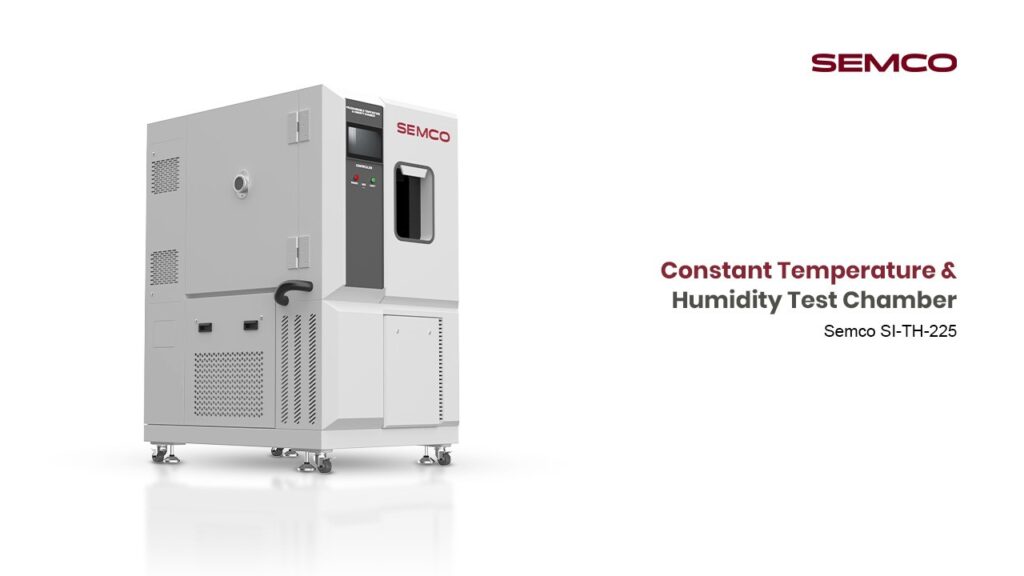
The Semco SI-TH-225CH Constant Temperature & Humidity Test Chamber is designed to recreate real-world environmental conditions inside a controlled laboratory setting, enabling manufacturers to verify product durability, safety, and long-term reliability before products reach the market.

Why environmental testing matters
Modern electronic and electro‑mechanical systems are expected to perform reliably across extreme temperature and humidity conditions, from hot, humid coastal climates to cold, dry high‑altitude environments. Environmental test chambers provide a controlled laboratory environment to reproduce these stresses, allowing manufacturers to validate design robustness, qualify suppliers, and comply with international standards before products reach the field.
For battery energy storage, EV subsystems, PCBs, connectors, and new materials, controlled exposure to high temperature, low temperature, and cyclic damp heat is essential to uncover latent defects, verify material compatibility, and predict lifetime under real‑world operating profiles.
Overview of SI‑TH‑225CH
The Semco SI‑TH‑225CH is a constant temperature and humidity test chamber with a marked inner volume of 225 L and an internal working space of 600 × 750 × 500 mm (W × H × D), designed as a versatile platform for component‑ and subsystem‑level environmental testing. Externally, the chamber measures approximately 900 × 1900 × 1450 mm and weighs about 280 kg, with an integral structural layout, mobile casters and positioning foot cups for easy relocation on the shop floor or in laboratory environments.

This series is intended to simulate harsh high‑temperature, low‑temperature, and hot‑and‑humid environments that electronic instruments, new materials, vehicle accessories, metals, electronic products, and aerospace materials may encounter during transportation, storage, and use, as well as to evaluate their resistance to thermal and moisture‑induced failure. Typical use cases include high‑temperature endurance, low‑temperature survivability, constant damp heat, and alternating temperature–humidity cycling tests.
Temperature and humidity performance
The SI‑TH‑225CH offers a broad operating range, enabling both standard qualification tests and custom user profiles. Its core environmental capabilities include:
- Temperature range from −20 °C to +150 °C, with other low‑temperature options (0 °C, −25 °C, −40 °C, −60 °C, −70 °C) and maximum high temperatures up to 150 °C or 180 °C available on selection.
- Humidity range from 20% to 98% RH under standard configuration, with special selection conditions extending to 10% to 98% RH.
- Resolution of 0.01 °C and 0.1% RH, enabling fine control and accurate logging of environmental conditions.

In terms of stability and uniformity, the chamber is specified for temperature fluctuation of ±0.5 °C and deviation of ±0.5 °C, with temperature distribution precision within 2.0 °C across the working volume. Humidity fluctuation is within ±2.0% RH and deviation within ±3.0% RH, ensuring that samples positioned at different locations in the chamber experience highly consistent environmental stress during a test run.
For dynamic performance, the chamber achieves a typical heating rate of about 4.0 °C/min from −20 °C to +150 °C (no‑load, non‑linear), and a cooling rate of about 1.0 °C/min from +150 °C down to −20 °C (no‑load, non‑linear). This combination of range and rate supports both gradual soak profiles and relatively faster ramps for a wide variety of standards‑driven tests.
Compliance with International Test Standards
The SI‑TH‑225CH is designed and configured to support a broad suite of global environmental test standards for electrical and electronic products. Representative standards covered include:
- GB/T 2423.1 and IEC 60068‑2‑1 (Test A: Low temperature), GB/T 2423.2 and IEC 60068‑2‑2 (Test B: Dry heat) for basic low and high temperature tests.
- GB/T 2423.3 (IEC 68‑2‑3 Test Ca: Constant damp heat) and GB/T 2423.4 / IEC 60068‑2‑30 (Test Db: Alternating damp heat) for moisture resistance evaluation.
- GJB 150.x series for high temperature, low temperature, and damp heat military environmental tests, as well as GB/T 5170.x series for performance confirmation of temperature and humidity test equipment.

By aligning with GB/T, IEC and MIL‑STD frameworks, the chamber helps laboratories and QA teams run standardized reliability and type tests, simplifies certification workflows, and provides confidence that measured performance is accepted by customers and regulators.
Energy‑efficient refrigeration architecture
A key differentiator of the SI‑TH‑225CH is its multi‑channel mechanical compression refrigeration system, designed with an explicit focus on energy efficiency, noise reduction, and control precision. The system adopts a two‑stage, multi‑channel main and bypass configuration that can be adaptively selected and activated according to different working conditions via the Semco intelligent control system.
Instead of relying on traditional “high‑power cooling versus high‑power heating” dynamic balance, the chamber uses a “static balance” temperature control strategy—no heating during cooling and no cooling during heating. The central controller calculates the required cooling capacity from the setpoint, adjusts the refrigerant flow via an automatically controlled capillary throttling system, and maintains temperature by modulating cooling output rather than offsetting it with heat.

This approach delivers several advantages:
- Reduction of operating load on the refrigeration compressor, leading to lower vibration, reduced noise, and improved service life.
- Energy consumption around 50% of comparable products under similar conditions, with overall savings of about 20% to 45% compared to traditional hot‑cold dynamic balancing technology, especially during long low‑temperature dwell periods.
- Improved control accuracy and temperature uniformity, with technical performance claimed to be 20% to 45% higher than conventional approaches.
Throttling technology is further used to adapt refrigeration output to various temperature change rate requirements, while sound absorption and silencing methods are incorporated throughout the structural and mechanical design to lower acoustic emissions.
Airflow and thermal uniformity design
To achieve uniform temperature and humidity across the chamber, the SI‑TH‑225CH employs a broadband pressure‑balanced temperature regulation system with a dedicated PID adaptive algorithm. A combination of temperature adjustment chamber, static pressure chamber and forced air duct system driven by centrifugal fan blades ensures sufficient cold and heat exchange and uniform air supply through a top air regulating plate to every space in the working area.
The controller continuously corrects according to temperature conditions during operation, targeting rapid stabilization with small overshoot and high stability. This design minimizes thermal gradients within the test volume, which is critical for consistent and repeatable test results, particularly for multi‑sample loads and densely packed fixtures.
Mechanical construction and ergonomics
The chamber’s mechanical design combines robustness, thermal insulation, and operator convenience. The test box uses an integral structural layout, with the entire exterior in white‑gray and the door and panel in gray, and is built on mobile casters with positioning foot cups for flexibility in installation.

Key construction features include:
- Inner chamber fabricated from SUS304 stainless steel plate (≥ 1.0 mm), precision‑cut and CNC‑bent, fully welded by argon arc welding, and finished to provide corrosion resistance and easy cleaning.
- Load‑bearing capacity of the laboratory floor rated at 50 kg, with standard two‑layer sample racks (20 kg/layer) and options for higher custom load‑bearing (50 kg, 80 kg, 100 kg etc.).
- External chamber built from ≥ 1.2 mm cold‑rolled steel plates, laser‑cut and CNC‑formed, treated by pickling and rust removal, then coated with high‑temperature baking paint for enhanced anti‑corrosion and anti‑rust performance.
The insulation layer combines high‑density rigid polyurethane foam and fiberglass to deliver high thermal efficiency and minimize heat leakage. A specially customized silicone sealing strip on the door provides high‑temperature resistance, non‑toxicity and excellent flexibility, improving door sealing and overall stability of the internal environment.
Operator interface and control system
At the heart of the SI‑TH‑225CH is a 7‑inch full‑color touch‑screen controller that provides a human–machine interface for configuration, operation and monitoring. The interface offers Chinese and English menus, touch input, and a graphical display of temperature and humidity set values (SV) and actual values (PV), along with program number, segment, remaining time and number of cycles.

Control system highlights include:
- Fixed value control and program control modes, with measurement ranges of −90.00 °C to +300.00 °C for temperature and 1.0% to 100% RH for humidity (measurement range beyond chamber’s operating envelope to support sensor linearity).
- Memory for up to 100 program groups and 1000 segments, with each segment programmable up to 530 hours 59 minutes, and each command repeatable up to 9999 times, allowing complex long‑duration profiles.
- PID control with automatic calculation, nine groups of PID parameter settings, dry and wet bulb automatic correction, and functions such as upper/lower limit standby, alarms, scheduled start/stop, and automatic adjustment of freezing capacity.
The system supports real‑time graphical display of program curves, operation cumulative time, and fault prompts with guidance for troubleshooting, as well as screen backlight adjustment and protection modes with timer or manual shutdown. A USB data export interface is provided for data logging and analysis, aligning with modern lab data workflows.
Safety and protection features
Given the criticality of safe operation in test environments, the chamber integrates multiple layers of protection at both refrigeration and electrical system levels. Refrigeration system protections include compressor over‑pressure and over‑current protection, oil pressure protection via an oil pressure protector, and high/low pressure protection to monitor refrigerant pressure and trigger alarms and shutdown on abnormal conditions.
Laboratory‑side protections include adjustable over‑temperature protection, motor overheating protection, humidifier dry‑burn protection, and water shortage alarm protection. At the system level, there is total power supply phase sequence and phase loss protection, ultra‑humidity protection, and appropriate circuit‑level devices such as circuit breakers, phase sequence relays, AC contactors and thermal relays from established brands like Schneider, Izumi, Qantas, Chint and others.

These protections are complemented by a single chamber door with explosion‑proof handle, anti‑condensation electric heating device, and a three‑layer vacuum explosion‑proof glass observation window with automatic defogging and LED lighting, enabling safe visual inspection of samples during testing.
Refrigeration hardware and noise management
The refrigeration subsystem uses imported ultra‑low temperature compressors (brands referenced include Hitachi, Taikang, and Bitzer‑type equivalents), operating with environmentally friendly refrigerants such as R404A or R232 that have zero ozone depletion potential. The primary heat exchange is realized by an evaporative condenser, with fin‑type air‑cooled condensers or shell‑and‑tube water‑cooled condensers used depending on configuration.
Key refrigeration components include laminated multi‑stage evaporators, refrigeration oil (Rainbow), oil separators (Emerson), filter dryers (Danfoss), solenoid valves (Herigong), condensing fans (with air‑cooling noise less than 80 dB), and pressure switches (Danfoss). The compressor is mounted on vibration‑absorbing springs and rubber pads to reduce vibration transmission to the frame, thereby lowering noise and improving mechanical reliability.
All system pipelines are pressure tested at 22 kg for leak detection, and the heating and cooling systems are completely independent. The combination of high‑quality components and the “static balance” control philosophy underpins both energy efficiency and long‑term stability for intensive laboratory use.
Chamber interior features and connectivity
To support practical test setups, the SI‑TH‑225CH includes several interior and connectivity features. A standard Φ50 mm test hole on the left side of the chamber allows routing of sensor cables, power leads, or fluid lines into the test space, with corresponding thermal insulation accessories and special sealing rubber plugs.
The three‑layer vacuum observation window (250 × 320 × 40 mm) provides a clear view of the test area and incorporates an automatic defogging function, while an internal low‑voltage, explosion‑proof LED lamp ensures good visibility. The equipment’s back side hosts the main power protection circuit breaker, power supply cables, water supply and drainage pipes, and cooling circulation water supply pipes, organizing utilities for easy installation.

For remote supervision, the system can be equipped with communication interfaces such as RS485 or a network port (optional) to enable remote connection and monitoring. Through a graphical interface, operators can manage the system, view automatic fault prompts and solution prompts, and quickly troubleshoot issues without needing to be physically present at the panel.
Installation and operating conditions
The SI‑TH‑225CH is designed to operate in typical laboratory or industrial environments with defined installation conditions. Recommended installation site conditions include ambient temperature of 5 °C to 35 °C, relative humidity ≤ 85% RH, and air pressure between 86 kPa and 106 kPa, with the chamber installed on a flat, vibration‑free ground.
To ensure stable operation and safety:
- The equipment should be kept away from heat sources, flammable and explosive substances, and not exposed to direct sunlight.
- Adequate clearances (≥ 60 cm on multiple sides and ≥ 100 cm at designated rear areas) should be maintained for ventilation, maintenance and operator access.
- The installation area should be clean and not located in dusty zones or near dust exhaust outlets.

Electrical supply requirements are AC 380 V, three‑phase four‑wire plus protective ground, with allowable voltage fluctuation of ±10% and frequency fluctuation of ±1% around 50 Hz. The grounding resistance of the protective ground wire should be less than 4 Ω, with TN‑S or TT mode power supply configurations, and the rated power is about 5.5 kW / 20 A.
Positioning within Semco’s broader portfolio
The SI‑TH‑225CH sits within Semco Infratech’s broader ecosystem of advanced battery assembly and testing solutions, which span fully automated battery manufacturing lines, high‑voltage testing systems, and containerized BESS test platforms. As India’s leading provider of battery assembly and testing solutions, Semco leverages decades of engineering expertise in lithium‑ion technology to deliver turnkey solutions across cell, module and pack manufacturing for EV, energy storage, and renewable sectors.

Contact Semco Infratech to discuss your EV & BESS manufacturing requirements and discover how automatic assembly solutions can enhance your production efficiency, ensure product quality, and accelerate your path to market competitiveness.