

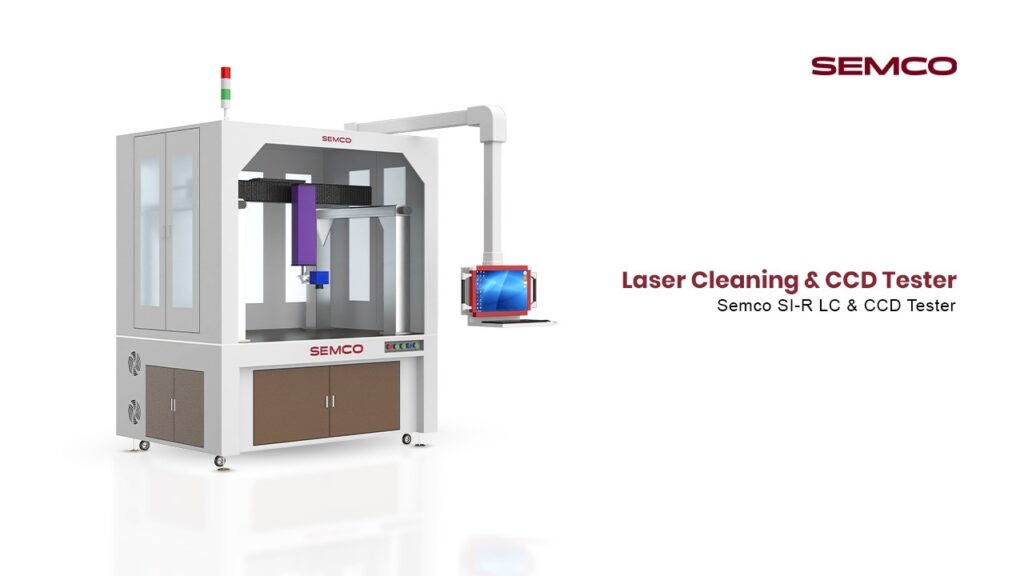
Semco Infratech’s SI-R Laser Cleaning & CCD Tester for prismatic cells is a dedicated station that combines laser-based pole surface cleaning with automated polarity detection to improve weld quality and assembly safety in lithium-ion prismatic cell packs.
Why laser cleaning and CCD testing matter
As prismatic cell formats become standard for EV and BESS applications, the quality of pole surface preparation and correct polarity arrangement directly impacts weld integrity, pack reliability, and downstream safety. Traditional mechanical or chemical cleaning methods struggle with consistency, while manual visual checks of polarity are error-prone at high line speeds. Semco’s SI-R LC & CCD Tester addresses both pain points in a single integrated machine aimed at modern lithium battery lines.

Scope of application on the line
The system is designed for surface cleaning and polarity detection of lithium battery poles, specifically targeting oxide layers and stains on square aluminium shell battery poles before welding. By removing these contaminants with a laser, the system prepares a low-resistance, weld-ready surface that supports more secure and repeatable welding quality. In parallel, it detects the arrangement of positive and negative electrodes in a battery pack based on their shape and orientation, enabling inline polarity verification.
In a typical workflow, an operator manually places the prismatic battery pack on the machine’s positioning bar, after which the coaxial vision system guides laser cleaning while simultaneously capturing images for analysis. Once laser cleaning and polarity testing are complete, the pack is manually removed, aligning the station with semi-automatic lines or as a dedicated QA/conditioning station within a larger automated line.

Integrated laser cleaning with vision
At the heart of the SI-R LC & CCD Tester is a 1064 nm, 200 W laser source coupled with a high-speed scanning galvanometer, optimized for oxide and stain removal at the current-collector interface region. The cleaning speed is specified in the 50–60 m/s range, enabling coverage of a maximum cleaning area of 700 × 600 mm, which is sufficient for multi-cell prismatic packs or large fixture layouts. A red-light positioning mode offers visual indication of the cleaning path, aiding setup and changeover.
The laser operates in pulsed mode with a modulation frequency window from 1 to 40,000 kHz, allowing process engineers to tune pulse width and frequency for different contamination levels and surface finishes. An optical fiber delivery system with a 5 m cable and a defined bending radius of 200 mm provides routing flexibility while maintaining beam stability. The combination of air-cooled laser architecture and controlled power instability (below 5 percent) supports stable output over a broad ambient temperature range.
CCD-based polarity detection and safety
A key differentiator of this system is its coaxial CCD visual positioning system, supplied through a Hikvision-based vision stack integrated by Semco. During laser cleaning, the CCD captures real-time images of the prismatic cell tops, using shape-based recognition to determine the positive and negative electrode arrangement in the battery pack. If the vision system detects a misarranged or inverted cell, it triggers an alarm and shuts down the machine, preventing downstream welding of incorrectly oriented cells.
This dual-function approach transforms what is often a manual, post-assembly inspection into an inline, automated control point. For manufacturing planners, this means the same station that prepares weld surfaces also enforces polarity discipline at pack level, thereby reducing rework, scrap, and safety risks associated with mis-polarity in high-voltage assemblies.

Mechanical architecture and work envelope
Mechanically, the SI-R LC & CCD Tester is built on a gantry-type XYZ motion module with a travel envelope of 800 × 600 × 400 mm. This gantry structure enables flexible scanning across various pack layouts and fixture designs, allowing the same platform to support different prismatic cell formats and configurations over time. The machine’s sheet-metal enclosure, sized around 1750 × 1300 × 2026 mm, provides a compact footprint relative to its working area, helping it integrate into space-constrained lines.
An industrial computer with an Intel i7 configuration and a 19-inch widescreen display forms the operator interface, while 400 W servo motors drive the motion stages for precise positioning. With a maximum machine power consumption of less than 6 kW and an operating voltage of 220 V AC, the system can be integrated into existing facility power without heavy infrastructure changes, though proper grounding and power quality are still required.
Laser module characteristics
The laser module, identified as YDFLP-E2-200-M7-M-R, is an air-cooled fiber laser designed for industrial cleaning applications. It delivers an average output power of 200 W with a maximum pulse energy of 1.5 mJ, offering a usable frequency range from 1 to 4000 kHz and pulse widths between 2 and 500 ns. These parameters give process engineers a wide processing window to balance ablation efficiency with minimal substrate damage.
The module is compact, with approximate dimensions of 340 × 265 × 100 mm and a mass around 10.5 kg, allowing integration inside the machine cabinet without significant space penalties. Operating temperature limits from 0 to 40 °C and storage from −10 to 60 °C align with standard factory conditions, while a supply voltage of 48 V and maximum power consumption below 700 W keep the laser’s electrical load manageable.
Environmental and facility requirements
To ensure stable performance, the device requires an ambient temperature between 15 °C and 40 °C and relative humidity between 40 and 80 percent without condensation. It specifies an AC 380 V, 50 Hz supply network with fluctuations limited to ±5 percent and a properly grounded grid that meets international standards, particularly when upstream stabilizers are not installed. In environments where voltage amplitude exceeds 5 percent, the document recommends automatic voltage and current stabilization devices to protect both the laser and control electronics.
Electromagnetic and mechanical noise constraints also apply: the installation site should avoid strong electromagnetic interference, radio transmitting stations, and relay stations, and it should maintain base vibration amplitudes below 50 µm and vibration acceleration under 0.05 g. The equipment should be installed in a smokeless, dust-free environment away from heavy metal polishing, grinding, or stamping equipment, and in some cases, anti-static floors and enhanced shielding are advised to protect sensitive electronics and optics.
Role in Semco’s broader portfolio
The SI-R LC & CCD Tester fits into Semco Infratech’s broader portfolio of battery assembly and testing solutions, which span cell, module, and pack manufacturing across EV, energy storage, and renewable applications. The company positions itself as a leading provider of turnkey battery manufacturing lines and high-voltage, containerized BESS testing systems aimed at India’s clean energy transition. By integrating laser cleaning, precision motion, machine vision, and control into a single station, Semco extends its value proposition from generic automation toward more specialized lithium-ion process equipment.
As a trusted partner to major industry players, Semco emphasizes performance, reliability, and scalability, and this system is a concrete example of how it combines precision engineering and automation to address niche but critical steps in the pack assembly process. For manufacturers scaling prismatic cell production for EV and BESS, the SI-R LC & CCD Tester offers a pathway to standardize surface preparation and polarity verification, thereby improving weld quality and reducing field failure risk.

Contact Semco Infratech to discuss your EV & BESS manufacturing requirements and discover how automatic assembly solutions can enhance your production efficiency, ensure product quality, and accelerate your path to market competitiveness.