

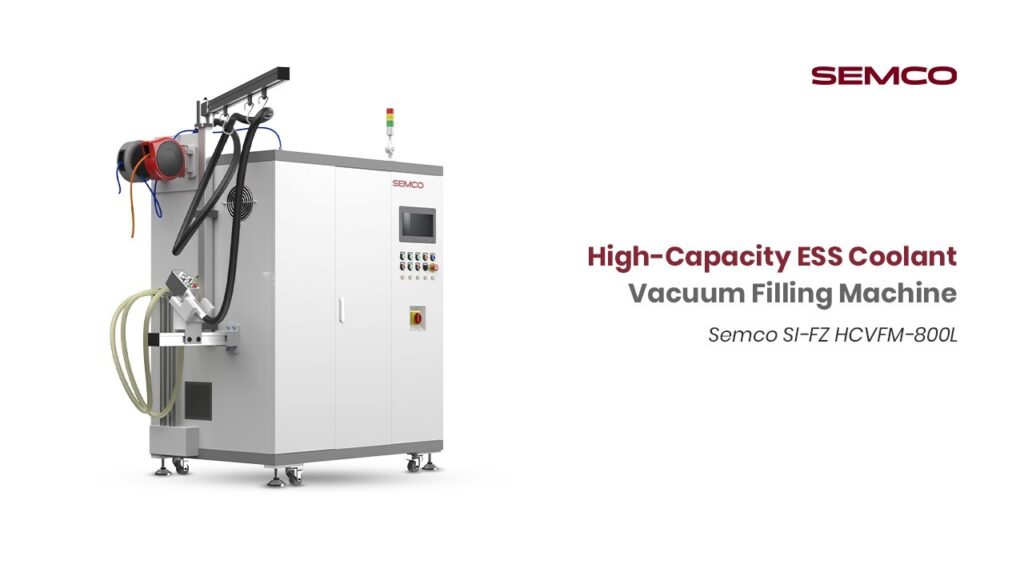
As Battery Energy Storage Systems continue to scale in capacity and complexity, manufacturing processes around thermal management are becoming just as important as cell chemistry, module architecture and power electronics.
For liquid-cooled ESS containers, coolant filling is not simply about transferring fluid into a thermal management circuit. The process must remove trapped air, confirm system airtightness, control filling pressure and flow, establish the required liquid level and ensure that every operating parameter can be verified later.
To address these requirements, Semco Infratech has introduced its High-Capacity ESS Coolant Vacuum Filling Machine, developed for automated coolant filling in large energy-storage systems.

Why coolant filling matters
As battery energy storage systems move toward higher capacities and denser containerized architectures, thermal-management quality becomes increasingly important. Poor filling can leave air pockets inside the circuit, interfere with coolant circulation and create avoidable commissioning and quality-control challenges.
Semco Infratech’s SI-FZ HCVFM-800L High-Capacity ESS Coolant Vacuum Filling Machine combines staged vacuum generation, leak detection, positive-pressure filling, pressure holding and residual-liquid recovery in one PLC-controlled process.
Built for High-Capacity ESS Production
One of the most important characteristics of the system is its ability to handle large coolant volumes.
The machine offers a specified filling speed of 40 L/min, supported by a 160-litre stainless-steel fluid reservoir. The documented filling cycle targets are:
- 0–200 L: ≤20 minutes
- 200–400 L: ≤30 minutes
- 400–600 L: ≤40 minutes
- 600–800 L: ≤60 minutes

This makes the equipment suitable for high-capacity ESS applications where both filling volume and production cycle time need to be carefully managed.
Automated Process: From Product Identification to Filling Complete
The machine has been designed around a largely automated production sequence.
The operator can first identify the product using a barcode scanner or manually select the appropriate product model. After the filling gun is securely connected, pressing the start button initiates the automated process.
The sequence broadly follows:
Product Selection → Vacuum → Major Leak Detection → Secondary Vacuum → Minor Leak Detection → Filling → Pressure Hold → Back-Suction → Filling Complete

During positive-pressure filling, the machine uses pressure, flow rate and time as control parameters. After filling, pressure is maintained for five seconds before liquid-level adjustment and back-suction are performed. This integrated workflow helps reduce dependence on operator judgement and supports greater process repeatability across multiple ESS units.
Designed to Detect Problems Before Coolant is Filled
A major production advantage of the system is that leakage checks are incorporated before and during the filling sequence. If the required vacuum level cannot be achieved, the operating system automatically stops and waits for further action. The machine also uses audible and visual alarms when major-leak detection, minor-leak detection or controlled filling does not meet the required parameters.
For manufacturers, this means the coolant-filling station also becomes an important quality-control checkpoint in the ESS assembly line.

Automation and traceability
The control architecture centres on a Siemens S7-1200-series PLC, a 9-inch Siemens colour touchscreen and an industrial all-in-one computer. A wireless barcode scanner supports product identification, while local storage and a reserved MES interface support digital production records.
The specification calls for vacuum, pressure, flow and temperature data to be recorded and uploaded in real time. This creates a traceable process history for each cabinet rather than relying only on an operator’s confirmation.
An operator-focused filling gun
The approximately 3 kg filling gun uses high-strength aluminium alloy and integrates separate valves for vacuum extraction, coolant filling and suction. A start/stop button near the handle enables operation directly at the cabinet connection point. The nozzle uses pneumatic clamping and automatic sealing. Stainless-steel contact components and an anti-drip design support repeated industrial use while limiting coolant release during disconnection. A dedicated holder includes a presence sensor that locks the start function while the gun is parked.

Fluid handling and maintenance
The stainless-steel reservoir, pipelines and joints are designed for corrosion resistance. The 160-litre reservoir includes four-point level monitoring—upper, lower, high-high and low-low—together with a visual level indicator and drain valve.
Coolant filtration is staged. The supply path uses 50-micron and 20-micron filtration, while the route from the reservoir to the filling gun includes 20-micron filtration. Detachable filters and service-friendly pipe connections simplify cleaning and replacement.
Manufacturing value
The SI-FZ HCVFM-800L converts evacuation, leak checking, coolant injection, pressure holding and fluid recovery into one traceable cycle. Automated interlocks reduce dependence on manual judgement and prevent a failed vacuum or filling condition from being overlooked.
For manufacturers of liquid-cooled energy storage cabinets, the result is fewer hand-offs between stations, more consistent execution and a clearer quality record for every assembled unit. The 800-litre operating range makes the platform particularly relevant to high-capacity ESS and containerized BESS production.
If you are attending The Battery Show India 2026 and planning to evaluate battery manufacturing, PACK assembly, testing or BESS production-line solutions, your booth time should be spent on the decisions that directly affect production performance — not just brochures, but real engineering answers.
If a supplier cannot translate your production target into a practical line concept during a focused discussion, that itself is an important signal.

Semco Infratech will be at The Battery Show India 2026, Hall No. 1, Stall No. 1.61, India Expo Mart, Greater Noida.
Our team will be available to discuss battery cell, module and PACK assembly solutions, testing equipment, automation and BESS manufacturing systems based on your specific production requirements.