

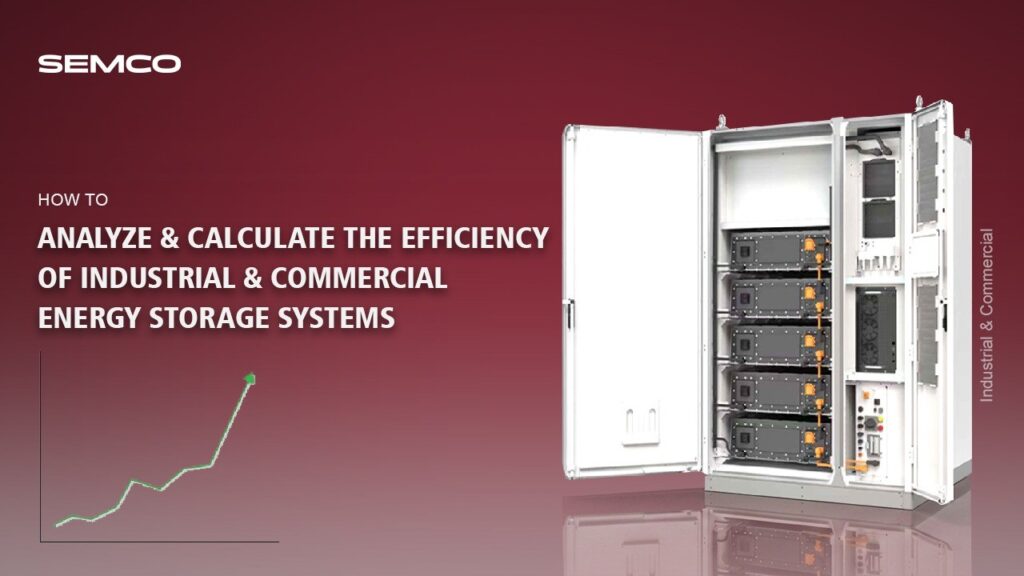
Commercial and industrial energy storage systems are gaining increasing attention as a flexible and efficient energy management tool. However, accurate calculation and analysis of their efficiency are crucial for accurately assessing the performance and economics of these systems.
Composition and Working Principle of Industrial and Commercial Energy Storage Systems
Commercial and industrial energy storage systems typically consist of battery packs, battery management systems (BMS), power conversion systems (PCS), control systems, and related electrical equipment.
Its working principle is to store electrical energy during off-peak hours and release it during peak hours, so as to achieve the goals of peak shaving and valley filling, demand response, and improving power supply reliability.
Factors Affecting the Efficiency of Industrial and Commercial Energy Storage Systems
Battery Performance: The type of battery (such as lithium-ion batteries, lead-acid batteries, etc.), weight, capacity, depth of charge and discharge, and cycle life all directly affect the efficiency of the energy storage system. High performance batteries typically have higher energy conversion efficiency and lower self-discharge rate.
Charge and Discharge Strategy: A reasonable charge and discharge strategy is crucial for improving the efficiency of energy storage systems. For example, selecting appropriate charging current and voltage, and discharge cutoff voltage can reduce energy loss.
Power conversion efficiency: PCS will generate certain losses during the power conversion process, and its efficiency directly affects the overall efficiency of the energy storage system. With the development of technology, the efficiency of PCS has been continuously improved, but there is still room for improvement.

Temperature: Ambient temperature has a significant impact on battery performance and efficiency. Excessively high or low temperatures will reduce battery charging and discharging efficiency and may even affect battery life.
Energy Management System (EMS): An efficient EMS can optimize battery usage, achieve rational energy allocation and scheduling, thereby improving the efficiency of the entire energy storage system.
Battery aging: As the usage time increases, the battery will gradually age, its internal resistance will increase, its capacity will decrease, and its charging and discharging efficiency will decrease.
System losses: These include line losses and losses from power conversion equipment (such as inverters and chargers). High-quality equipment and reasonable line design can reduce these losses.
Energy Storage System Efficiency
Overall efficiency: The overall efficiency of an energy storage power station is defined as the ratio of the amount of electricity fed into the grid to the amount of electricity discharged from the grid during the operation of the energy storage power station within the evaluation period. That is: Overall efficiency = Total amount of electricity transmitted to the grid by the energy storage power station within the evaluation period ÷ Total amount of electricity received from the grid by the energy storage power station.
Charging efficiency: Initial AC charge = (System rated capacity × depth of charge/discharge) ÷ Battery system charging efficiency ÷ Energy storage converter rectification efficiency ÷ Power line efficiency ÷ Transformer efficiency + Auxiliary equipment power consumption. Charging efficiency = (system rated capacity × depth of charge/discharge) ÷ initial charge on the AC side.

Discharge efficiency: Initial discharge on the AC side = (system rated capacity × depth of charge/discharge) × battery system charging efficiency × energy storage converter inverter efficiency × power line efficiency × transformer efficiency auxiliary equipment power consumption. Discharge efficiency = Initial discharge amount on AC side ÷ (System rated capacity × Depth of charge/discharge).
Efficiency Calculation and Analysis
Battery efficiency is one of the most critical factors in energy storage systems. According to the performance requirements for battery clusters in GB/T 36276-2018 “Lithium-ion Batteries for Electric Energy Storage,” the initial energy efficiency of a battery cluster under (25±5) ℃ and rated power conditions should not be less than 92%. However, according to the latest GB/T 36276-2023 “Lithium-ion Batteries for Electric Energy Storage,” the initial energy efficiency of a battery cluster under (25±5) ℃ and rated power conditions should not be less than 95%.
Considering that the above efficiency requirements are initial efficiencies, and taking into account the actual operation of the energy storage system and the development of market products, the battery system efficiency is temporarily set at 93% (bidirectional).

Power conversion system efficiency includes rectification efficiency and inverter efficiency. Based on market PCS production conditions, it is generally taken as 98.5% (unidirectional).
Power line efficiency
Power lines generate heat loss when transmitting current. Due to the high integration of industrial and commercial energy storage cabinets, the DC-side line loss is negligible. The losses on the PCS AC side and transformer AC side vary depending on the actual site conditions, and will be calculated based on the actual losses. For this study, the unidirectional efficiency is tentatively assumed to be approximately 99%, and considering bidirectional losses, the power line efficiency is approximately 98.01%.
Transformer efficiency
Currently, integrated energy storage cabinets for industrial and commercial use mainly employ low-voltage access solutions. The PCS output line of the integrated cabinet is connected to the low-voltage busbar of the existing transformer in the factory area, and the loss efficiency of independent high voltage transformers is not considered at this time.

Auxiliary system power consumption
Energy storage power stations require certain auxiliary equipment during operation, such as security systems, fire alarm systems, and air conditioning systems. The power consumption of these devices accounts for a significant proportion of the total energy consumption of the power storage station. Especially under specific environmental conditions, the power consumption of the air conditioning system will increase accordingly due to changes in ambient temperature.
Case Analysis
Taking a commercial and industrial energy storage project as an example, its configuration scale is 1MW/2MWh, and the depth of discharge is designed to be 90%. The main power-consuming equipment includes security systems, air conditioning systems, etc. The energy storage system utilizes the price difference of electricity to achieve peak-valley arbitrage, with two charge and two discharge cycles, 0.5C charge and discharge, and full power charge and discharge completed in two hours; the average operating power of the auxiliary power consumption of a single system is about 1.5kW/h.

Energy storage system charging efficiency
Initial AC charge = (System rated capacity × Depth of charge/discharge) ÷ Battery system charging efficiency ÷ Energy storage converter rectification efficiency ÷ AC line efficiency + Auxiliary equipment power consumption (Auxiliary system power consumption during 2 hours of charging) =2000×0.9÷96.44%÷98.5%÷99%+(1.5×10)×2=1944.01kWh.
The AC side charging efficiency of the energy storage system = (2000 × 0.9) ÷ 1944.01 = 92.59%.
Discharge efficiency of energy storage system (considering a single discharge) Initial discharge on the AC side = (system rated capacity × depth of charge/discharge) × battery system charging efficiency × energy storage converter rectification efficiency × AC line efficiency – auxiliary equipment power consumption (auxiliary system power consumption during 2 hours of charging = 2000 × 0.9 × 96.44% × 98.5% × 99% – (1.5 × 10) × 2 = 1662.78 kWh).
The AC charging efficiency of the energy storage system = 1662.78 ÷ (2000 × 0.9) = 92.38%.

The overall efficiency calculation is based on an evaluation period of 1 day, with 2 cycles per day (4 hours of charging, 4 hours of discharging, and no standby time considered);
The daily comprehensive efficiency of the energy storage power station is calculated as follows: Daily comprehensive efficiency = Daily discharge / Daily charging = {2×(2000×0.9×96.44%×98.5%×99% (1.5×10)×2)÷{2×(2000*0.9÷96.44%÷98.5%÷99%+(1.5×10)×2)}=85.53%.
In practical applications, there may be some deviations in the data within the evaluation period under different application scenarios and working modes. In project calculations, it is necessary to take into account different working environment conditions and the status of energy storage devices for reasonable analysis.

Contact Semco Infratech to discuss your BESS manufacturing requirements and discover how automatic assembly solutions can enhance your production efficiency, ensure product quality, and accelerate your path to market competitiveness.