

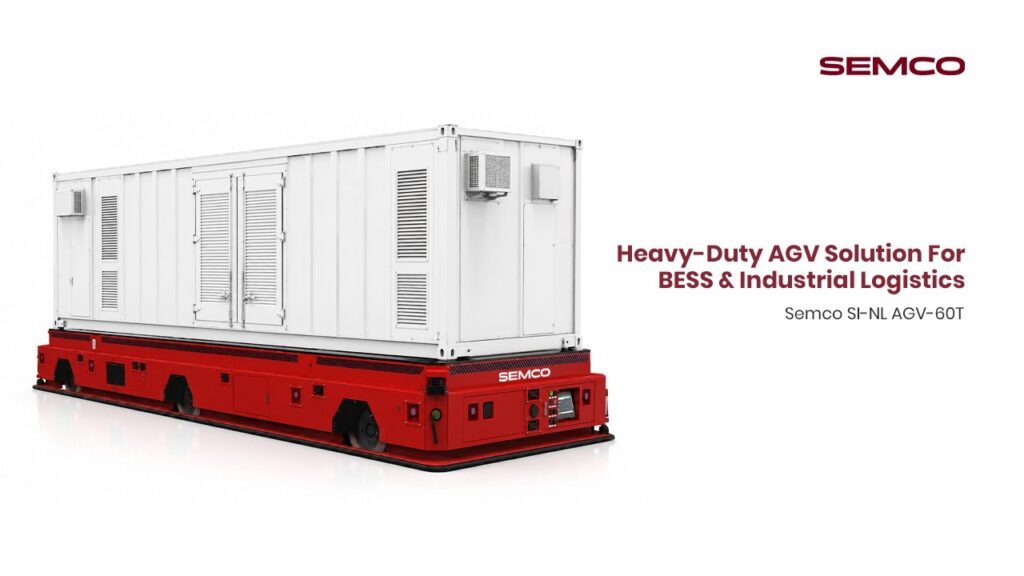
Heavy-duty automated guided vehicles (AGVs) are becoming essential infrastructure for modern factories handling large, high-value and safety-critical products. For battery energy storage system (BESS) manufacturing, container assembly and industrial logistics, they replace complex manual movement with controlled, traceable and scalable material flow.
Semco Infratech’s proposed 60-ton omnidirectional lift-type AGV is designed for this class of application: moving energy-storage cabins, 20-foot containers, heavy racks, fixtures and other oversized loads between buffer, assembly, testing, rain-test and shipping areas. The solution combines high-capacity transport, multi-point lifting, laser-SLAM navigation, precision magnetic guidance and fleet-level traffic control into one integrated system.

Why heavy-duty AGVs matter
Moving a 40–60 tonne BESS container or prefabricated electrical cabin is fundamentally different from moving pallets or bins. The load is large, may have a high centre of gravity, can contain sensitive electrical equipment, and must often be positioned precisely at assembly, test or dispatch stations.
Traditional movement methods—such as forklifts, cranes, trailers or manually operated transporters—can introduce several constraints:
- Dependence on skilled operators and equipment availability
- Higher safety exposure around suspended or moving heavy loads
- Limited manoeuvrability in congested layouts
- Inconsistent positioning at process stations
- Difficulty in achieving repeatable, digitally tracked movement
- Bottlenecks between manufacturing, testing and shipping stages

A heavy-duty AGV addresses these limitations by treating material handling as an automated production process rather than a standalone logistics activity. It can receive a transport request from MES, WMS or production-management systems; select a route; reserve travel resources; pick up the load; move it safely; position it accurately; and report task completion back to the host system.
The Semco 60T AGV concept
The Semco SI-NL AGV-60T is a low-profile, omnidirectional, back-lift AGV proposed for payloads of 60,000 kg or more. Its compact vehicle envelope—up to 6,500 mm long, 2,100 mm wide and 675 mm high, excluding project-specific tooling—allows it to travel beneath a supported cabin or container, lift it from designated points and transfer it without relying on a conventional forward-facing forklift arrangement.

The final configuration must be validated against the actual load centre of gravity, wheel loads, floor condition, duty cycle, layout and safety requirements.
The key differentiator is omnidirectional movement. Unlike conventional transporters that need turning radius and clear forward/reverse routes, an omnidirectional AGV can move sideways, diagonally and rotate in place. This is especially valuable in BESS factories where space is constrained, station clearances are critical and product dimensions are large.
Precision where it matters
For general factory travel, the AGV uses laser SLAM navigation. Safety laser scanners identify environmental features, build a map and continuously localize the vehicle. This reduces the amount of fixed guidance infrastructure required for workshop routes and makes future route or station changes easier to accommodate.
However, final positioning beneath a BESS container or into a support saddle requires tighter control. Semco’s proposed approach uses magnetic precision guidance at defined station approach and exit zones.

The operating sequence is designed around controlled transitions:
- The AGV reaches an approved approach point using laser SLAM.
- It verifies station permission, saddle availability, obstacle clearance and localization quality.
- Magnetic sensors detect a guide strip or magnetic markers.
- The AGV switches to low-speed closed-loop guidance, correcting lateral and heading error.
- It confirms the final position through magnetic markers, travel position, mechanical references and load sensing.
- The vehicle performs synchronized lifting only when alignment, load and safety conditions are valid.
- After pickup or placement, it exits along the controlled magnetic path and transitions back to SLAM navigation.
The target is a saddle stopping accuracy of ±5 mm with an angular accuracy of ±1°, although final performance depends on guide installation quality, floor flatness, saddle geometry and mechanical-interface tolerances.
This dual-navigation architecture is practical for heavy manufacturing: SLAM delivers flexibility across the plant, while magnetic guidance delivers repeatability at critical load-transfer points.
Safe lifting of high-value loads
The AGV’s lifting system is designed around multiple synchronized lift points matched to the approved load-bearing structure. Position and pressure feedback at every lift point enable closed-loop synchronization and automatic levelling during lifting and lowering.

For a heavy BESS cabin, the lifting process cannot be treated as a simple up-and-down motion. The system must account for:
- Actual load presence
- Uneven weight distribution
- Centre-of-gravity offset
- Lift-point synchronization
- Vehicle and load inclination
- Upper and lower travel limits
- Mechanical interference at the station
- Abnormal obstructions during the lifting sequence
If the system detects overload, excessive inclination, synchronization error or another abnormality, it stops the lifting operation and raises an alarm. The proposal also includes controlled pressure release or lowering for safe recovery after a power or equipment fault.
The vehicle frame itself is intended to be validated through finite-element analysis and fatigue assessment under rated load, offset load, braking, turning, lifting and slope conditions. This is crucial because the true design case is not merely the 60-tonne nominal payload; it is the combination of payload, dynamic forces, wheel loading, floor characteristics and worst-case centre-of-gravity position.
A layered safety architecture
Heavy-duty AGV automation only delivers value if it improves—not compromises—safety. Semco’s proposed design follows a layered safety principle: prevent, detect, slow, stop, remove power and recover. Safety functions remain independent of normal task-control logic.

The proposed protection system includes:
- Four-side safety laser coverage for 360-degree scanning
- Dynamic warning, deceleration and stop fields that change with speed, direction, turning state and loaded envelope
- Safety edges around the lower perimeter to trigger a contact-based stop
- Depth cameras and high/low obstacle sensors for people, forklifts, doors and low-profile objects
- Monitoring of the upper load envelope to help prevent collisions with ducts, doors and overhead structures
- Emergency-stop buttons positioned around the vehicle and operator station
- Fail-safe braking in the event of power loss, E-stop actuation, safety-chain fault or communication failure
- Slope-hold capability to prevent rollback under rated load
- Hold-to-run manual control for controlled maintenance and recovery activities
The system is also designed to stop safely in response to loss of wireless communication, localization loss, speed-control faults, overload conditions or critical sensor faults.
For BESS production environments, these measures are particularly important because the AGV moves through areas that may involve electrical testing, rain testing, charging infrastructure, people, doors, station tooling and other industrial vehicles.
Charging without disrupting production
A heavy-duty AGV must remain available without creating charging-related production bottlenecks. The proposed system uses a 48 V, 600 Ah lithium iron phosphate battery, approximately 30.7 kWh, with an automatic opportunity-charging strategy and a manual emergency-charging option.
Rather than waiting for complete battery depletion, the fleet-management system can assign charging tasks according to state of charge, task priority, vehicle position, charger availability, production demand and planned work windows.

The automatic charging cycle includes:
- Triggering a charge task when the AGV reaches the configured SOC threshold
- Reserving an available and electrically permitted charger
- Low-speed docking with secondary position confirmation
- Validating parking, contact engagement, insulation and BMS status
- Regulating charging current and voltage through charger–BMS coordination
- Monitoring battery temperature, SOC, faults and insulation condition
- De-energizing and safely opening contacts before releasing the AGV back into service
The proposed charging power is approximately 16 kW, with a target charging time of two hours or less under agreed operating conditions. The final charging window must be aligned with battery limits, ambient temperature, production schedule and actual energy consumption.
Fleet management turns vehicles into a system
A single heavy-duty AGV can automate a specific transfer route. A fleet-management system creates the real operational value when multiple AGVs, stations, chargers, doors and workflows need to operate together.
The proposed fleet-control platform supports:

The system can treat route nodes, narrow aisles, intersections, stations and charging zones as reservable resources. An AGV receives permission before entering a constrained or conflict-prone area. This approach becomes increasingly important as factories scale their BESS output and introduce more automated movement between assembly, electrical testing, rain-test and shipping operations.
Site readiness is non-negotiable
The performance of a 60-tonne AGV depends as much on site engineering as on vehicle design. A technically capable AGV cannot compensate for inadequate floor strength, poor flatness, weak wireless coverage, insufficient clearance or undefined station interfaces.
The proposal identifies several critical site conditions:
- Reinforced concrete floor capacity must be confirmed against final wheel-load calculations.
- Recommended floor flatness is ≤5 mm over 2 metres, without abrupt steps, holes, loose covers or excessive joint-height differences.
- Main routes are preferably limited to a 1% gradient, while local ramps should not exceed 3° with smooth transitions.
- Aisle width, turning envelope, load envelope, clear height and safety zones require layout simulation.

- Industrial WLAN coverage must be continuous across AGV routes, with robust roaming and site-load testing.
- BESS container mass, centre of gravity, bottom structure and approved lifting points must be frozen before final design.
- Support saddles need defined mechanical references, sufficient clearances and verified strength.
- MES/WMS, PLC, door, charging and fire-system interfaces require agreed protocols, I/O lists, error handling and test plans.
These are not administrative details. They determine whether the solution can meet its payload, positioning, availability, safety and throughput objectives in daily production.
From concept to acceptance
A heavy-duty AGV project should progress through a disciplined engineering process: requirements capture, site survey, logistics simulation, design freeze, manufacturing, factory acceptance testing, installation, commissioning, site acceptance testing and a loaded trial run.
Semco’s indicative implementation schedule is approximately 14–20 weeks from design freeze to factory release, followed by about 3–6 weeks for site commissioning and trial operation, subject to equipment quantity, custom tooling, component availability, site readiness and interface completion.

Acceptance testing should validate more than basic vehicle movement. For a 60-tonne BESS AGV, the critical criteria include:
- Rated 60-tonne payload under the approved centre-of-gravity condition
- Loaded travel speed of at least 0.5 m/s
- Synchronized, stable lifting with at least 200 mm stroke
- SLAM stopping accuracy targeted at ±10 mm
- Magnetic saddle positioning targeted at ±5 mm with angular error within 1°
- At least eight hours of endurance under the agreed duty cycle, or equivalent energy validation
- Complete automatic and manual charging functionality
- Successful operation of safety scanners, E-stops, edges, braking and interlocks
- Continuous stability operation without major failure under agreed test conditions
The path to smarter BESS logistics
As BESS manufacturing and containerized energy-storage deployment expand, logistics inside the factory becomes a strategic capability. Handling large battery containers safely, consistently and at the required takt time can directly influence throughput, quality, labour utilization and delivery schedules.
For organizations planning automated movement of BESS cabins, 20-foot containers, heavy battery racks or large industrial assemblies, the right starting point is not vehicle selection alone. It is a complete design-freeze exercise covering product weight and centre of gravity, floor capacity, station tooling, routes, interfaces, wireless communication, safety strategy and throughput simulation.

Contact Semco Infratech to discuss your EV & BESS manufacturing requirements and discover how automatic assembly solutions can enhance your production efficiency, ensure product quality, and accelerate your path to market competitiveness.