

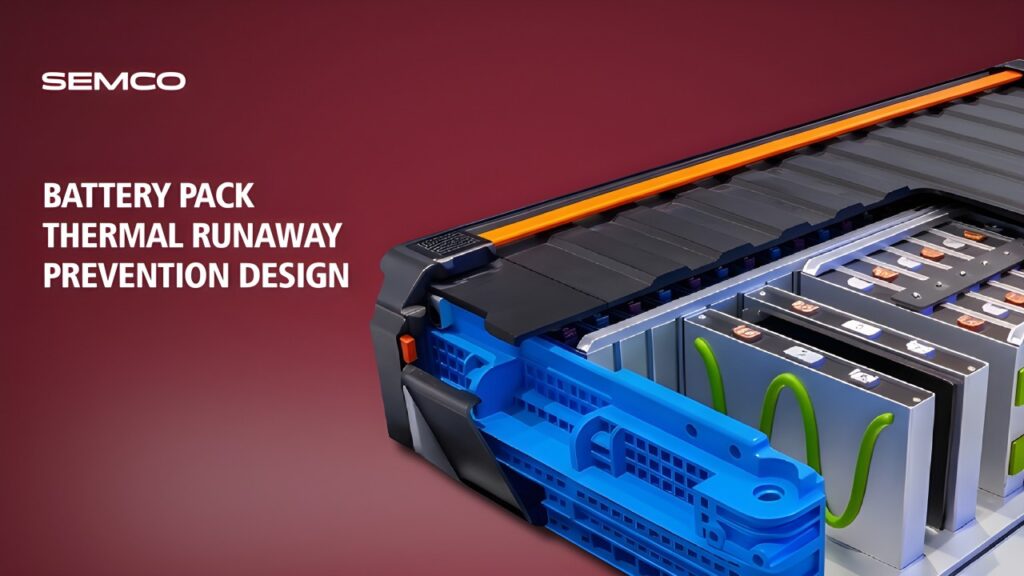
Battery thermal runaway occurs because the rate of heat generation in the battery far exceeds its rate of heat dissipation, resulting in a large accumulation of heat that is not dissipated in time. Essentially, thermal runaway is a positive energy feedback loop: increased temperature leads to a hotter system, which in turn raises the temperature, making the system even hotter. Loosely speaking, battery thermal runaway can be divided into three stages:

Stage 1: Internal thermal runaway stage of the battery
Due to internal short circuits, external heating, or the battery itself generating heat during high-current charging and discharging, the internal temperature of the battery rises to around 90℃~100℃, causing the lithium salt LiPF6 to begin decomposition. The carbon anode in the charging state has very high chemical activity, approaching that of metallic lithium. At high temperatures, the SEI film on the surface decomposes, and the lithium ions embedded in the graphite react with the electrolyte and binder, further pushing the battery temperature up to 150 ℃ . At this temperature, new and violent exothermic reactions occur, such as the large-scale decomposition of the electrolyte to generate PF5, which further catalyzes the decomposition of organic solvents.
Srage 2: Battery Swelling Phase
When the battery temperature reaches above 200 ℃ , the positive electrode material decomposes, releasing a large amount of heat and gas, causing the temperature to continue to rise. At 250-350℃, the lithium-intercalated negative electrode begins to react with the electrolyte.
Stage 3: Battery thermal runaway and explosion failure stage
During the reaction, the charged positive electrode material begins to undergo a violent decomposition reaction, the electrolyte undergoes a violent oxidation reaction, releasing a large amount of heat, generating high temperature and a large amount of gas, and the battery burns and explodes.

Thermal runaway protection and design concept
Battery system thermal runaway protection is mainly addressed from four aspects: isolation, heat dissipation, leakage, and early warning.
First, we need to talk about isolation, specifically how the battery cell and the PACK are isolated.

Battery cell protection measures
- Insulate heat transfer between battery cells (aerogel, ceramic insulation sheet, composite foam, phase change insulation sheet, mica)
- Enhance the battery’s rapid heat dissipation capability (graphene composite materials, phase change heat-absorbing materials, thermally conductive silicone pads)
- Construct battery self-protection mechanisms (fuse-off mechanism, battery pressure relief valve)
Encapsulating adhesive reduces heat transfer (flexible packaging modules)
PACK Protection Measures
Thermal runaway protection is a systematic process that requires the combined effect of reasonable structural design, thermal management and early warning, and necessary thermal protection measures.

Secondly, there are thermal runaway protection materials and components.
Protective Material Aerogel
Aerogel is a material with a nanoporous structure. It is dried using supercritical fluid to replace the liquid in the gel with gas, while the network structure of the gel remains largely unchanged. It has the characteristics of high porosity and high specific surface area, which can reduce convection, radiation and heat conduction, thereby providing heat insulation and sound insulation properties.

Structural characteristics
- Pore diameter: 1-30nm
- Porosity: 90%~ 99.8%
- Low density: 0.04-0.10 g/cm³
- Large specific surface area: 800-1000 m2/g
- Thermal conductivity at room temperature and pressure: 0.02 W/m·K

Structural strength: Pre-oxidized fiber aerogel > Glass fiber aerogel > Ceramic aerogel
Temperature resistance: Ceramic aerogel > Glass fiber aerogel > Pre-oxidized fiber aerogel
Uniform thickness: Pre-oxidized filament aerogel > Glass fiber aerogel > Ceramic aerogel
Protective material Phase change heat insulation pad
Insulation principle:
- The air insulation layer formed by the “waffle” structure;
- The material itself has good heat absorption capacity; above 200℃, the heat absorption of the material is 600kJ/kg (irreversible).
- The compression of the insulation pad has a significant impact on its insulation performance; the greater the compression, the worse the insulation effect.

Protective materials mica materials
Mica Board
- Application areas: between modules, top cover
- Main functions: impact resistance, fireproofing and heat insulation
- Features: Can be processed into special shapes
Mica Paper
- Application areas: Top cover, battery cell tabs
- Main function: fire prevention
- Features: Thin, flexible, and bendable

Mica composite materials
- Application area: Between battery cells
- Main functions: fireproofing and heat insulation
- Features: Compressible
Protective materials – composite materials
While conventional foam has some heat insulation properties, it is not heat resistant. Composite materials have a double or triple layer structure, which not only meets the requirements of compressibility, but also has certain heat insulation and fire resistance, and provides a certain degree of protection for batteries. The main composite materials are pre oxidized fiber felt and glass fiber.

Protective material silicone fireproof foam
The main components of silicone fireproof foam are organosiloxanes and fireproof fillers. At room temperature, it mainly relies on the cell structure for heat insulation. At high temperature, it forms a porous ceramic structure to achieve heat insulation. Under compression, it can inhibit the expansion and cracking of the material. The pore structure is less likely to be damaged, resulting in better heat insulation performance.

Protective materials fireproof covers
Aramid is phthaloyl phenylenediamine, which has excellent properties such as high strength, high modulus, high temperature resistance, acid and alkali resistance, insulation, and aging resistance. The temperature resistance was tested using a 1000℃ flame gun, and the temperature on the back was below 400℃, indicating good heat insulation capabilities.

Pressure relief components battery pressure relief valve
- The pressure relief pressure of explosion-proof valves is generally between 0.65 and 0.8 MPa;
- Ternary materials have a slightly higher cell pressure relief than lithium iron phosphate cells

Pressure relief components explosion-proof valve
Working principle: The explosion-proof valve uses polytetrafluoroethylene (E-PTFE) microporous membrane as the main waterproof and breathable material. The pore diameter of the E-PTFE membrane is between 0.1-10um, while the average diameter of air molecules is only 0.00036um and water vapor is 0.00047um. In addition, due to the low surface energy of the E-PTFE membrane, under the action of surface tension (water molecules pulling each other), small water droplets will quickly form water beads on the surface of the E-PTFE membrane. Therefore, gas can pass through smoothly, while liquid water cannot pass through, thus having good waterproof and breathable performance.

Thermal runaway isn’t just a cell-level issue — it’s a system design failure waiting to happen if not engineered right.
From material selection to pack architecture and testing protocols, every layer matters.
At Semco Infratech, we don’t just supply equipment — we help you design safer, compliant, and future-ready BESS systems from day one.
Contact Semco Infratech to discuss your BESS manufacturing requirements and discover how automatic assembly solutions can enhance your production efficiency, ensure product quality, and accelerate your path to market competitiveness.