

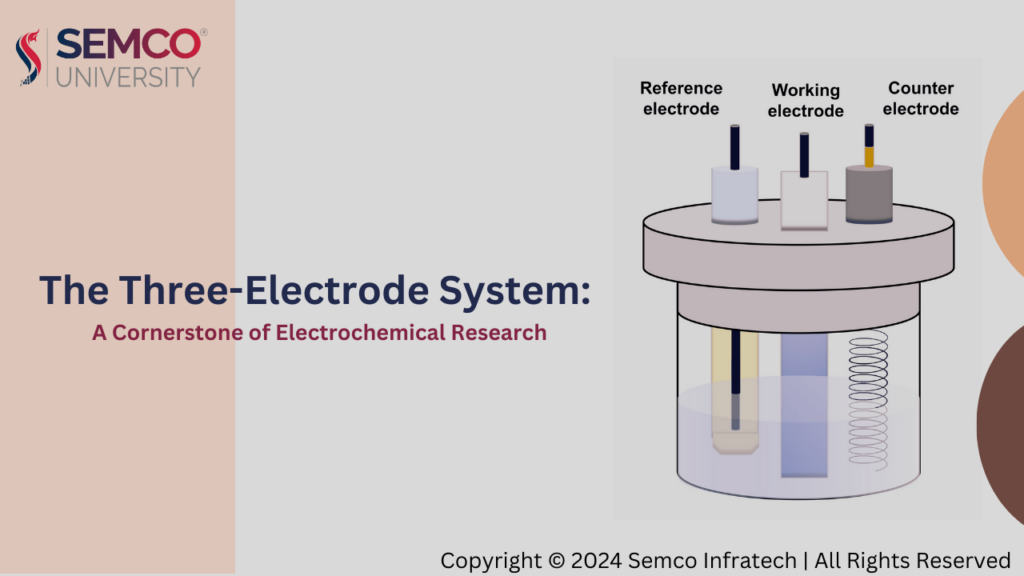
Electrochemistry, the study of reactions involving electricity and chemical change, is fundamental to various scientific and technological fields. At the heart of electrochemical experiments lies the three-electrode system, a powerful tool that enables precise control and measurement of electrochemical processes.
The Trio of Electrodes
A three-electrode system comprises three key components:
- Working Electrode (WE): This is the electrode where the primary electrochemical reaction of interest takes place. It’s the stage for the electrochemical performance.
- Counter Electrode (CE): The CE acts as a current sink or source, balancing the charge flow at the WE. It ensures the smooth operation of the electrochemical cell.
- Reference Electrode (RE): This electrode provides a stable reference potential against which the potential of the WE is measured. It acts as a constant benchmark, allowing researchers to accurately monitor and control the electrochemical reactions.
The Power of Three
The three-electrode system offers several advantages over the simpler two-electrode system:
- Precise Potential Control: The RE enables precise control of the WE’s potential, allowing for the study of specific electrochemical processes with high accuracy.
- Isolation of Electrode Reactions: The RE isolates the WE from the CE, minimizing interference from side reactions and providing clearer insights into the desired electrochemical process.
- Enhanced Data Quality: By providing a stable reference potential, the RE contributes to more accurate and reproducible experimental data.

Advanced Electrochemical Workstations: A Synergistic Partnership
To fully harness the potential of the three-electrode system, advanced electrochemical workstations are essential. These instruments offer a range of features that enhance the precision and efficiency of electrochemical measurements:
- High-Precision Potential Control: Ensuring accurate and stable potential control, especially for delicate electrochemical processes.
- Sensitive Current Measurement: Detecting even subtle current fluctuations, crucial for understanding reaction kinetics.
- Low-Noise Electronics: Minimizing noise interference to obtain high-quality data.
- Wide Frequency Range: Covering a broad spectrum of frequencies for impedance spectroscopy and other advanced techniques.
- Versatile Functionality: Integrating various electrochemical techniques, such as cyclic voltammetry, chronoamperometry, and electrochemical impedance spectroscopy.
The Future of Electrochemistry
The three-electrode system, coupled with advanced electrochemical workstations, is driving innovation in fields such as energy storage, corrosion science, and materials science. By understanding the fundamental principles of electrochemistry and utilizing powerful tools, researchers can develop new materials, optimize existing technologies, and address global challenges. As we continue to explore the frontiers of electrochemical research, the three-electrode system will remain an indispensable tool, enabling us to unravel the mysteries of the electrochemical world.
______________________________________________________________________________________
About Semco – Semco University is an educational website that is catering to the needs of students and researchers. Offering information on Lithium-ion batteries. The resources and content are compiled from various sources including manufacturers, test labs, crowdsourcing, etc. Our motto is to provide a viable resource for companies, students, and enthusiasts interested in participating in the Li-ion Battery industry. Our initiative is to make people aware of the benefits, and opportunities of the revolutionary Lithium Batteries for multiple applications.