

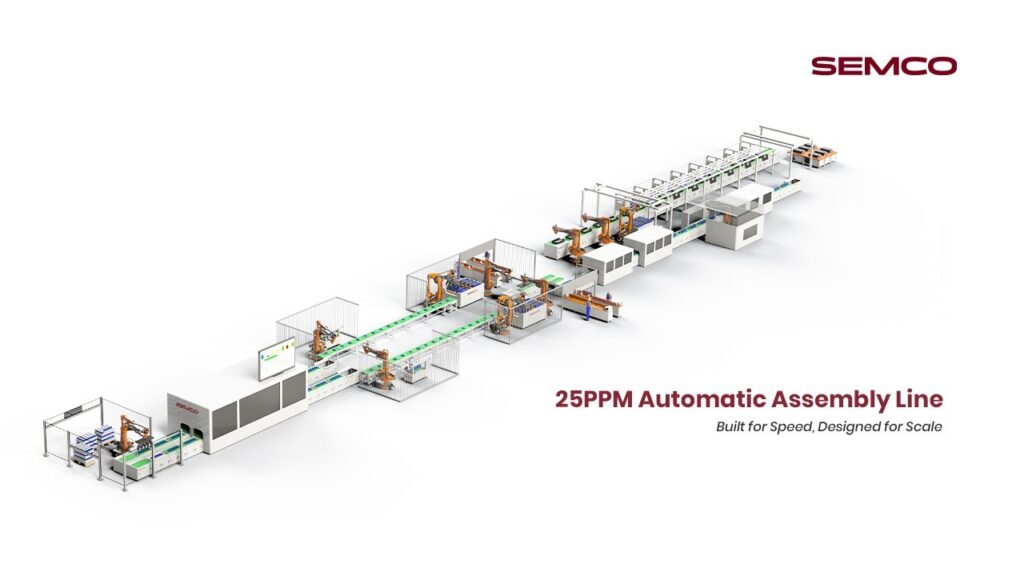
As battery manufacturing scales to meet the growing requirements of energy storage, electric mobility and high-capacity battery applications, manufacturers face a challenge that goes beyond simply increasing production volume. The real requirement is to manufacture faster without compromising consistency, safety, traceability or product quality.
The Semco Automatic Assembly Line – 25 PPM from Semco Infratech is designed around this requirement, bringing together automated cell handling, inspection, module assembly, welding, PACK integration, testing and MES-based production traceability within one integrated manufacturing solution.

Designed for a production cycle of 20–25 parts per minute (PPM), the line targets a first-pass yield of ≥98% and a final pass rate of ≥99.5%, while the specified equipment failure rate is ≤3%. The complete line is divided into battery-cell processing, module assembly/welding and PACK assembly sections.
From Individual Cells to Finished Battery PACKs
One of the major strengths of the 25 PPM line is its integrated manufacturing approach.
Instead of treating cell preparation, module production and PACK assembly as isolated operations, the production line creates a structured flow in which inspection and process control are incorporated throughout manufacturing.
The process begins with automatic cell feeding and continues through barcode scanning, OCV detection, NG exclusion, plasma cleaning, mica-sheet application, adhesive application and inspection. Cells then move into module pre-stacking, extrusion, shaping, marking and scanning, safety inspection, pole processing, welding and post-weld inspection before progressing to PACK assembly.
At the PACK stage, operations include liquid-cooling-plate preparation, module installation, busbar and cable installation, airtightness testing, cover installation, general inspection and EOL testing.
This creates a manufacturing environment where quality is checked throughout the process rather than only at the end of the line.

Automated Cell Handling and Incoming Quality Control
Battery PACK reliability begins with the cells entering the assembly process.
The Semco line uses automated cell loading combined with robotic handling. An AGV transports battery-cell stacks to the loading position, after which a robotic arm performs destacking and places cells onto the conveyor. The system is designed for the robot to pick up 10 cells at a time, while the AGV also handles empty pallets and foam separators.
Once cells enter the line, barcode scanning establishes their digital identity and OCV testing evaluates the cells before they progress further.

The line also incorporates individual cell thickness measurement. Cells are clamped at a defined pressure and a laser displacement sensor measures thickness, with measurement data uploaded into the system. Cells identified as non-conforming based on OCV and thickness results can be automatically separated and replaced with qualified cells.
This early-stage screening helps prevent unsuitable cells from moving deeper into the manufacturing process, where defects become progressively more expensive to correct.
Automated Polarity Control and Cell Preparation
Correct cell orientation is critical before module stacking.
The system uses OCV results to determine cell polarity and checks whether the orientation matches module placement requirements. The handling mechanism can rotate cells as required and arrange them according to the specified stacking sequence.
Cell preparation also includes adhesive and mica-sheet application. Robotic handling retrieves adhesive-backed mica material, removes release paper and applies it to the cell surface. Additional adhesive processes prepare the cells for subsequent stacking operations.

Importantly, adhesive application is not simply assumed to be correct. A CCD vision inspection system checks for defects such as missing or misaligned adhesive. Before stacking, cell polarity is also re-inspected.
This combination of automation and in-process inspection helps reduce the possibility of assembly errors propagating downstream.
Precision Module Assembly
Once individual cells have passed the required checks, the line moves into module formation.
Cells are merged and transferred to the pre-stacking equipment, where robotic systems create the required arrangement. During pre-stacking, a defined pre-compression force is applied before the module proceeds toward the extrusion stage.

The production concept then progresses through module extrusion, module shaping, marking and scanning, safety inspection, terminal processing, welding and post-weld verification.
This is important because module manufacturing requires control not only over cell placement but also over compression, alignment, electrical connections and weld consistency.
Four-Head Welding for Higher Productivity
Welding is one of the most critical processes in battery-module manufacturing because poor weld quality can directly affect electrical resistance, thermal performance and long-term reliability.
Semco’s 25 PPM line uses a four-head welding method, as providing improved speed and welding quality compared with traditional single-head systems. The welding equipment also incorporates quick-changeover capabilities.
But welding does not end when the laser stops.

After welding, modules undergo insulation and withstand-voltage testing. A dedicated CCD inspection station then checks the completed welds. According to the line documentation, 2D cameras inspect missed welds and positional deviations, while 3D cameras inspect weld depth, with four 2D/3D cameras performing simultaneous inspection.
This creates an important closed quality loop:
Weld → Inspect → Test → Record
rather than relying only on process assumptions or manual visual inspection.
PACK Assembly and Final Integration
After module production, the manufacturing process transitions into PACK assembly.
The documented PACK manufacturing sequence includes liquid-cooling-plate cleaning, chassis component installation, bottom-plate adhesive application, module insertion and fixing, positive/negative electrical connections, wiring-harness connections, module interconnection, insulation/withstand-voltage testing, BMU installation, top-cover installation, airtightness testing and EOL testing.

Camera-based positioning is also used during module fixing. Once the module is correctly located, screws are tightened to secure it. Similar vision-assisted positioning is used for top-cover fastening, where screw-hole locations are detected before automatic tightening, with tightening data uploaded to MES.
The result is a manufacturing approach that combines automation where repeatability is critical with controlled manual operations where production flexibility is required.
Airtightness and End-of-Line Testing
A battery PACK cannot be considered complete simply because its mechanical assembly is finished.
Final validation is essential.
The Semco line includes PACK airtightness testing, during which the product QR code is scanned and test data is subsequently uploaded to the MES system.

The overall PACK process also includes EOL testing as one of the final manufacturing stages.
By integrating testing into the production workflow, manufacturers can identify non-conforming products before they leave the factory while maintaining a digital record of critical production and quality information.
MES: Creating a Digital Thread Across Production
One of the most significant features of the Semco 25 PPM line is its Manufacturing Execution System (MES).
The MES communicates with PLC-based workstations and enables data exchange between production equipment and the manufacturing management system. It records production data across cells, modules and PACKs, supporting subsequent traceability and quality control.
The scope of traceable information is extensive. It includes cell OCV sorting, module stacking and extrusion, laser marking, insulation and withstand-voltage testing, polarity testing, laser welding, weld inspection, module EOL results, PACK airtightness, PACK-to-module bonding, BMU information, final PACK EOL results and PACK weight.

During module welding, the module code can be bound to the corresponding cell codes, while key welding parameters such as welding speed and welding power can be traced. Welding offset and cell-height measurement information can also be stored.
This transforms traceability from a simple serial-number record into a much deeper manufacturing genealogy.
If a quality problem emerges later, manufacturers have the ability to trace the product back through critical process and inspection data.
Built for Flexible Battery Manufacturing
High throughput alone is not enough if every product change requires major line reconstruction.
The 25 PPM line has therefore been designed with compatibility and changeover in mind. According to the supplied documentation, the cell sorting system supports different cell specifications with adjustments to gripper and probe spacing. The extrusion machine can accommodate different module specifications, while module-welding carrier plates can be adapted by adjusting front and rear clamps.
The control system also uses a recipe-based programming approach, enabling different product models to be produced by switching recipes.
For manufacturers operating across multiple battery configurations, this flexibility can become particularly important as products evolve and production portfolios expand.

Designed for Industrial-Scale Deployment
The specified production-line footprint is approximately 96 metres × 10 metres, with a maximum height of no more than 4 metres.
Utility requirements stated in the document include:
- Electrical power: 150–300 kW
- Compressed air: 3,000 L/min at 0.4–0.7 MPa
- Nitrogen: 25 L/min at 0.4–0.6 MPa
- Cycle time: 20–25 PPM
- First-pass yield: ≥98%
- Final pass rate: ≥99.5%
- Equipment failure rate: ≤3%
These specifications make the solution particularly relevant for manufacturers planning structured, high-throughput battery production where productivity must be supported by quality assurance and digital process control.
Why 25 PPM Matters
The real value of a 25 PPM assembly line is not simply that it can move products quickly.
In modern battery manufacturing, speed without process control can simply produce defects faster.
The stronger manufacturing model combines throughput with:
Automation + Inspection + Testing + Traceability + Flexible Changeover
That is the philosophy reflected across Semco Infratech’s 25 PPM Automatic Assembly Line.
Cells are identified and tested before assembly. Adhesive application is inspected. Polarity is verified. Modules undergo controlled stacking and welding. Welds are inspected through 2D and 3D vision. Electrical insulation and withstand-voltage tests are incorporated into the process. PACKs undergo airtightness and EOL validation. Meanwhile, MES connects critical manufacturing information into a traceable digital production record.
From Cell to PACK. From Automation to Traceability.
With its 25 PPM automatic assembly solution, Semco Infratech is enabling battery manufacturers to move beyond isolated machines toward a connected manufacturing line where every critical process can be controlled, inspected and traced.

Planning to establish or scale a battery module and PACK assembly facility?
Contact Semco Infratech to discuss your EV & BESS manufacturing requirements and discover how automatic assembly solutions can enhance your production efficiency, ensure product quality, and accelerate your path to market competitiveness.