

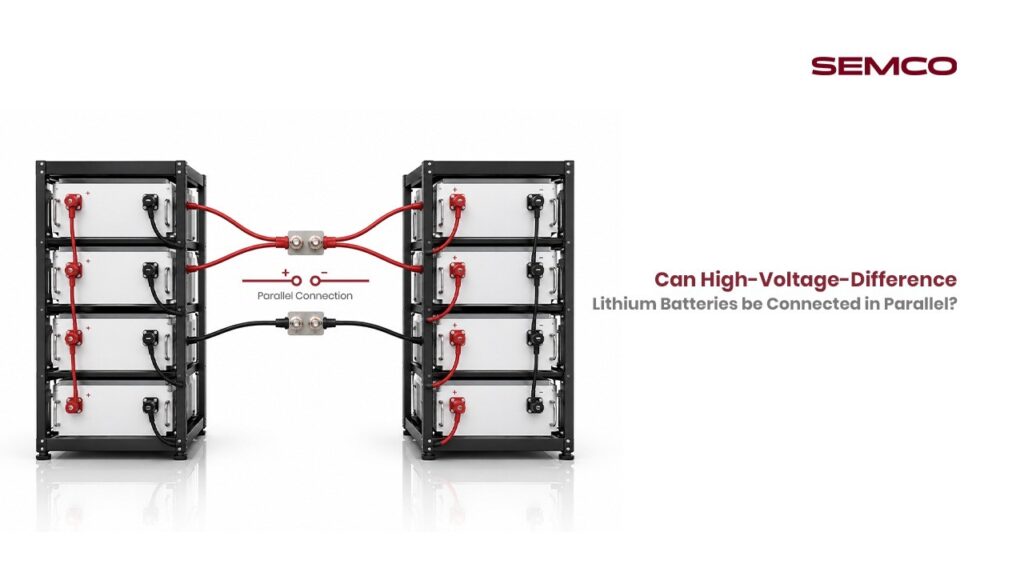
Connecting two battery banks with a large voltage difference directly in parallel not only significantly degrades battery performance but also creates serious safety hazards. The core premise of parallel battery connection is that the voltages must be essentially the same. Once the voltage difference exceeds a safe threshold, a series of negative problems will follow, potentially leading to battery damage, fire, and other dangerous situations.
When batteries are connected in parallel, they follow the physical law that “the voltage of each branch in a parallel circuit is equal.” If there is a significant voltage difference between two sets of batteries (e.g., one set is 13V and the other is 11V), the battery with the higher voltage will act like an “active power source,” forcibly “charging” the battery with the lower voltage. This creates an internal high-current loop that does not require an external load. This current is called “circulating current” (or “balancing current”), and circulating current can cause multiple cascading problems.

First, the instantaneous high-current surge can directly damage the battery structure. The greater the voltage difference, the higher the intensity of the circulating current (reaching hundreds of amperes in some scenarios), far exceeding the normal charging and discharging current range of the battery. For lithium batteries such as lithium iron phosphate and ternary lithium, the instantaneous high current can damage the internal electrode materials and break down the separator, directly and significantly shortening the service life. Lead-acid batteries, on the other hand, will experience plate sulfation and active material shedding due to the high current, which also accelerates the aging process.
Secondly, high current will cause intense heat generation. According to Joule’s law (Q=I²Rt), a large amount of heat will be generated when current passes through the battery’s internal resistance. If the heat cannot be dissipated in time and accumulates inside the battery, lithium batteries may trigger thermal runaway, resulting in bulging, leakage, and in extreme cases, even fire and explosion. Lead-acid batteries may experience electrolyte boiling and casing deformation due to high temperatures, while releasing toxic gases such as hydrogen sulfide.

Furthermore, the system performance will actually decrease after parallel connection. Even if the batteries are not immediately damaged, the lower-voltage battery will be in a state of “forced charging” for a long time, while the higher-voltage battery will be continuously “forced discharging.”
The two sets of batteries can never charge and discharge synchronously. Ultimately, the capacity of the entire parallel system will be limited by the “lower-voltage battery” (i.e., the “weakest link effect”), which is equivalent to “a large battery forcibly driving a small battery,” completely losing the meaning of parallel capacity expansion and instead causing a waste of resources. Furthermore, circulating current can damage charging and discharging equipment. The sudden surge of current during parallel connection can impact the connection lines and subsequent charging and discharging controllers (such as inverters and chargers), potentially triggering overcurrent protection, blowing fuses, and in severe cases, damaging core internal components.

Different types of batteries have varying tolerances to voltage differences. The industry standard safe parallel connection requires meeting four core conditions:
- First, the batteries must be of the same type (e.g., all ternary lithium batteries or all lead-acid batteries; mixing different types of batteries in parallel is strictly prohibited, such as lithium batteries and lead-acid batteries).
- Second, the specifications must be consistent (including capacity, nominal voltage, discharge rate, and other key indicators).
- Third, the voltage difference must be controlled within 0.1V~0.2V (based on the nominal voltage; for example, for a 12V battery pack, the voltage difference must be strictly controlled within 0.1V).
- Finally, the batteries must be of similar aging levels (the number of cycles should not differ by more than 20% to avoid mixing “new batteries” with “old batteries”). If the voltage difference between two battery packs exceeds 0.2V, even if they are of the same type, direct parallel connection is not recommended.
If it is necessary to connect two sets of batteries in parallel, and their types, capacities, discharge rates, and other parameters are identical, with only a voltage difference, the voltage difference must first be eliminated through “voltage balancing.” The specific steps are as follows:
First, fully charge each set of batteries individually to achieve initial balancing: Fully charge each set of batteries using their respective matching chargers. The appropriate charging parameters must be set according to the battery specifications— lithium batteries should be charged with a constant voltage/constant current charger, and lead-acid batteries with a three-stage charger. After fully charging, let the batteries stand for 1-2 hours to allow the battery voltage to stabilize and eliminate “floating voltage.” If the voltage difference between the two sets of batteries still exceeds 0.2V at this point, further processing is required.

The second step, if the voltage difference still doesn’t meet the standard after initial equalization, requires forced equalization using a “battery equalizer”: Select a battery equalization module with the corresponding voltage (e.g., 12V or 24V specifications), connect the two sets of batteries respectively, and use the equalizer’s internal resistors or DC-DC circuit to slowly transfer energy from the higher-voltage battery to the lower-voltage battery until the voltage difference between the two sets of batteries is ≤0.1V.
Note that the equalization process must be performed in a well-ventilated environment, and the duration depends on the magnitude of the voltage difference, potentially lasting several hours.
The third step, using a series current-limiting resistor to buffer the impact during parallel connection: When initially paralleling after voltage equalization, a power-type current-limiting resistor (resistance value calculated based on battery capacity, typically 1~5Ω, power ≥10W) should be connected in series in the higher voltage battery branch to weaken the circulating current impact at the moment of parallel connection; observe for 10~30 minutes after parallel connection. If the battery does not heat up significantly and the voltage remains stable, remove the current-limiting resistor to complete the permanent parallel connection.
In summary, two battery packs with a large voltage difference must never be directly connected in parallel, otherwise it will cause serious consequences such as circulating current, overheating, and battery damage. The core prerequisites for parallel battery connection are “same type, same specifications, same condition, and low voltage difference.” If parallel connection is absolutely necessary, the voltage difference must first be eliminated through “separate charging + equalizer” to ensure that the voltage difference is ≤0.1V before proceeding. It is also recommended to prioritize the use of brand-new battery packs with completely identical parameters for parallel connection to fundamentally avoid safety risks.

Contact Semco Infratech to discuss your EV & BESS manufacturing requirements and discover how automatic assembly solutions can enhance your production efficiency, ensure product quality, and accelerate your path to market competitiveness.