

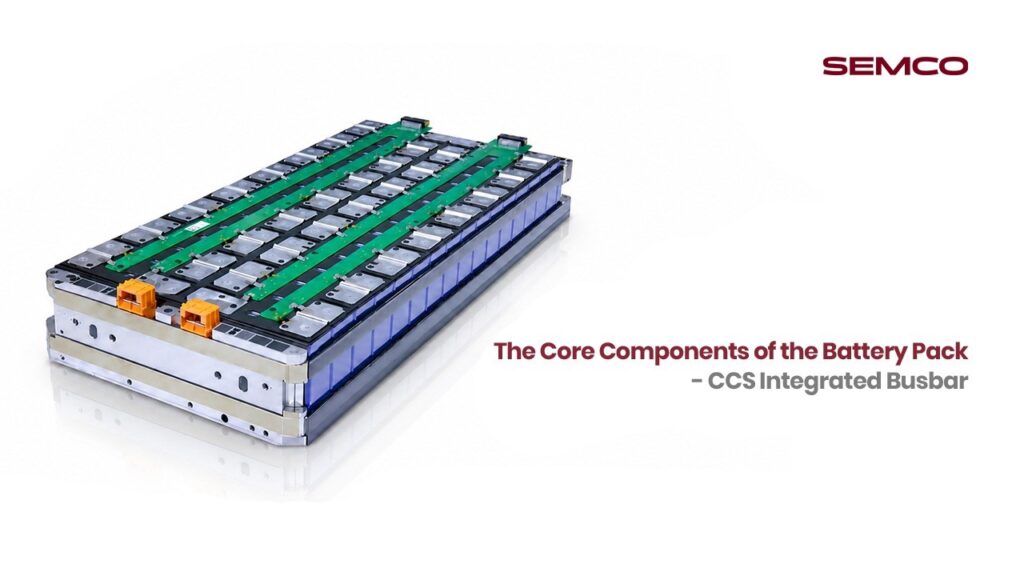
CCS integrated bus is the core connection part of PACK. On the one hand, it is the “main vessel” of PACK, carrying the large current transmission of DC main circuit of PACK. On the other hand, PACK’s “Divine Network” accurately collects the voltage and temperature signals of the cells to provide accurate data for the operation of the BMS and the implementation of protection strategies.

First understand: What is CCS?
Core functions of CCS
CCS full name Cell Contact System (Cell connection system), often referred to as integrated busbar harness board integrated component, it is a battery module inside the electrical connection, signal acquisition, structural support and other functions highly integrated module。Its core positioning is to be the only bridge between the battery cell and the BMS, and at the same time, it undertakes two irreplaceable core functions:

Power transmission: Through the copper / aluminum bus bar , realize the series and parallel connection of the battery cells , form the high voltage main circuit of the battery PACK , and carry the large current of charging and discharging.
Signal acquisition: Through integrated collection lines and sensing elements, the voltage and temperature data of single cells are accurately collected and transmitted to the battery management system in real time, providing data support for charge and discharge control, balance management and safety protection.
Nuclear Value of CCS
Its core values are reflected in four dimensions:
Determine the upper limit of the electrical performance of the PACK
Current-carrying capacity, contact resistance and line voltage drop of CCS directly determine the charging and discharging efficiency, high current performance and cycle life of PACK. Virtual welding, internal resistance is too large CCS, will be in high current conditions, rapid heating, not only loss of electricity, but also lead to deterioration of the consistency of the cell, and even cause fire.

The “eyes and ears” of BMS
The BMS protection control logic for the battery depends on the voltage and temperature data uploaded by the CCS. CCS acquisition accuracy is insufficient, signal delay, node missing, will directly lead to BMS misjudgment, lead to overcharge, overdischarge, thermal runaway and other fatal risks.
Integration reduces costs and increases efficiency
CCS integrates all functions and components (flow lines, collection beams, insulation, supports, etc.) to achieve “one-off assembly,” which greatly reduces the PACK assembly process and reduces labor costs, while reducing the beams connection points and reducing the failure rate.
The Core Structure of CCS
A complete CCS, seemingly a flat integration, is actually composed of five core modules, each module design and material selection, directly determines the product performance and reliability.
Power conductive matrix: the “main vessel” of PACK
This is the power core of CCS, which is responsible for the battery series parallel and high-current transmission, and the core is divided into two categories:
Flow lines (copper / aluminum lines): T2 copper / aluminum alloy nickel / tin plating, excellent conductivity, strong oxidation resistance. Current-carrying capacity of CCS is directly determined by the thickness, width and flow area of CCS.

Signal Acquisition Unit: “The End of the Mind” of PACK
This is the signal core of CCS, which is responsible for accurate sensing and data transmission of the cell state, and the core includes:
Capture line substrate: The mainstream is FPC flexible circuit board, some scenes use FFC Flat flexible cable or traditional discrete wire harness, built-in voltage acquisition line and temperature acquisition line, to achieve stable signal transmission.
NTC thermistor: The core temperature sensing element is fixed on the FPC by surface mount soldering and is placed on the surface of the battery cell or at key positions of the busbar to collect the battery cell temperature in real time, with a mainstream accuracy of ±1℃.

Voltage capture nickel flakes: The core conductive connector, which is precisely collected by single core voltage, uses Pure Nickel or Nickel Alloy One end is fixed on the voltage collection point of the cell pole ear or the bus bar by welding, and the other end is reliably connected with the FPC / PCB sampling circuit. Its core role is to transmit the real-time voltage signal of each cell to the BMS (Battery Management System) stably, for cell balance control, over-voltage / under voltage protection and SOC / BMS.
Signal Connector: Standard interface for docking with BMS management system to realize stable docking of low voltage signal.
Insulation protection structure: PACK’s “safety separation belt”
This is the safety core of CCS, responsible for the insulation isolation between high and low voltage, charged body and shell, and is the key to avoid short circuit and breakdown:
Insulating membrane layer: The mainstream uses PET / PI high temperature insulation film, through hot pressing process and conductive matrix composite, to achieve single-layer insulation voltage ≥ 2kV, with excellent flame retardant, high and low temperature resistance, anti-aging performance.

Structural support framework: Mostly use FR4 fiberboard and flame retardant PP / PC engineering plastic injection molding to provide structural support for the entire CCS, at the same time achieve the positioning and isolation of the flow drain and collection line, and reserve the avoidance space for the explosion prevention valve and buffer foam cotton.
Auxiliary protective equipment: They include flame retardant foam, fixed buckle, and insulating pads for shock reduction, positioning, and secondary insulation protection during assembly.
Comparison of Mainstream CCS Techniques and Routes
At present, CCS in the industry is mainly divided into three technical routes, which are adapted to different application scenarios, there is no absolute good or bad, only adaptation or not. Let’s use a table to illustrate the differences between the three:

A key:
- Large-scale , high-reliability requirements for passenger cars / large storage scenarios , FPC flexible CCS is the mainstream , but also the future development direction of the industry.
- Small batch, non-standard customization, low-cost scenarios, traditional wiring harness CCS still has irreplaceable advantages.

A Guide to avoiding Common Misunderstandings in the industry
Misunderstanding 1: CCS is a wiring board, no technical content
Correct answer: CCS is a set of materials science, welding technology, electrical design, structural engineering, electronic technology in one of the precision components. Poorly designed CCS will directly lead to the deterioration of cell consistency, short circuit and thermal runaway. It is the core control point of PACK safety and has a very high technical threshold.
Misunderstanding 2: FPC scheme must be better than traditional wiring harness scheme
The correct answer: There is no good or bad plan, only whether it is suitable or not。 In small volume non-standard scenarios, the traditional beam solution is cheaper, faster delivery and more convenient for maintenance.The advantages of the FPC solution can be fully realized in large-scale standardized scenarios.

Misunderstanding 3: Choosing the model only looks at the carrying capacity , ignoring the insulation and temperature measurement accuracy
Correct answer: The carrying capacity is only the basic indicator of CCS, insulation withstand voltage level , temperature resistance, NTC temperature measurement accuracy, welding yield, is the core of product long-term reliability and safety. The use of inferior insulation materials, low precision NTC, short-term use can not see the problem, long-term high temperature and high humidity conditions are prone to insulation failure, temperature measurement drift, cause safety accidents.
Conclusion
With the continuous explosion of the new energy and energy storage industry, the technology iteration of CCS will become faster and faster, and the integration, intelligence and security will become the core thread of the industry development. Some companies have begun to promote the deep integration of CCS and BMS from the control board, further reducing the number of PACK parts and achieving “one-piece assembly,” greatly reducing the design and assembly cost of PACK.

Contact Semco Infratech to discuss your EV & BESS manufacturing requirements and discover how automatic assembly solutions can enhance your production efficiency, ensure product quality, and accelerate your path to market competitiveness.