
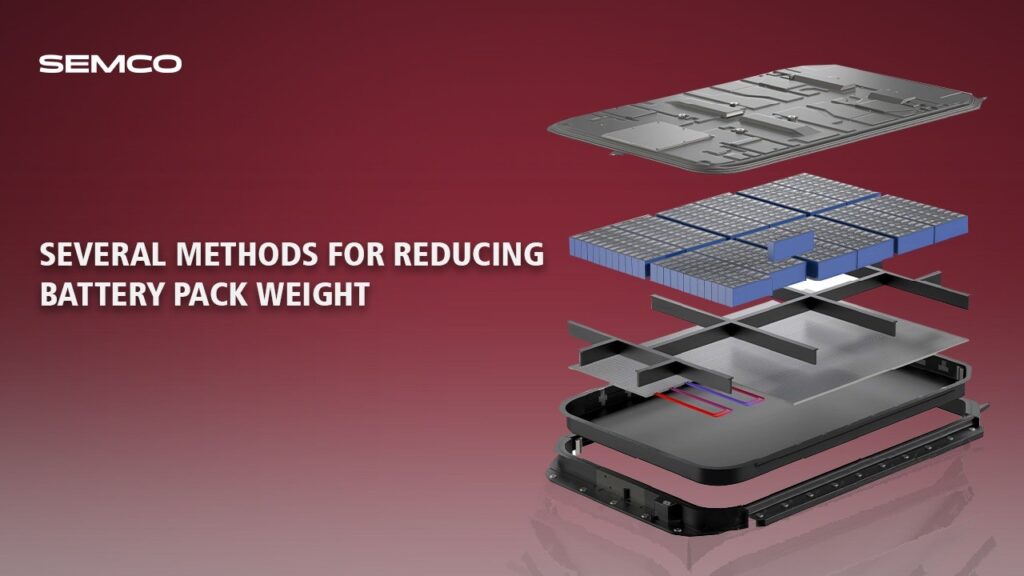
The power battery pack is one of the core components of electric vehicles. The battery pack accounts for about 20-30% of the total weight of the vehicle and is also one of the components with the highest cost in the production of the whole vehicle.
As we all know, battery packs have extremely stringent safety requirements, which also determine the vehicle’ s performance in terms of power and range.
To improve performance, the overall weight of the vehicle is also crucial. The issue of reducing the weight of the battery pack, which accounts for nearly one-third of the vehicle’ s weight, is particularly critical.
Why should battery packs be made lightweight?
Research data shows that reducing the weight of traditional gasoline- powered vehicles by 10% can improve fuel economy by 6-8%. Under constant speed driving conditions, a 10% reduction in the weight of an electric vehicle can increase its driving range by about 10%.

So how can we improve the driving range?
From the perspective of battery packs, due to the significant limitations in cell material composition and size, the only way to reduce weight is to focus on the structure. Lightweighting of the casing and compacting of modules have become the key research directions for new energy vehicle companies.
How to achieve lightweight battery packs?
Battery pack lightweighting can be broadly divided into two levels: system design and detailed design. A detailed breakdown of these levels is shown in the diagram below:
While prioritizing lightweight design, the battery pack structure still needs to meet safety requirements such as mechanical safety, sealing and insulation, and fire resistance. The strength, rigidity, impact resistance, and stability of the enclosure structure all affect the battery pack’ s performance.

In the pursuit of lightweight design, the following five methods are considered relatively effective:
Optimize Battery Pack Layout
Within the limited space of the battery pack housing, a certain number of individual battery cells are connected by specific mechanical and electrical connections to form a battery module.
Based on the spatial shape and load-bearing characteristics of vehicle battery packs, battery modules are arranged in series and parallel to form a power battery system. The arrangement and structural form of modules in the battery pack vary greatly.
Common types of battery cells include cylindrical, square aluminum shell, and soft-pack aluminum-plastic film. In addition, the battery pack also contains auxiliary functional components such as BMS controller and high- voltage wiring harness.

The arrangement of the power battery pack is usually determined by the overall vehicle space characteristics, and factors such as the vehicle drive mode, the vehicle’ s center of gravity position and ground clearance need to be considered.

Power battery pack manufacturers develop vehicle power battery packs with different module arrangements, battery pack box shapes, and mounting lug positions based on the needs of vehicle manufacturers.
Through continuous research and development, common structural arrangements for battery packs include bottom-mounted, integrated with the vehicle body structure, and distributed in standard enclosures.
Bottom-Mounted
Early electric vehicles were mostly converted from traditional gasoline vehicles. The power battery pack was usually installed in the front compartment, trunk, or under the floor of the car, as shown in the picture below, with the Nissan Leaf’s ” concave” shaped battery pack.

The battery pack, which is suspended at the bottom of the vehicle body and bolted to the bottom of the car frame, has the advantages of efficient and flexible design and good independent manufacturing. It is a widely used power battery pack structure in passenger cars, such as the Nissan Leaf and Geely Emgrand EV.
Distributed Box
Standard enclosure distributed systems are formed by connecting several identical or structurally similar standard enclosure battery packs in series and parallel, and feature flexible layout and diverse installation locations.
This structural form is often used in buses or special-purpose vehicles with larger and more regular spaces, such as the Yutong E10 pure electric bus.

As the demand for longer driving ranges in electric vehicles continues to increase, traditional automotive structures with limited space cannot meet optimal design requirements, leading to a growing emphasis on integrated body structures and battery pack layouts. The maturity of forward design technology for electric vehicles has resulted in the emergence of dedicated electric vehicle design platforms, such as the GAC GEB electric vehicle platform shown in the figure, which integrates the battery pack into the body structure.

The increasing demand for electric vehicle driving range, coupled with the development of automotive forward design technology, has prompted the collaborative development of vehicle body design and battery pack structure, striving for a compact vehicle body structure while achieving superior battery pack performance.
Currently, there is a growing trend of platform-based and modular vehicle body structures with integrated power battery packs, such as the Audi Q4 e-tron based on the Volkswagen MEB platform, and the Tesla Model S and Model X based on the Tesla platform.
Optimize Battery Module
At the system design level, lightweight battery pack design begins with the selection of cell parameters and individual cell size.
There are matching design issues between lithium-ion power cells and power battery systems under different chemical systems and size parameters, which usually need to be calculated and determined during the conceptual design stage of the battery system.
Finally, by optimizing the internal layout of the battery pack enclosure and reducing design layers, the maximum utilization of the enclosure space can be achieved.
For example, CATL proposed the Cell To Pack (CTP) technology, and the figure shows the structural design of a CATL CTP system.
In this CTP design, the individual cells and battery management system are directly fixed in the battery pack housing, and the cells are built into the upper and lower housings, with the inside of the housings filled with thermally conductive adhesive.
In addition, pressure or temperature sensors are built into the cell sidewall and cell casing. The two sensors work together to identify defective individual cells and detect potential safety accidents such as thermal runaway in advance.
This design, by not using a modular structure, increases the battery pack volume utilization rate by 15-20%; individual cell assembly reduces assembly difficulty and increases production efficiency by approximately 50%. More importantly, it enables timely detection and replacement of faulty cells, and the cell casing reinforcement scheme can reduce the protection level of the battery pack casing.
New Grouping Methods
Large module design
Increasing the size and capacity of individual battery cells reduces the structural mass allocated to each cell. For example, CATL’ s large module design structure:
The large module design eliminates the battery box found in existing technologies, allowing the battery module to be directly mounted on the vehicle via a fastener, a support sleeve, and a mounting beam. This achieves a lighter battery pack while improving the connection strength of the battery pack within the vehicle.

Integrated design
By reducing intermediate layers such as battery pack modules, the size of individual battery cells can be optimized, thereby improving the utilization rate of the enclosure space.
For example, BYD’s ” blade battery” battery pack design, as shown in the figure, involves designing a flat, large-sized battery cell and arranging it in an array inside the battery pack housing. The individual battery cells are inserted into the battery pack like ” blades”.
It is understood that this design can increase the specific energy of the battery pack by about 50% and reduce production costs by about 30%.
Application of Lightweight Materials
Why is it considered a “major” aspect? Because the use of lightweight materials in the box’ s weight-reduction design has a very significant effect on reducing the overall weight of the box.
Currently, the most mature lightweight materials used are aluminum- magnesium alloys and composite materials.
Among metallic materials, aluminum alloys are lightweight, have good oxidation resistance, and are easy to recycle, making them widely used in battery packs. Considering structural strength, die-cast aluminum boxes and extruded-welded aluminum boxes are mostly used in the lower body, while stamped-welded aluminum boxes are generally used in the upper cover.
Moving on to non-metallic materials, composite materials are currently a hot topic. Their advantages, such as extremely light weight, good insulation properties, and ease of processing and molding, are being fully utilized in battery packs and even the entire vehicle.
Currently, in areas such as engine hoods, oil pans, and battery pack covers, various composite material parts are replacing traditional metal parts on a large scale.

However, it should be noted that composite materials are limited by raw materials, costs, and other factors. Currently, the most commonly used composite materials are glass fiber reinforced plastics (SMC) and various modified resins.
Data shows that battery pack covers made of SMC are about 38% lighter than those made of traditional metal materials, and the application of carbon fiber composite materials is also gradually increasing, with composite materials showing significant weight reduction effects.
Some companies have tried to apply composite materials to the underbody of electric vehicles, but composite materials have poor stiffness characteristics and need to be thickened or have a sandwich structure to improve the bending resistance of the structure.
Meanwhile, the battery pack housing will be designed with a sandwich structure, and a metal or honeycomb aluminum structure will be added in the middle layer to combine metal and non-metal, which has many advantages such as lightweight, high strength and good impact resistance.
Lightweight materials such as magnesium-aluminum alloys and composite materials have significant weight-reduction effects in the lightweight design of battery pack structures. However, the application of lightweight materials in battery pack structure design currently has the following two shortcomings:
- There is a lack of research findings and design methods that can be referenced to develop battery pack structures that combine key battery pack performance with excellent performance and lightweight effect.
- The use of appropriate materials in appropriate locations has been initially applied in battery pack structural design, but there is insufficient research on multi-material selection methods for battery packs and multi-material design methods that combine performance constraints.

Extreme Design
Extreme design refers to performance optimization during the detailed design phase of a product or design improvements made to the product in later stages.
Extreme design requires a clear understanding of the design’ s critical values. It must not only meet various performance requirements but also satisfy the requirements of component processing and product assembly processes.
Extreme design typically utilizes CAE to explore the critical values of various product performance parameters and manufacturing process parameters, and uses CAE simulation analysis technology to pinpoint the exact location.
For example, the load-bearing parts of the battery pack can be reinforced, while thin-walled materials can be used for non-load-bearing parts. The thickness of the pack can be varied at different locations to meet the structural performance requirements while minimizing weight.
In addition to these lightweighting requirements, the current development of the automotive industry has placed even more demands and challenges on plastics.

Contact Semco Infratech to discuss your BESS manufacturing requirements and discover how automatic assembly solutions can enhance your production efficiency, ensure product quality, and accelerate your path to market competitiveness.