

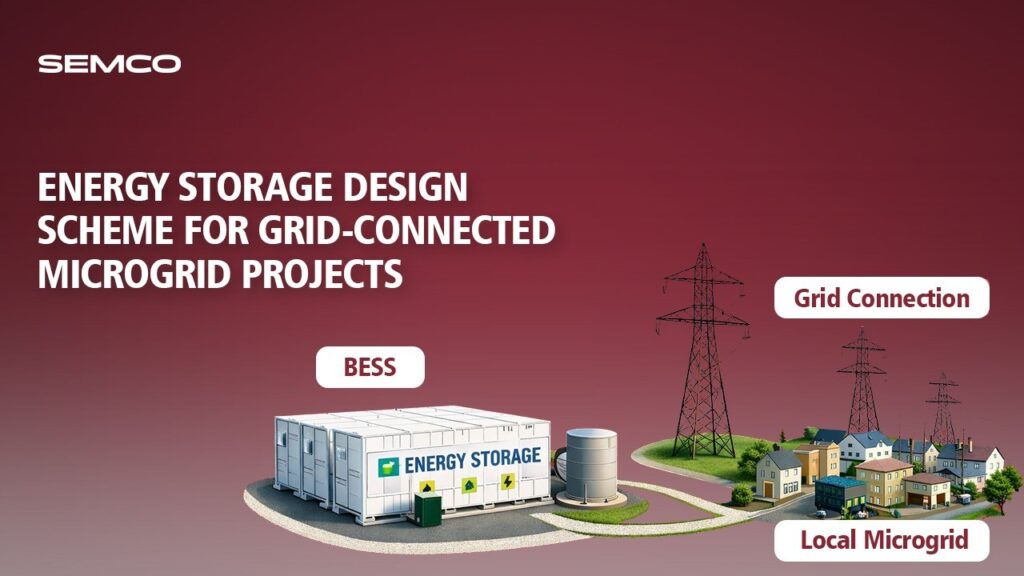
The core of a grid-connected microgrid is the synergy of “source-grid-load-storage + EMS system”. “Source” refers to distributed power sources such as photovoltaics and wind power, for example, an industrial park often has 10MW of photovoltaic power and 2MW of wind power; “grid” refers to the distribution network within the microgrid (generally 0.4-10kV), and also needs to have a grid connection interface (connecting to the main grid’s 110kV/35kV lines); “load” refers to user loads, which must be distinguished between important loads (such as factory production lines and hospital ICUs) and ordinary loads (such as lighting and air conditioning); “storage” refers to the energy storage system, which is both a “power source” when off-grid and a “regulator” when on-grid; finally, it relies on the EMS system (Energy Management System) for unified scheduling, such as using energy storage to smooth peaks and fill valleys when on-grid, and using energy storage to support voltage and frequency when off-grid.

Core Design Points
The first advantage is “seamless grid-connected/off-grid switching,” which is also the core advantage of grid-connected microgrids and the most prone to problems. The design should include a “bidirectional PCS + ATS automatic transfer switch”: When grid-connected, the PCS controls the charging and discharging of energy storage, for example, buying electricity from the main grid during off-peak hours to charge the system and discharging it to the load during peak hours to reduce electricity costs; when the main grid loses power, the EMS system will detect it within 200 milliseconds and immediately trigger the ATS switch to disconnect the grid-connected interface, while simultaneously switching the PCS to off-grid mode.

The energy storage quickly adjusts the voltage and frequency (e.g., maintaining a frequency of 50±0.2Hz and a voltage of ±5%) to ensure uninterrupted power supply to critical loads. For example, in a microgrid in an electronics factory, the production line (critical load) operates without interruption during a power outage, while ordinary loads (air conditioning) are temporarily shut down. Once the grid is restored, it can automatically reconnect without manual intervention.
The second factor is energy storage capacity configuration. Energy storage configuration requires considering two factors: first, the “off-grid supply duration.” For example, if a critical load is 2MW and you want to maintain off grid supply for 4 hours, the energy storage capacity needs to be at least 2MW × 4h = 8MWh. Considering an 85% efficiency, a 10MWh capacity is practically necessary. Second, the “peak shaving and valley filling demand” during grid connection.

For example, if the peak-valley price difference is $0.112/kWh, and a factory uses an extra 30,000 kWh during peak periods, and the energy storage discharges 30,000 kWh per day, the annual savings would be:
30,000 kWh × $0.112 × 365 = $122,640,or approximately $122,640 per year.
Therefore, a 3 MW energy storage capacity (corresponding to 30,000 kWh / 10 hours of discharge) is sufficient.
In summary, a “3–5 MW / 8–15 MWh” energy storage configuration is commonly used, satisfying both off-grid supply needs and peak shaving revenue.

The third is protection strategies to prevent risks, focusing on two key issues: First, the “islanding effect,” where microgrids continue to supply power to the grid after a large grid outage, threatening the safety of maintenance personnel. Therefore, “anti-islanding protection devices” must be installed to disconnect the grid connection switch within 0.1 seconds after detecting grid voltage loss.
Second, “overvoltage and overcurrent,” such as a sudden surge in photovoltaic output (from cloudy to sunny), which can lead to excessively high voltage. Overvoltage protection must be added to photovoltaic inverters and energy storage PCS to automatically reduce load when the voltage exceeds 1.1 times the rated voltage, preventing equipment burnout.

Typical Design Schemes for Different Scenarios
Industrial park microgrid:
Focusing on “peak shaving and valley filling + supply guarantee for important loads”, the standard configuration is “10MW photovoltaic + 2MW wind power + 5MW/15MWh energy storage”, with a 35kV grid connection interface. When off-grid, it prioritizes production lines (3MW for important loads) and can guarantee supply for more than 5 hours, saving 800,000 to 174,353 US Dollars in electricity costs per year.
Rural microgrids:
Focus on “stable power supply + cost control”, typically equipped with “5MW photovoltaic + 1MW wind power + 2MW/8MWh energy storage”, with a 10kV grid connection interface. When off-grid, it ensures power supply for residents (1.5MW for important loads) and irrigation equipment, without the need for high-end equipment, thus controlling initial costs.

Island microgrid:
Focusing on “resistance to harsh environments + consumption of new energy”, it requires the use of salt spray resistant photovoltaic panels and energy storage cabinets, equipped with “3MW photovoltaic + 5MW wind power + 4MW/12MWh energy storage”. Because there is a lot of wind power on the island, the energy storage needs to smooth out wind power fluctuations. The grid connection interface is selected as 35kV, and when off the grid, it protects the seawater desalination equipment and residential electricity.
Contact Semco Infratech to discuss your BESS manufacturing requirements and discover how automatic assembly solutions can enhance your production efficiency, ensure product quality, and accelerate your path to market competitiveness.

For demos, solutions, or collaborations:
Connect at sales@semcoindia.com | +91-8920681227 | www.semcoinfratech.com