


In the world of modern energy storage, particularly for demanding applications like electric vehicles and grid-scale systems, lithium battery voltage consistency stands as a paramount factor. This refers to the ability of individual lithium battery cells within a single batch or system to maintain identical terminal voltage levels when operating under the same conditions. This seemingly simple metric holds profound implications for the overall performance, lifespan, and, crucially, the safety of the entire lithium battery pack.
1. The Undeniable Importance of Voltage Consistency
Voltage consistency is not merely a technical detail; it is deeply interwoven with the fundamental characteristics and reliability of a battery pack.
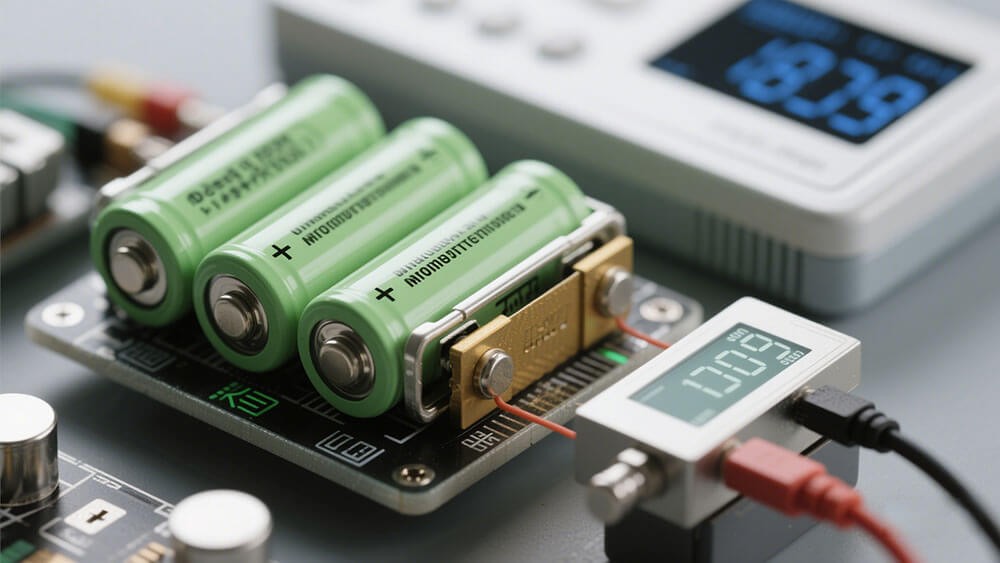
- Impact on Overall Performance: Imagine a team where some members lag behind or push too far ahead. In a battery pack, if there are variations in the voltage of individual cells, some cells will inevitably reach their upper (fully charged) or lower (fully discharged) voltage limits prematurely during the charge and discharge cycles. When one cell hits its limit, the entire battery pack is often forced to cease operation to prevent damage, effectively reducing the overall usable capacity and energy efficiency of the pack. It’s like having a full tank of fuel but being able to use only a fraction of it because one gauge shows empty.
- Direct Link to Safety: Perhaps the most critical consequence of voltage inconsistency is its direct impact on battery safety. When cells in a pack exhibit inconsistent voltages, some might become overcharged while others are over-discharged. Both scenarios are dangerous. Overcharging can lead to excessive heat generation, potentially triggering a runaway chemical reaction known as thermal runaway, which can result in severe safety incidents like fire or explosion. Similarly, over-discharging can damage the cell’s internal structure, making it prone to instability.
- Influence on Battery Lifespan: Inconsistent voltage also directly affects the longevity of lithium batteries. Cells that are repeatedly pushed to their limits due to imbalance will experience more extreme charge and discharge cycles. This accelerated stress causes these cells to degrade faster, leading to a shorter individual lifespan. Since the overall life of a battery pack is often dictated by its weakest link, the premature failure of even a few cells due to inconsistency can significantly shorten the service life of the entire battery pack.
2. The Ripple Effect: How Voltage Inconsistency Degrades Batteries
The presence of voltage differences among individual cells within a battery pack can trigger a cascade of detrimental effects:

- Performance Degradation: The most immediate impact is a decline in the battery pack’s overall performance. During discharge, a cell with a lower voltage will act as a bottleneck, prematurely limiting the discharge voltage and the total energy that can be drawn from the entire pack. This effectively reduces the battery pack’s usable energy output.
- Unbalanced Charging and Discharging: Voltage inconsistency leads to a lack of harmony during battery operation. Some cells may reach full charge or complete discharge before others. This means that while some cells are at their limits, others might still have capacity remaining, leading to underutilization of the battery pack’s overall energy capacity. It’s an inefficient use of resources.
- Increased Thermal Runaway Risk: As mentioned, this is a major safety concern. Cells that are forced into overcharged or over-discharged states generate significant heat. If this heat cannot be effectively managed and dissipated, it can accumulate, raising the cell’s temperature to a critical point and initiating thermal runaway, a destructive self-propagating chemical reaction that can escalate into a fire or explosion.
- Shortened Lifespan: The repeated stress of overcharging and over-discharging due to voltage imbalances accelerates the degradation of individual cells. These stressed cells will fail much earlier than others, becoming the “weakest link” that determines the reduced lifespan of the entire battery pack. This can lead to earlier replacement costs and diminished long-term value.
3. Strategies for Cultivating Lithium Battery Voltage Consistency
Achieving and maintaining high voltage consistency in lithium batteries requires a multi-pronged approach, encompassing design, manufacturing, and operational strategies:
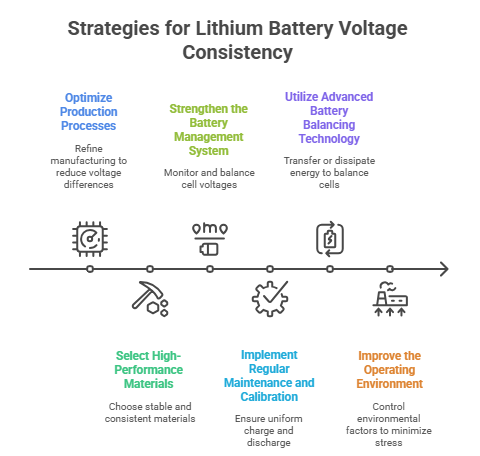
- Optimize Production Processes: The journey to consistent cells begins at the manufacturing stage. By continually refining production processes and enhancing the precision and uniformity of each step, manufacturers can significantly reduce inherent voltage differences between cells. This involves meticulous optimization of parameters during electrode coating, cell winding, and final packaging to ensure every battery cell adheres to identical standards and specifications throughout its creation.
- Select High-Performance Materials: The quality and consistency of the raw materials themselves are fundamental. Choosing electrode materials (positive and negative), electrolytes, and separators that exhibit stable performance and inherent consistency is crucial. Furthermore, maintaining stable relationships with reliable suppliers helps minimize fluctuations in material properties that could impact cell voltage consistency.
- Strengthen the Battery Management System (BMS): The BMS is the indispensable guardian of battery consistency. Through real-time monitoring of individual cell voltages, the BMS can detect and address imbalances. It actively adjusts charging and discharging currents to ensure the entire battery pack maintains voltage consistency. Crucially, the BMS implements balanced management strategies, either actively or passively, to prevent individual cells from becoming overcharged or over-discharged, thereby preserving the health of the entire pack.
- Implement Regular Maintenance and Calibration: Even with advanced systems, periodic maintenance and calibration are vital for long-term voltage consistency. Regular charge and discharge calibration cycles, for example, ensure that all cells within the battery pack reach a uniform state of charge and discharge, effectively “resetting” any minor inconsistencies that may have developed over time.
- Utilize Advanced Battery Balancing Technology: This technology is a cornerstone of maintaining voltage consistency. Active balancing systems can transfer energy from higher-voltage cells to lower-voltage cells, while passive balancing dissipates excess energy from higher-voltage cells. Both methods work to reduce voltage differences to an acceptable range, ensuring the pack operates harmoniously.
- Improve the Operating Environment: The environment in which the battery operates also plays a role. By controlling factors such as temperature fluctuations, vibrations, and mechanical shocks, the negative impact of environmental stressors on battery performance can be minimized. Maintaining stable and optimal environmental conditions helps preserve the inherent voltage consistency of the battery cells.
Conclusion
The voltage consistency of lithium batteries is not merely a desirable trait; it is a critical determinant of a battery pack’s performance, safety, and operational lifespan. The insidious effects of inconsistency, leading to reduced overall performance, unbalanced charging and discharging, elevated thermal runaway risk, and shortened life, underscore its profound importance.
Therefore, proactively improving voltage consistency is paramount. By diligently optimizing production processes, meticulously selecting high-performance materials, empowering the battery management system, implementing consistent maintenance and calibration, deploying advanced battery balancing technologies, and controlling the operating environment, we can significantly enhance the voltage consistency of lithium batteries. This comprehensive approach ensures that battery packs operate safely, stably, and efficiently, unlocking the full potential of lithium-ion technology for a wide array of applications.