

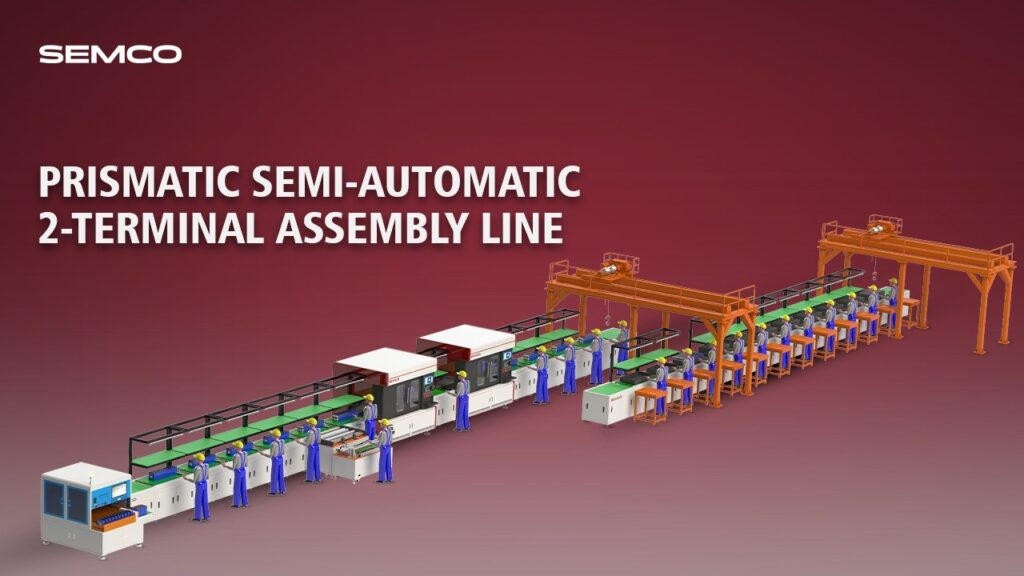
cAs the global transition toward electric mobility and energy storage accelerates, battery manufacturers are under constant pressure to improve precision, yield, and traceability while maintaining flexibility across cell formats. Addressing this critical need, Semco Infratech presents its Prismatic Semi-Automatic 2-Terminal Assembly Line, a high-performance solution engineered for liquid-cooled battery modules and compatible with air-cooled systems.
This advanced assembly platform combines automation with controlled manual operations, ensuring superior weld quality, production efficiency, and operational reliability.
Engineered for 280Ah & 314Ah Prismatic Modules
The line is designed for liquid-cooled 1P8S, 1P12S, and 1P13S configurations, supporting:

- Module dimensions up to 977 × 182 × 218 mm
- Cell specifications for 280Ah / 314Ah prismatic cells
- Square aluminum shell battery compatibility
- Modular tooling adaptability for alternate cell formats
With compatibility built into fixtures, jigs, and profiling tooling, manufacturers can confidently scale or modify production models with minimal downtime.
High-Performance Production Metrics
On the performance side, the line is rated at 8 pieces per minute, calculated by cell count for the reference 1P13S liquid‑cooled module, excluding manual loading and unloading time. First‑pass yield is specified at ≥98% based on welds, while overall final line yield reaches ≥99.5% including repairs but excluding defective raw materials and non‑equipment issues. Individual machines are designed for ≤2% failure rate and ≥98% uptime, and line changeovers between compatible models can be completed within 4 hours.

The assembly line delivers robust industrial performance:
- Capacity: 8 PPM (based on 1P13S configuration)
- First Pass Yield (FPY): ≥98%
- Final Line Yield: ≥99.5%
- Single Machine Uptime: ≥98%
- Failure Rate: ≤2%
- Model Changeover Time: ≤4 Hours
These metrics ensure consistent productivity and minimize rework losses, protecting profitability.
Intelligent Process Flow
The 2-Terminal Assembly Line follows a precision-controlled workflow:
Automatic Polarity Detection & Laser Cleaning
At the entry of the automatic section, the polarity detection and laser cleaning station ensures correct orientation and surface preparation of each cell or module terminal. The roller conveyor brings the module tray into the station, where sensors detect arrival and a blocking mechanism stops it before a lifting platform raises it to the working height. A 3‑axis gantry moves a coaxial camera and laser cleaning galvanometer over the terminals, with a distance sensor continuously calibrating focus.

The vision system performs automatic polarity detection and can mark the running direction of the module, with a specified detection rate of ≥99.99%. Simultaneously, a 200 W MOPA laser cleans the terminal surfaces to remove oxides and contaminants, creating a stable base for subsequent welding. If a module fails polarity checks or other criteria, it is diverted to an NG workbench with both audible and visual alarms for corrective action. The station integrates an industrial PC, high‑precision motion system, and robust frame enclosure sized at roughly 2400 × 1700 × 2250 mm.
Manual Busbar Placement
Following cleaning, the busbar placement station supports structured manual assembly guided by sensors and fixtures. The module tray is transported in by the conveyor, positioned by a stopper, and then accessed by the operator. Operators install a profiling fixture on top of the module and place busbars according to the configured series count and cooling design. After placement, a simple release button sends the tray to the next process, minimizing handling errors.

Precision Laser Welding
Modules arrive via the powered conveyor, are detected by sensors, and locked in place by a blocking mechanism before a lifting mechanism elevates the tray into the welding position. A 3‑axis motion system then positions an off‑axis camera and a high‑power galvanometer‑controlled welding head over each weld location.

The vision system captures the precise coordinates of terminals or busbar holes and feeds this to the control system to execute vision‑aligned welding paths. A 6000 W Raycus laser source and LaserZ galvanometer deliver high‑speed, high‑energy welding, while a custom pressure head assembly ensures intimate contact between busbar and terminals. The target module output yield is >99.5%, with each weld designed to withstand at least 1000 N pull force in mechanical testing, reflecting EV‑grade reliability.
Post-Weld Inspection
Once welding is complete, the module is transferred to a post‑welding inspection station where an operator visually checks weld quality and removes the profiling fixture. The workstation includes a simple start button to acknowledge inspection completion and release the module to subsequent handling or packing. This manual step closes the loop between automated welding and human quality assurance, enabling quick feedback for fixture or parameter adjustments if defects are observed.
Advanced Roller Conveyor Architecture
At the heart of the line is Semco’s Advanced Powered Roller Conveyor System, engineered in segmented modular design:
- Dual-level roller configuration (upper/lower)
- Lift-and-position mechanisms
- Positioning stoppers
- Manual, transfer, and equipment segments
- SOP display boards and integrated lighting
Line Dimensions: 18m (L) × 2.8m (W) × 2.15m (H)

The conveyor architecture ensures smooth module handling across:
- Cell Processing Section
- Pre / Mid / Post Welding Section
- Unloading Section
In addition to the main assembly line, Semco proposes key auxiliary systems:
- OCV Testing and Sorting Machine with HIOKI BT3561A, providing 5+1 grade sorting (5 OK, 1 NG) based on open‑circuit voltage, AC impedance, and DC internal resistance.

- This unit runs at ≥10 pieces per minute, with ≥99% product yield, ≥98% sorting pass rate, and 99.9% sorting accuracy, and occupies roughly 2600 × 1250 × 1800 mm.
- A pneumatic extrusion battery assembly station for shaping and strapping square aluminium shell battery packs, compatible with lengths from 180–1000 mm and heights from 120–260 mm.
- The extrusion station operates at 0.1–0.6 MPa air pressure, providing up to 1 ton clamping force at 0.6 MPa, with a pressure sensor range of 0–1 T and ±5 kg accuracy, and requires only one operator.

These auxiliary systems extend the line into a full module pre‑assembly and quality control ecosystem, from cell sorting and grading to mechanical compression and final terminal welding.
Data traceability and design flexibility
A major strength of Semco’s semi‑automatic prismatic 2‑terminal assembly line is its built‑in data and traceability framework. Critical parameters from key equipment and stations are uploaded to a central database, and the final module carries an integrated barcode linking to its entire process history. This one‑to‑one mapping between module ID and process data enables complete traceability for audits, warranty analysis, and continuous improvement.

Built for India’s Scaling BESS & EV Market
The EV and energy storage markets demand three things: Precision, Scalability and TraceabilityThis line delivers all three. From vision-guided welding to barcode-integrated data traceability , every module can be tracked one-to-one in the database. That means: Faster recalls (if ever required), Clear quality documentation and Compliance with global manufacturing standards. In an industry where one faulty weld can lead to catastrophic failure, this level of control is invaluable.

Conclusion
Semco Infratech’s semi‑automatic prismatic 2‑terminal assembly line with advanced powered roller conveyors offers a tightly integrated solution for high‑volume, high‑reliability module manufacturing, combining precise laser welding, structured manual operations, and robust module tooling to support 280/314 Ah prismatic cells.