

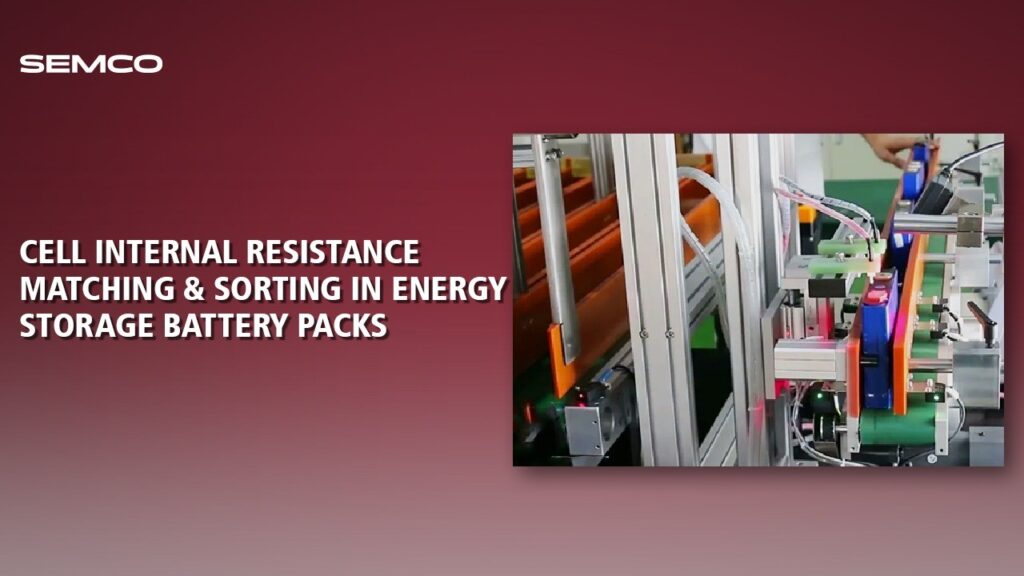
The largest applications of lithium batteries are currently in two main areas: automotive power battery packs and energy storage battery packs. In the design, development, component selection, and manufacturing processes of battery packs, the internal resistance matching and sorting of cells or modules are crucial for ensuring pack consistency, safety, and cycle life. This has a significant impact on the safety, lifespan, and durability of the battery system.

Battery packs typically consist of multiple cells connected in series and parallel, especially in high-capacity and high-voltage battery systems. If the internal resistance of the core components ( cells ) is inconsistent, the current and internal distribution during charging and discharging will be uneven, leading to overheating and accelerated aging of some cells, ultimately causing a decline in the performance of the entire battery pack or even thermal runaway. Therefore, the purpose of sorting is to select cells with highly consistent internal resistance and other parameters for pairing.
While in principle, higher internal resistance consistency is better when assembling battery cells or modules into a pack, absolute consistency is unattainable considering practical factors such as manufacturing process feasibility and cost. A certain range is acceptable and has minimal impact on battery safety, lifespan, and performance. This is a common matching principle in the industry.

The core of internal resistance sorting
The core of optimizing the PACK -level internal resistance matching process is to improve sorting efficiency, reduce manufacturing costs, minimize process anomalies and after-sales risks, and support flexible production, all while ensuring battery pack performance, safety, and lifespan. This achieves the following results:
- Reduce internal imbalance of modules / battery packs.
- Reduce the load on the balancer and improve BMS efficiency.
- Control temperature rise differences to prevent hotspots from forming.
- Extend cycle life ( PACK lifetime ≥ 90% of individual cell lifetime).
Recommendations for internal resistance sorting
The cell model, chemical system, capacity, rate capability, whether it’s stacked or wound, and application field all determine that different cells have different internal resistance standards. Even the internal resistance of the same cell model can vary between different manufacturers, making it difficult to reach a unified standard for internal resistance values. Currently, there is no industry standard for any specific parameter of a battery. However, we can still provide relatively useful suggestions based on experience. The following is a summary based on 280Ah prismatic lithium iron phosphate cells used in energy storage (requires a high-precision internal resistance tester).

Internal resistance sorting strategy
The process of testing and selecting the AC internal resistance of battery cells is relatively simple. It can be completed with skilled operators, stable and reliable high-precision testing instruments, and work instructions as specified in the process. However, some strategies and principles still need to be considered in actual execution.
Multi-parameter joint sorting
Same batch: Ensure that the battery cells being tested are from the same production batch and have the same process parameters (e.g., the production date, batch number, etc.).
Same capacity or same model: Same model, same standard. Avoid blindly copying or misattributing capacity differences. It is recommended that the tolerance be ≤ ±1% of the nominal capacity.

New cells with the same SOC : The internal resistance will vary depending on the SOC. The internal resistance of cells that have been in stock for a long time is often not exactly the same as that of newly produced cells. It is recommended that the open circuit voltage difference be ≤5mV.
MES system intelligent grouping
If possible, the cell data provided by the cell manufacturer can be imported into the MES system of the PACK production line. Combined with the pre-launch test results, the algorithm can automatically recommend the optimal cell combination. Ideally, multiple parameters should be grouped and sorted simultaneously, with resistance, voltage, and tolerance all meeting the Maonan standard.
Dynamic curve matching (EIS charge/discharge curve method)
Currently, the industry commonly uses static parameters for sorting and matching. However, the ideal method should be to use the dynamic curves of the battery for sorting. For example, electrochemical impedance spectroscopy ( EIS ) or charge-discharge curves can be used for similarity sorting, selecting cells with high curve overlap. Experience shows that this can improve the cycle life of the battery system by 10% to 15%.

Strictly prohibited from joining the group
- The internal resistance exceeds the upper limit of the specification.
- The internal resistance is abnormally high ( more than 5% higher than the average value).
- Abnormal voltage levels (too high or too low).
- Rapid self-discharge (voltage drops rapidly after being left undisturbed for several days).
- Defects such as bulging, electrode oxidation, leakage, and deformation.
- Mixed packaging of different batches and different capacity ranges.
At Semco Infratech, we offer state-of-the-art battery cell sorting machines designed for precision, speed, and scalability. Our machines ensure accurate measurement of key parameters like voltage, capacity, and resistance, allowing manufacturers to build reliable battery packs with optimal performance. Features include:
- High-speed automatic sorting with multi-channel testing.
- Advanced algorithms for precise classification.
- Customizable sorting bins to match manufacturing requirements.
- User-friendly interface for seamless operation and monitoring.
As battery technology advances, ensuring high-quality manufacturing processes is critical. With Semco Infratech’s cell-sorting solutions, manufacturers can enhance efficiency, safety, and performance in lithium-ion battery production.
Conclusion
PACK -level internal resistance matching is not about ” the smaller the better, ” but rather about ” sufficient consistency. ” This consistency extends beyond just internal resistance; it also includes consistency in state, manufacturer, and equipment. In the future, with the upgrading of intelligent manufacturing, AI – based dynamic matching technology is under development. Once mature, it will replace manually set thresholds, becoming a new paradigm for high- consistency PACK manufacturing.
Contact Semco Infratech to discuss your BESS manufacturing requirements and discover how automatic assembly solutions can enhance your production efficiency, ensure product quality, and accelerate your path to market competitiveness.