

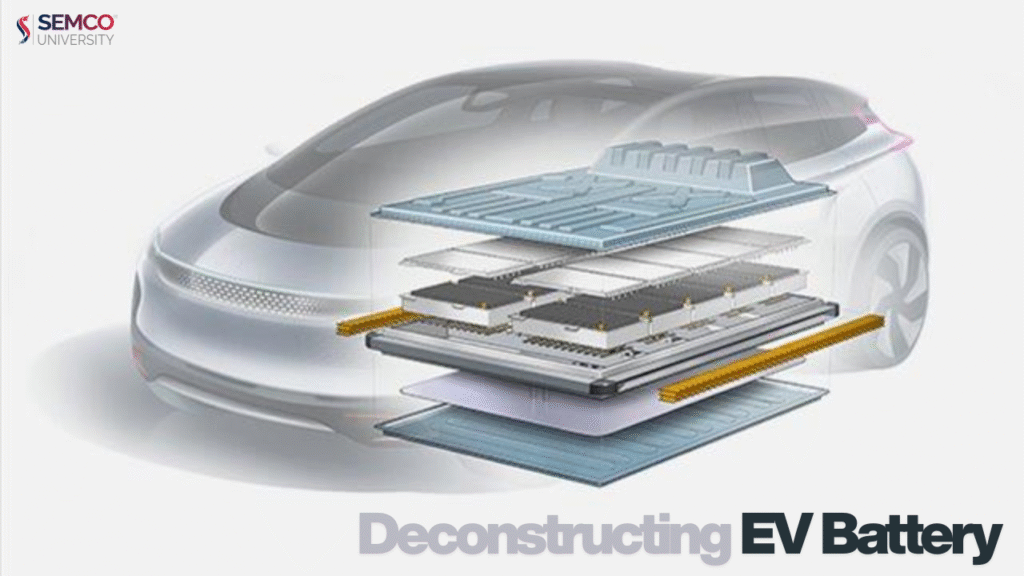
The rapid ascent of new energy vehicles in recent years, significantly propelled by a global commitment to pure electric mobility, has directly catalyzed a phenomenal boom in the EV battery industry. It’s truly remarkable to consider that a world-leading powerhouse in this sector, now with a market capitalization exceeding a trillion units of currency, was established as recently as 2011. This meteoric rise underscores the intense innovation and demand driving this industry. To truly appreciate the complexity and engineering marvel behind these crucial components, it’s essential to understand how power batteries are meticulously constructed, step by step, from their fundamental building blocks.
Unpacking the Terminology: Cells, Modules, and Packs
Before delving into the intricate assembly process, it’s vital to clarify some commonly used, yet often conflated, terms: “battery cell,” “module,” and “battery pack.” While the general term “battery” is ubiquitous, its specific meaning can vary depending on context. For instance, when referring to a small device like a toy car battery or a standard household battery, one is typically referring to a “battery cell.” However, when discussing a laptop battery, the reference is almost always to a “battery pack.” The key to distinguishing these lies in their hierarchical structure and the presence of sophisticated management systems.
The journey of a power battery is one of careful aggregation, progressing from the smallest individual units to a comprehensive, intelligent system ready to power an electric vehicle. This process can be visualized as a clear progression: Battery Cell → Module → Battery Pack.

From Tiny Cells to Mighty Packs: The Composition Journey
Driving a vehicle weighing over a ton is fundamentally different from powering a smartphone. The sheer power difference is measured in tens of thousands of times. While an electric car battery indeed utilizes thousands of individual cells, not dissimilar in principle to those found in mobile phones, their integration is far more complex. Although the exact battery composition may vary slightly across different vehicle models, the overarching principle remains consistent: cells are grouped into modules, and modules are then assembled into battery packs.
The crucial aspect here is not merely the physical assembly but the strategic organization required for safe and effective management of hundreds, if not thousands, of cells within a power battery pack. These cells are not randomly distributed but meticulously arranged in a structured manner according to modules and packs.
Let’s break down each component:
- Battery Cell: This is the absolute smallest unit of the power battery and serves as the fundamental energy storage unit. Its primary requirement is a high energy density, enabling it to store the maximum possible amount of energy. This directly translates to the electric vehicle’s driving range – the higher the energy density of the cells, the longer the vehicle can travel on a single charge. Furthermore, the longevity and integrity of each individual battery cell are paramount. Any damage or degradation to a single cell can compromise the performance and even lead to the failure of the entire battery pack. Battery cells come in various forms, including cylindrical (like those famously used in some high-performance EVs), prismatic (box-shaped for efficient stacking), and pouch cells (flexible and lightweight).
- Module: When multiple battery cells are carefully packaged together within a common outer shell or frame and connected to the external environment through a unified interface, they form a module. This modularization serves several critical purposes. Firstly, it provides structural integrity and protection to the individual cells from external impacts, vibrations, and temperature fluctuations. Secondly, it simplifies the assembly process of the larger battery pack. Thirdly, it often incorporates basic monitoring and balancing circuitry to ensure the cells within that specific module operate optimally and consistently. A group of cells, typically arranged in series or parallel to achieve a desired voltage or capacity, collectively functions as a module.

- Pack: The pinnacle of the power battery assembly is the (battery) pack. This is formed when several modules are integrated into a unified whole, which is then comprehensively controlled and managed by sophisticated systems. These critical systems include the Battery Management System (BMS) and the Thermal Management System. The BMS acts as the “brain” of the entire battery, constantly monitoring vital parameters of individual cells and modules (such as voltage, current, temperature, and state of charge). It ensures safe operation, prevents overcharging or over-discharging, balances cell voltages, and communicates critical data to the vehicle’s control unit. The Thermal Management System is responsible for maintaining the battery pack within its optimal operating temperature range, crucial for both performance and longevity, often utilizing liquid cooling or air cooling mechanisms. The enclosure of the pack also provides robust protection against environmental elements and mechanical stress.
To illustrate this hierarchy, consider the example of a popular electric vehicle model, like the BMW i3. Its power battery system is composed of 96 individual battery cells. These cells are intelligently grouped, with every 12 cells forming a single module, resulting in a total of 8 modules that collectively constitute the vehicle’s entire battery pack.
The Significance of Structure and Management
The distinction between cells, modules, and battery packs extends beyond mere counting; it lies fundamentally in the increasing layers of management and protection. While a battery cell is simply an energy storage unit, a module adds physical protection and some basic electrical connections. The battery pack, however, represents a complete, intelligent, and highly controlled energy storage system, integrated with advanced electronics and thermal regulation to ensure optimal performance, safety, and longevity in the demanding environment of an electric vehicle.
This layered architecture is key to the reliability and efficiency of modern electric vehicles. It allows for detailed monitoring of individual cell health, enables targeted thermal management, and facilitates easier servicing or replacement of specific modules rather than the entire pack. As the power battery industry continues its rapid evolution, driven by the relentless pursuit of higher energy density, faster charging, and enhanced safety, this foundational understanding of cell, module, and pack composition remains central to appreciating the technological marvel that propels the electric vehicle revolution.