

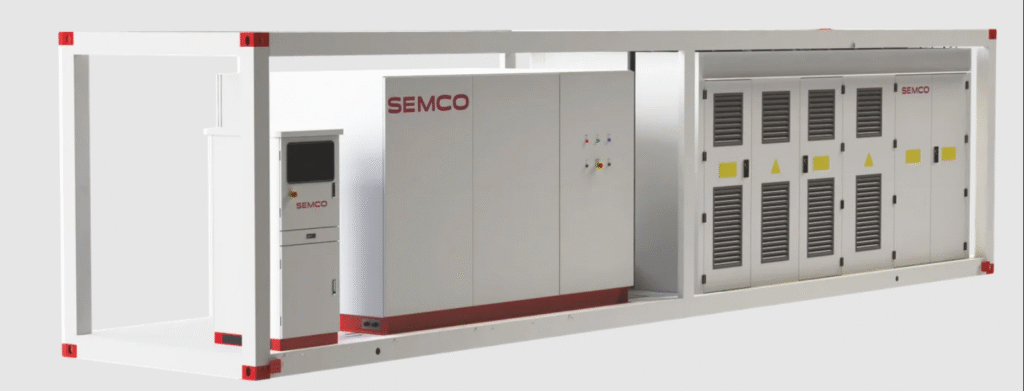
The renewable energy revolution is accelerating at an unprecedented pace, and at the heart of this transformation lies the BESS Container Assembly Line—a sophisticated manufacturing solution that’s reshaping how we produce and deploy battery energy storage systems. As global energy storage installations surged by 53% in 2024, reaching 205 GWh globally, the demand for efficient, scalable assembly solutions has never been more critical.
Understanding BESS Container Assembly Line Technology
A BESS Container Assembly Line is not just another manufacturing setup—it’s a comprehensive, automated production system specifically engineered to integrate battery modules, power conversion systems, thermal management, and safety features into standardized shipping containers. This innovative approach transforms energy storage from a complex, custom project into a plug-and-play solution that can be deployed anywhere in the world.
The energy storage container production line represents the convergence of automotive-grade manufacturing precision with utility-scale energy requirements. Modern facilities can achieve production capacities of 15-20 units per minute, with output stabilization exceeding 18 pieces per minute in optimized environments. This level of efficiency wasn’t possible just five years ago.
Key Components of Modern BESS Manufacturing
At Semco Infratech, our BESS manufacturing automation system integrates multiple critical production stages into a seamless workflow. The process begins with battery cell sorting and testing, moves through module assembly and welding, and culminates in complete container integration with all electrical, thermal, and safety systems installed and tested.
The battery storage container assembly equipment utilized in modern production lines includes laser welding systems capable of handling prismatic and cylindrical cells, automated busbar installation robots, thermal interface material application systems, and advanced testing stations that validate every electrical connection under real-world load conditions.
The Automation Advantage
Traditional lithium battery container assembly required extensive manual labor, with workers spending hours on wiring, testing, and quality verification. Today’s automated lines reduce human intervention by up to 70%, while simultaneously improving quality consistency and throughput. The BESS container manufacturing automation we implement features vision-guided robotics, AI-powered defect detection, and real-time process monitoring that identifies potential issues before they become costly failures.
Production facilities incorporating full automation report qualified rates exceeding 99% for pilot production lines, compared to 88% utilization rates for multi-vendor manual assembly approaches. This improvement translates directly to reduced warranty claims, lower lifecycle costs, and enhanced customer satisfaction.
Container Integration: Where Assembly Meets Engineering
The final stage of any BESS Container Assembly Line involves comprehensive system integration within ISO-standard or custom-designed containers. This process, often called containerization, requires precise coordination of multiple subsystems including battery racks, power conversion systems, HVAC or liquid cooling systems, fire suppression equipment, and sophisticated monitoring interfaces.
Modern ESS container assembly automation goes beyond simple component placement. It includes automated cable routing systems that optimize space utilization while maintaining serviceability, thermal modeling software that validates cooling system performance before final assembly, and electrical safety testing that simulates years of operational stress in hours of accelerated testing.
Quality Control and Testing Protocols
Every unit produced on a BESS Container Assembly Line undergoes rigorous quality validation. End-of-line testing includes insulation resistance verification at operating voltages up to 1650V, full charge-discharge cycling under controlled thermal conditions, communications protocol verification for BMS and EMS integration, and safety system validation including fire detection and suppression activation testing.
The comprehensive testing approach we employ at Semco Infratech ensures that every battery energy storage system container assembly leaving our facility meets or exceeds international standards including IEC 62619, UL 9540, and relevant local safety certifications.
Market Dynamics and Future Outlook
The containerized BESS market was valued at USD 9.33 billion in 2024 and is projected to reach USD 35.82 billion by 2030, representing a compound annual growth rate of 20.9%. This explosive growth is driven by accelerating renewable energy deployment, grid modernization initiatives, and the declining cost of lithium-ion batteries, which have fallen from $270/kWh in 2022 to approximately $115/kWh in 2024.
As energy storage container production scales globally, we’re seeing regional manufacturing hubs emerge in key markets. China maintains dominance in cell production and system integration, while North America and Europe are rapidly building domestic assembly capacity to reduce supply chain dependencies and qualify for local content incentives under programs like the U.S. Inflation Reduction Act.
Choosing the Right Assembly Line Partner
When evaluating BESS container manufacturing partners, consider their track record with full system integration, not just component assembly. Look for providers who offer end-to-end solutions including factory modeling and simulation, custom automation development, MES (Manufacturing Execution System) integration, and ongoing technical support.
At Semco Infratech, we’ve invested heavily in developing proprietary assembly technologies that address the unique challenges of BESS production. Our modular line designs allow for rapid scaling as demand grows, while our standardized interfaces ensure compatibility with battery cells from multiple tier-one suppliers.
Conclusion: Building the Foundation for Clean Energy
The BESS Container Assembly Line is more than manufacturing equipment—it’s essential infrastructure for the global energy transition. As renewable penetration increases and grid stability becomes increasingly critical, the ability to rapidly produce, test, and deploy high-quality energy storage systems will determine which markets successfully transition to clean energy.
With proper automation, quality control, and system integration expertise, modern assembly lines can produce BESS containers that deliver 20+ years of reliable service, supporting everything from utility-scale renewable firming to behind-the-meter commercial applications. The technology exists today; the challenge is scaling production to meet unprecedented global demand.
Ready to establish or upgrade your BESS Container Assembly Line? Contact Semco Infratech at www.semcoinfratech.com to discuss custom manufacturing solutions tailored to your production requirements and market positioning.