

As the consensus becomes that battery cells should be ” large”, the new battleground is the ” power” of battery packs!
The energy storage industry is ushering in an era of leaps in cell capacity, with the transition from 280Ah to 500Ah+ already a reality . While the industry focuses on the ” size” of the cells, the ” strength” of the pack— namely, i ts mechanical structural load-bearing and safety mitigation capabilities— is becoming a new competitive focus. Regardless of how the cell’ s chemical system and capacity evolve, i ts expansion force, thermal runaway energy, and mechanical loads must ultimately be borne by the mechanical foundation of the pack’ s casing.
This article will explore, from a structural design perspective , how the battery pack enclosure can address the differentiated mechanical and thermal management requirements in the context of the divergence of battery cell technology routes, and how to build sustainable and adaptable engineering capabilities.
Mechanical analysis of the three major technical paths: the triangular problems of Load, Heat and Space
The increase in cell capacity directly alters the boundary conditions of pack system design. The lower enclosure, as the system’ s ” skeleton” and ” skin,” needs to re-answer three fundamental questions:
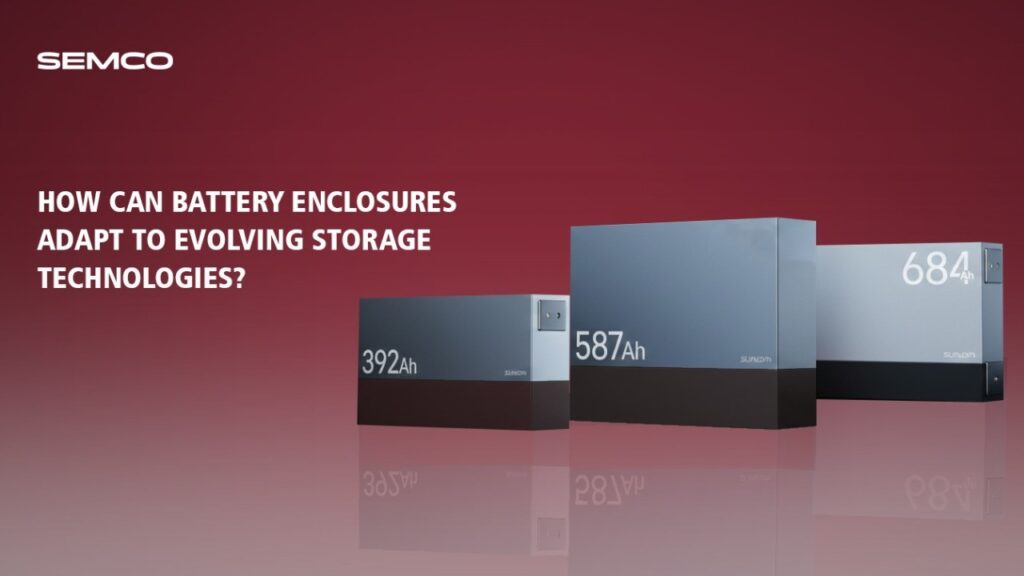
Mechanical analysis of 587Ah (high integration path)
The core objective is to achieve an energy density of ≥ 6 MWh within a standard 20 -foot container, which has led to an extremely compact layout with 4 rows and 8 clusters.
Lower enclosure challenge:
Structural load-bearing optimization: With the overall mass increasing and the number of support points decreasing, the load transmission path of the box needs to be optimized, taking into account both the overall stiffness and the local strength of key areas, in order to ensure structural stability during transportation and operation.
Thermal management structure integration: The liquid cooling system is deeply integrated with the base plate and supporting structure of the enclosure, serving as both the core of thermal management and contributing to the overall load-bearing capacity. The design must ensure the long-term reliability of the cooling seal under long-term structural loads and thermal cycling.
Precise spatial coordination: The enclosure must reserve reasonable gaps within a limited space for cell expansion, thermal displacement of electrical connections, and fire protection pipelines, so as to achieve reliable coexistence of each subsystem in a compact layout.

Thermodynamic and structural correspondence analysis of 684Ah (ultra- large capacity path)
The core objective is to reduce the cost per Wh by maximizing the capacity of a single cell, but this brings about a centralization effect at the physical level.
Lower enclosure challenge:
The “focal point” effect of expansion force: The expansion force of a single cell is not l inearly related to its capacity, but rather grows almost exponentially. The internal frame of the enclosure needs to be designed with a stronger and more uniform “constraint system” to distribute the concentrated expansion stress throughout the enclosure and avoid localized plastic deformation.
The “uniformity” dilemma in thermal management: Larger heat-generating elements require more efficient heat conduction paths. The material and thickness of the bottom plate of the lower casing, as well as the design of the contact interface with the bottom of the battery cell (such as the compression ratio setting of the thermal pad), become crucial. In the event of thermal runaway, the greater energy release places higher demands on the directional f low capability of the pressure relief channel and the flame- retardant performance of the internal fireproof partition.
Structural response due to weight concentration: The heavier single cell changes the overall vibration mode of the pack, and the lower enclosure needs to be re-fatigue simulated to prevent the connection from loosening or the structure from cracking due to resonance at a specific frequency.

Manufacturing Adaptation Notes for 392Ah (Robust Transition Path)
Core objective: To achieve a balance between performance, cost, and delivery efficiency, and to provide the market with well-proven solutions.
Lower enclosure challenge:
Stable implementation of mature solutions: Based on proven design and process systems, strict process control ensures product consistency and supports a rapid and stable mass production pace.
Deep supply chain collaboration: Relying on a mature supply system, we continuously improve the overall cost competitiveness of our products through material selection, process optimization, and large-scale procurement.

Engineering thinking to deal with differentiation
Faced with multiple technological approaches, lower enclosure suppliers cannot rebuild the technological system for each path. The real solution lies in precise platform-based response— efficiently adapting to different needs through scalable modular design.
Focusing on common physical principles and collaborative models
Battery cell iteration follows stable physical laws. We have established a collaborative evaluation process based on core parameters, combining material and structural data to quickly assess the feasibility of new battery cells, identify matching risks early, help converge design directions, and reduce later iterations.
Build a flexible system of “standard interfaces + configurable modules”
To address the customization needs arising from the divergence in technology approaches, we have established a clear design system that standardizes interfaces and allows for the configuration of internal modules:
- Unified external interfaces: The installation and positioning of the enclosure and energy storage container, electrical penetration interfaces, cooling system docking points, etc., all strictly follow common industry specifications to ensure system-level compatibility and assembly consistency.
- Configurable internal structure: We offer a series of internal support components and thermal management integration solutions that can be flexibly combined according to cell size and layout.
- Thermal Management Integration Module: The thermal management module adopts a modular design, with optimized temperature rise control and cell temperature uniformity as the core, and can flexibly adapt to the thermal management needs of different technical routes.

Implement flexible production lines based on the manufacturing as design model.
To accommodate the diversity of technological approaches, our manufacturing system is organized around a scalable foundational platform and modular assembly:
- Basic enclosure platform manufacturing: ensuring the precision and consistency of the main structure and providing a reliable carrier for different configurations.
- Modular assembly units: These units allow for flexible selection of appropriate internal support and thermal management modules based on cell size and layout. This layout enables efficient production switching between products using different technologies on the same production l ine, helping customers address supply chain and delivery challenges arising from parallel development of multiple technologies.
Redefinition of the value of the lower box: from passive carrying to active empowerment
The lower enclosure is transitioning from a passive container to a critical power-enabling component of the system, directly impacting safety, energy density, and total lifecycle cost.
Safe load- bearing structure: By providing a reliable structural channel and installation foundation for system-level pressure relief and fireproof isolation, it together with heat spread control to build a multi-level safety protection.
Energy density support: Lightweight and high-strength design reduces its own weight and space occupation, leaving more performance margin for the battery cell and cooling system.
Long- term reliability assurance: Structural integrity and fatigue durability design support the system to cope with continuous challenges such as long- term cycling and transportation vibration.

Conclusion: Build a bridge between the upstream of differentiation and the determined downstream
As battery cell technology evolves, energy storage systems continue to pursue safety, high density, and low cost. The underlying enclosure needs to provide a reliable and adaptable supporting foundation, employing modular and flexible manufacturing to address different technological approaches. Industry competition is shifting towards system-level engineering, and the battery pack enclosure is a crucial component within this framework.