

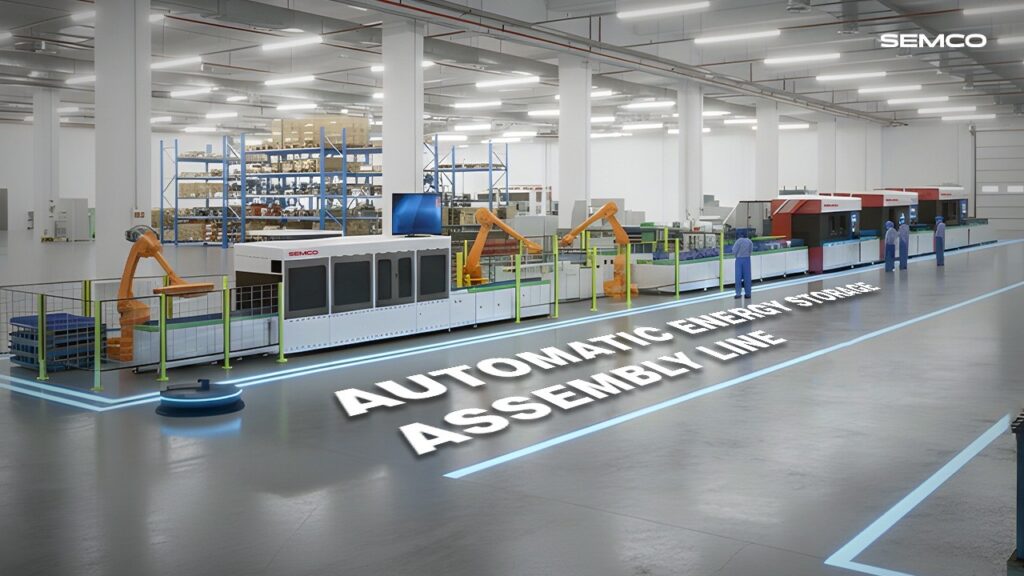
As the world accelerates toward renewable energy and grid-scale storage, the demand for precision-engineered battery systems has never been higher. To meet this need, Semco Infratech has developed a fully automated Energy Storage Assembly Line—a streamlined, high-efficiency manufacturing ecosystem that transforms individual lithium-ion cells into fully validated Battery Energy Storage System (BESS) containers.
This article explores the complete workflow, core technologies, and the advanced testing infrastructure that define Semco’s integrated cell-to-container solution.

The Complete Assembly Ecosystem
Modern automatic BESS assembly lines represent a paradigm shift in how battery energy storage systems are manufactured. Rather than treating assembly as isolated, disconnected processes, contemporary automation solutions integrate 21 sequential operations from initial cell loading through final pack validation, creating what industry experts term a “cell-to-container solution.” This comprehensive approach eliminates bottlenecks, ensures traceability, and establishes consistent quality standards throughout the production workflow.

Stage 1: Cell Reception and Grading
The journey begins with automatic cell loading, a critical operation that establishes the foundation for all subsequent processes. Incoming lithium-ion cells enter the assembly line through automated feeding systems that handle multiple cell form factors, including prismatic, cylindrical, and pouch cells.
Stage 2: Cell Testing and Sorting
Following initial loading, cells undergo comprehensive testing through scanning and Open Circuit Voltage (OCV) analysis. This critical phase involves measuring voltage, capacity, and internal resistance for each individual cell, with measurements typically collected through high-throughput testing systems designed for accuracy in high-volume production environments.
Stage 3: Surface Preparation and Cleaning
Before assembly, cells require rigorous surface preparation using two complementary cleaning technologies. Plasma cleaning removes particulates and contaminants from cell surfaces, while laser cleaning provides precision surface treatment in targeted areas. These operations are fundamental to preventing impurities that could compromise electrical performance or safety during operation.

Stage 4: Module Assembly and Interconnection
The transition from individual cells to organized modules involves several integrated steps. Automatic module stacking arranges graded cells into precise configurations, followed by the installation of extrusion steel belts that provide mechanical support and structural integrity. This is complemented by polarity detection and addressing systems that verify correct positive and negative terminal orientation, preventing potentially hazardous assembly errors.
Laser welding then creates durable electrical connections between cells, establishing series and parallel configurations that achieve target module voltage and capacity specifications. Contemporary laser welding systems feature integrated quality verification, ensuring consistent weld penetration and electrical conductivity. Thermal imaging and optical inspection systems validate every weld before progression to subsequent stages.

Stage 5: Module Integration and System Assembly
Once modules are assembled and tested, they progress to automatic module loading in enclosures, where protective casings shield modules from physical damage and environmental exposure. The system integrates automatic gluing and liquid cooling plate installation, establishing thermal management pathways essential for maintaining safe operating temperatures during charge-discharge cycles.CATALOUGE-CMYK2-1.pdf
CCS (Common Cooling System) busbar installation follows, connecting series-parallel module combinations while maintaining structural integrity. This is succeeded by end-of-line module testing, which validates that each module meets voltage, capacity, and impedance specifications before pack-level integration.
Stage 6: Battery Pack Assembly
The module-to-pack transformation involves module transfer systems that autonomously transport completed modules from testing stations to pack assembly areas. Here, modules are configured in series and parallel combinations to achieve final pack specifications, addressing specific customer voltage and capacity requirements for varying grid applications, industrial backup systems, and renewable energy integration scenarios.
Harness installation establishes electrical connections between modules, while BMS installation integrates the Battery Management System—the intelligent control backbone that monitors cell voltages, manages charging cycles, regulates temperature, and ensures safety throughout the pack’s operational life. The BMS continuously collects data that enables advanced diagnostics, predictive maintenance algorithms, and performance optimization.

Stage 7: Comprehensive Pack Validation
End-of-line pack testing subjects each assembled pack to rigorous validation protocols. These tests verify charging uniformity across all cells, measure voltage and impedance, confirm insulation integrity, and validate BMS functionality under simulated operating conditions. High-voltage testing ensures the pack can safely manage the electrical loads encountered during grid-scale deployments.
Leak testing confirms the integrity of sealed enclosures, preventing electrolyte leakage that could compromise performance or create safety hazards. Top cover installation follows, establishing the final protective barrier before module fixation, which secures all internal components against mechanical stress during transportation and installation.
Stage 8: Containerization and Final Deployment Preparation
The culmination involves pack offline utilities, where completed packs integrate into containerized BESS systems. BESS container testing represents final validation, conducting full-scale charge-discharge cycles, thermal stress testing, and safety verification under simulated grid conditions. This comprehensive containerized system validation ensures readiness for immediate deployment into stationary energy storage applications.

India’s Lithium Battery Manufacturing Backbone
Semco’s market position underscores its importance to India’s battery ecosystem. With 30+ years of engineering and manufacturing expertise, a team of 100+ skilled professionals, and partnerships with 500+ customers, the company powers over 20 GWh of annual production—positioning it as India’s largest provider of lithium battery assembly and testing solutions and the only company in India offering complete cell-to-container equipment capabilities.
This vertical integration—from automated assembly lines through high-voltage testing systems to containerized deployment solutions—eliminates critical gaps in India’s battery value chain while enabling localization opportunities under government incentive schemes like the Production Linked Incentive (PLI) and Viability Gap Funding (VGF).

Know More About Semco Infratech’s BESS Assembly Solutions
Explore how Semco Infratech’s automatic BESS assembly lines can transform your battery manufacturing operations. The company offers comprehensive solutions tailored to your production scale—from startup R&D operations to full commercial manufacturing volumes. Semco’s integrated approach combines state-of-the-art equipment, intelligent process management, and expert technical support to establish efficient, scalable battery production capabilities.
Looking to deploy reliable BESS systems?
Semco Infratech provides: Cell to BESS Container Solutions | Factory Setup & Turnkey Integration Support | On-Site Training & After-Sales Service