

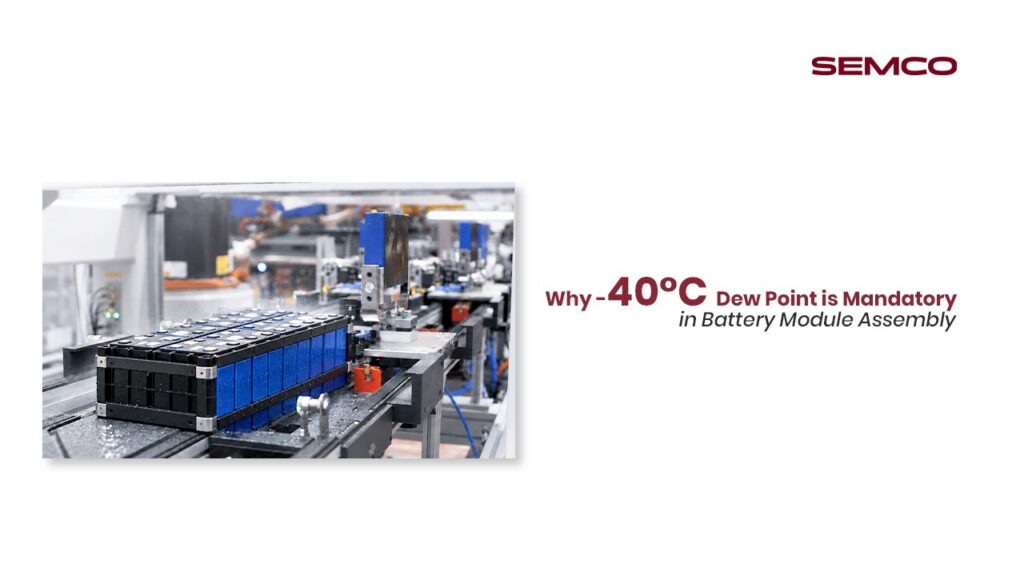
When designing a high-yield battery pack assembly line for Grid-Scale Energy Storage Systems (ESS), manufacturers naturally focus on laser welding quality, automation accuracy, cycle time and robotics speed.
But there is another critical production variable that deserves equal attention:
Moisture.
During cell-to-module and module-to-pack assembly, battery cells pass through processes such as terminal cleaning, busbar positioning, laser welding, electrical testing and final integration. Maintaining a controlled manufacturing environment during these stages helps protect product quality, insulation performance and long-term reliability.

At Semco Infratech, we believe a modern battery assembly line should control not only how precisely a battery is assembled, but also the environment in which that assembly takes place.
The Chemistry Behind Moisture Control
Lithium-ion battery electrolytes containing LiPF₆ (lithium hexafluorophosphate) are moisture-sensitive.
In the presence of water, LiPF₆ can undergo reactions that lead to the formation of undesirable compounds, including hydrofluoric acid (HF).
Moisture (H₂O) + LiPF₆ → HF-containing reaction products
This is one reason moisture management is an important consideration throughout lithium-ion battery manufacturing.
Excessive moisture can contribute to several manufacturing and reliability concerns:

1. Corrosion Risk: Moisture-related electrolyte decomposition products can contribute to corrosion of sensitive metallic surfaces and interfaces.
2. Electrical Insulation Concerns: Moisture and contamination can adversely affect insulation resistance, increasing the importance of environmental control, cleanliness and proper electrical testing.
3. Long-Term Reliability: Uncontrolled moisture can contribute to undesirable side reactions within lithium-ion battery systems, potentially affecting ageing behaviour and long-term performance.
For Grid-Scale ESS, where battery systems are expected to operate reliably for years and through thousands of cycles, controlling these variables during manufacturing becomes especially important.
Why Dew Point Matters More Than Relative Humidity
One common mistake in battery manufacturing is looking only at Relative Humidity (RH).
Relative humidity changes with temperature. For battery manufacturing environments, dew point provides a more useful indication of the actual moisture content in the air.
That is why dry-room specifications are commonly expressed in terms of dew point.
Why Target Around -40°C Dew Point?
A -40°C dew point represents an extremely dry manufacturing environment and is widely used as an engineering benchmark for moisture-sensitive battery production processes.
Rather than treating -40°C as simply another HVAC specification, manufacturers should view it as part of the overall process-control strategy.
The lower the dew point, the lower the amount of water vapour available to interact with moisture-sensitive materials and processes.

For battery assembly lines, this becomes particularly important around:
- Cell handling and preparation
- Terminal and surface preparation
- Laser cleaning
- Busbar positioning
- Laser welding
- Module assembly
- Electrical and insulation testing
- Pack integration
The objective is simple:
Control the environment before environmental contamination becomes a product-quality problem.
Low-Dew-Point Manufacturing Environment
Controlled dry-room conditions can reduce exposure to atmospheric moisture during moisture-sensitive production stages.
Depending on the cell chemistry, process requirements and customer specification, battery manufacturing areas can be engineered around demanding dew-point targets, including approximately -40°C or lower where required.
The Tier-1 Standard: -40°C Dew Point & ISO Class 8
To guarantee a 10-year lifespan for ESS deployments, Tier-1 Gigafactories do not assemble batteries in standard warehouse conditions. Huiyao Laser engineers our turnkey assembly lines to integrate seamlessly with medical-grade environmental controls.
• Ultra-Low Dew Point (-40°C): We configure our automated enclosures and transfer tunnels to maintain a strict -40°C dew point (equivalent to less than 1% Relative Humidity at room temperature). This entirely eliminates the risk of electrolyte degradation during the cell-to-module (CTM) phase.
• ISO Class 8 Cleanroom Compatibility: Dust particles are just as dangerous as moisture. A single metallic dust particle from an unshielded conveyor belt can cause a micro-short circuit. Our equipment utilizes fully enclosed Cartesian robots, negative-pressure dust extraction at the laser welding stations, and cleanroom- grade pneumatics to strictly meet ISO Class 8 particulate standards.

Building Quality Into the Production Line
For a Grid-Scale ESS manufacturer, environmental control should not be treated as an afterthought added once the machines are installed.
It should be considered during the initial production-line design. The interaction between dry-room conditions, material flow, automation, laser processes, testing equipment and operator access needs to be engineered as a complete system.
This is particularly important as manufacturers move from pilot production to high-volume battery manufacturing. A process that works for a few modules per day may not remain stable when production increases to thousands of cells and hundreds of modules.
The Semco Infratech Approach
At Semco Infratech, our approach goes beyond supplying individual machines. We work toward integrated battery manufacturing solutions covering critical stages of the production journey, including:
For ESS manufacturers, this means designing production systems where equipment performance, process control, environmental requirements and quality assurance work together.

Contact Semco Infratech to discuss your EV & BESS manufacturing requirements and discover how automatic assembly solutions can enhance your production efficiency, ensure product quality, and accelerate your path to market competitiveness.