

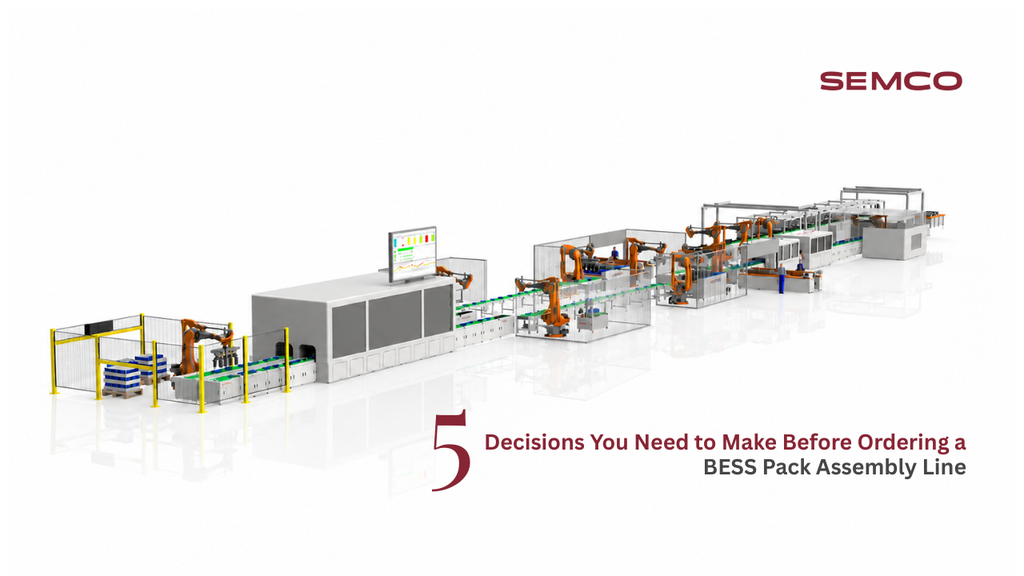
Ordering a Battery Energy Storage System (BESS) pack assembly line is not simply a machinery purchase. It is a long-term manufacturing decision that determines which products a plant can build, how consistently it can build them, how easily production can scale, and how much evidence the manufacturer can provide when a quality or warranty issue appears.
Before requesting a quotation, buyers should therefore define five decisions clearly. The answers become the foundation of the user requirement specification, line layout, acceptance criteria, implementation schedule, and commercial comparison.

If you are planning to order a BESS pack assembly line in the next 12 months, the five decisions below will determine whether your line starts on time, hits its capacity target, and can adapt when your cell format changes. Most suppliers will not raise these questions proactively. They wait for you to ask — and if you don’t ask before signing, the answers become change orders.
This article is based on the specification reviews and line design consultations our engineering team has run with European customers over the past two years.
Decision 1: Fixed Format or Mixed-Flow?
This is the most consequential decision and the one most buyers defer for too long.
A fixed-format line is optimized for one cell size and one PACK configuration. It runs faster, costs less, and is easier to commission. If you are building a dedicated factory for a single product — a 280Ah 1P16S BESS PACK — a fixed-format line is the right answer.
A mixed-flow line handles multiple cell formats and PACK configurations on the same line without a full retooling stop. It uses servo-adjustable fixtures, vision-guided positioning, and AGV-based logistics that can reroute based on product type. The tradeoff: higher upfront investment, more complex commissioning, and a longer lead time — typically 4–6 weeks more than a fixed-format line.

Product definition must also include the roadmap, not only the first pack scheduled for launch. If multiple cell suppliers, capacities, or pack variants are planned, the request for quotation should identify what must be changed through recipes, what needs replaceable tooling, and what would require a machine modification. This is where “flexibility” must become measurable: maximum and minimum product dimensions, tooling-change time, supported recipes, automatic model verification, and planned changeover frequency.
Decision to freeze: the launch pack specification, future product variants, and the exact flexibility envelope the line must support.
Decision 2: What Is Your Actual Takt Time Requirement?
Most buyers state a capacity target in GWh per year. That number needs to be converted into a takt time before it becomes a line specification — and the conversion depends on assumptions that your supplier needs from you, not the other way around.
The formula is straightforward:
Takt time = (Available production time per day) ÷ (Required units per day)
But “available production time” is not your shift hours. It is shift hours minus planned maintenance, changeovers, breaks, and an OEE buffer. In a well-run facility, OEE of 80–85% is realistic for a new automated PACK line in its first year. Many buyers plan at 90–95% OEE and then wonder why the line cannot meet output targets.
What you need to decide before the RFQ:
- Shifts per day and working days per year
- Expected OEE in year one (be conservative: 80%)
- Whether the takt time applies to the PACK cycle or the module cycle
- Whether EOL testing is integrated into the line takt or runs in parallel

A buyer should translate the business plan into an operating model:
- Packs required per year, month, shift, and hour
- Working days per year and shifts per day
- Net production time after breaks, maintenance, and planned changeovers
- Target cycle time and bottleneck cycle time
- Expected first-pass yield, scrap, rework, and availability
- Ramp-up volumes for the first year and steady-state demand
- Product mix and batch size
- Required production buffer between major processes
- Planned expansion stages
A supplier who quotes you a line without asking for these inputs is quoting you a line that may not meet your real capacity requirement. If you need a structured framework for converting your GWh target into a full line specification, our BESS Assembly Line Planning: Capacity, Layout and Equipment Budget guide walks through the calculation step by step.
Decision to freeze: the required output of accepted packs, operating calendar, product mix, ramp-up plan, target OEE, and expansion strategy.
Decision 3: Where Does Automation End and Where Does Manual Work Begin?
Full automation is not always the right answer — and partial automation done incorrectly creates bottlenecks that are harder to fix than a manual station. The question is not “how automated should the line be?” The question is: which specific stations justify automation, and which do not?
Stations that almost always benefit from automation:
- Laser welding (busbar, cover plate, cell-to-busbar)
- OCV / HiPot EOL testing
- AOI visual inspection
- AGV-based inter-station transport

Stations where manual or semi-manual often makes more sense:
- Initial cell loading and orientation (especially for new cell formats with loose tolerances)
- Foam/TIM dispensing for complex PACK geometries
- Final PACK visual check and label application
- Complex electrical harness routing

The decision: Map your PACK assembly process step by step and decide the automation level for each station before you issue the RFQ. If you hand this decision to the supplier, they will quote full automation — because it has higher margins — whether or not it is the right answer for your product. A detailed Prismatic Battery PACK Line Supplier Evaluation Checklist can help you hold suppliers accountable on this point during technical review.
Decision 4: How Will This Line Connect to Your MES?
This decision is frequently left to “after delivery” — and that is one of the most reliable ways to delay your production start by 3–6 months.
A BESS pack assembly line generates traceability data at every station: cell serial numbers, weld process parameters, test results, torque values, dispensing volumes. That data needs to go somewhere — your MES, your ERP, or a standalone SCADA system. The format and protocol matter: OPC-UA, Modbus, custom CSV export, or a proprietary API are all common, and they are not interchangeable without integration work.
Under the EU Battery Regulation (Regulation (EU) 2023/1542), battery systems placed on the European market from February 2027 will require a Battery Passport with traceability data linked to individual cells and packs. If your line does not have a traceable, structured data output from day one, you will be retrofitting this capability under production pressure.

What you need to decide:
- Which MES or ERP system will receive line data?
- What data format and communication protocol does it accept?
- Who owns the MES integration — you, the line supplier, or your MES vendor?
- Is EU Battery Passport traceability a requirement for this line’s output?
Specify MES integration requirements in the RFQ, not after line acceptance. The same applies to EOL testing scope — see Battery PACK EOL Testing Equipment: What to Specify Before Sending an RFQ for the test item checklist that belongs in your RFQ from day one.
Decision 5: What Is Your Acceptance Criterion?
Factory Acceptance Testing (FAT) is where unclear specifications become disputes.
A vague acceptance criterion — “the line must meet the agreed capacity” — does not protect you. Suppliers will demonstrate the line running at target speed during a short FAT run under ideal conditions. What you need is an acceptance criterion that reflects real operating conditions.
Recommended FAT parameters to specify in your contract:

Do not accept a FAT that runs for 2 hours at full speed. That demonstrates the line can run, not that it will run reliably. Your Site Acceptance Test (SAT) should mirror these parameters at your facility.
Turn the Decisions Into an RFQ
Before approaching an equipment supplier, a BESS manufacturer should be able to answer five questions:

The Semco Approach
Semco Infratech’s BESS manufacturing portfolio includes a Cell-to-Pack BESS AGV Line designed around automated handling, robotic welding, process integration, and testing. The platform can be configured as part of a broader cell-to-container manufacturing flow, linking pack production with downstream rack and container integration.
The strongest project starts before equipment is ordered. It starts with a structured engineering discussion about the product, required output, automation philosophy, quality evidence, and factory conditions. With those five decisions defined, the assembly line becomes more than a collection of machines—it becomes a controlled production system built for repeatability, traceability, scale, and long-term BESS manufacturing performance.

Planning a BESS pack manufacturing facility? Engage Semco Infratech early to review pack architecture, production targets, automation scope, testing, traceability, and plant layout before finalizing the RFQ.
Contact Semco Infratech to discuss your EV & BESS manufacturing requirements and discover how automatic assembly solutions can enhance your production efficiency, ensure product quality, and accelerate your path to market competitiveness.