

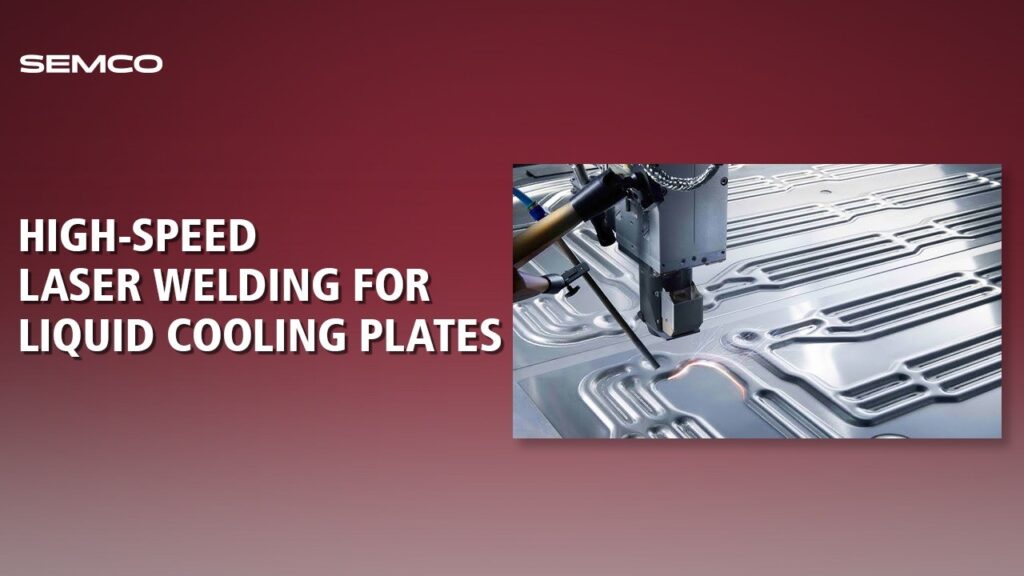
High-speed laser welding technology is primarily used to manufacture cooling components that require high sealing and reliable quality, and it has wide applications in new energy vehicles, data centers, and energy storage systems. This technology is gradually replacing traditional welding methods and becoming a key to industrial upgrading.
Core Technologies and Application Advantages
Brief Description of Technical Principles
Method: Using an extremely high energy density laser beam as a heat source, the workpiece is locally and rapidly melted and welded.
Core requirements: For precision components such as liquid cooling plates, the core objective is to achieve micron-level precision control and complete sealing of microchannels (usually referring to the water channels inside the cooling plate).

Key Challenges to be Solved
High reflectivity materials: For commonly used liquid cooling plates such as aluminum and copper, the high reflectivity problem is overcome by using technologies such as beam energy modulation (e.g., splitting the beam into an inner core and an outer ring).
Sealing and Deformation: Through AI real-time molten pool monitoring, closed loop feedback and path optimization algorithms, heat input is dynamically controlled to ensure sealing and keep deformation at an extremely low level (e.g., flatness ≤ 0.5mm/m² ) during high-speed welding.
Extra-long welds: Combining precision positioning and synchronous cooling systems ensures stable, continuous, and high-quality welding of welds several meters long.
Key Technological Advantages
High efficiency: The welding speed is extremely fast, with some equipment reaching a maximum speed of ≥ 15 meters per minute, making it suitable for large scale production.
High precision and low damage: The heat-affected zone can be less than 0.1mm , and the overall deformation of the workpiece is minimal.
Strong sealing performance: It can form welds with a high depth-to-width ratio (up to 10:1), withstand harsh pressure tests, and achieve reliable sealing.

Industrial Applications and Market Outlook
High-speed laser welding can effectively meet the growing demand for liquid cooling plates in fields such as new energy vehicles, energy storage, and data centers. For example, in one case, the laser solution has helped achieve mass production of large aluminum alloy liquid cooling plates, whose welds can withstand more than 100,000 pressure cycle tests.
Its driving force mainly comes from two aspects:
Replacement of traditional processes: Compared with traditional brazing (high energy consumption and long cycle), laser welding has obvious advantages in green manufacturing and automation.
Market demand growth: The market size of liquid cooling plates for new energy vehicles is growing rapidly, and the demand in emerging fields such as energy storage and data centers is also surging, creating an urgent need for high-precision and high-reliability welding technologies.
Comparison with other welding processes
There are three main technical approaches to welding liquid-cooled plates, each with its own emphasis:

Laser welding
- Key advantages: extremely fast speed, minimal thermal deformation, and high sealing precision.
- Main challenges: extremely stringent requirements for workpiece assembly clearance (typically <o.1mm), and high equipment investment.
- Typical applications: sealing of liquid cooling plate covers for power batteries, microchannel welding for data centers, and other high-precision components.

Brazing
- Key advantages: It can weld complex and long seams in one go, with high overall strength and a smooth surface.
- Main challenges: long process cycle, high energy consumption, and potential risk of brazing filler metal corrosion.
- Typical application: mainstream liquid cooling plates for new energy vehicle battery packs with complex structures that require overall heat dissipation.

Friction stir welding
- Key advantages: Excellent mechanical properties of the weld (close to the base material), and higher tolerance for assembly gaps than laser welding.
- Main challenges: The “keyhole” left after welding needs to be addressed, and the adaptability to complex three-dimensional contours needs to be improved.
- Typical applications: dissimilar material connections, battery trays, and other fields with extremely stringent requirements for strength and reliability.
Development Trends of High-Speed Laser Welding
The development of high-speed laser welding in the field of liquid-cooled plate manufacturing shows the following trends:
Deep integration with intelligent technology: AI technologies such as real-time monitoring, closed-loop control, and automatic code generation from drawings are driving its development towards greater intelligence and flexibility.
Application of process combinations: For complex components, the future may see a combination of multiple welding processes (such as laser welding + friction stir welding) used in different parts to balance efficiency, strength and cost.
Semco Infratech’s Laser Welding Solutions
As part of its end-to-end battery manufacturing and BESS infrastructure solutions, Semco Infratech offers advanced laser welding systems designed for precision battery and thermal component manufacturing.
These solutions are engineered to meet the growing requirements of EV battery manufacturers, energy storage integrators, and thermal management component suppliers.

Laser Welding Applications from Semco
Semco’s laser welding technologies support multiple applications within the battery ecosystem:
- Liquid Cooling Plate Welding Precision welding of aluminum cooling plates used in battery packs and BESS systems.
- Battery Module and Busbar Welding High-precision welding of copper and aluminum busbars for efficient current flow.
- Battery Pack Structural Welding Laser welding of battery trays, covers, and structural components.
- Microchannel Sealing Ensuring leak-proof sealing for high-performance thermal management systems.

Conclusion
High-speed laser welding is transforming the manufacturing of liquid cooling plates, enabling higher precision, faster production, and superior sealing reliability.
With the rapid growth of EVs, data centers, and grid-scale energy storage systems, advanced manufacturing technologies will play a central role in supporting the energy transition.
Through its laser welding solutions, turnkey battery assembly infrastructure, and BESS container integration expertise, Semco Infratech is helping manufacturers build the next generation of safe, reliable, and scalable energy storage systems.