

As the global transition toward renewable energy accelerates, energy storage systems (ESS) have become the backbone of modern power infrastructure. From grid stabilization and renewable integration to industrial energy management and electric mobility, the demand for reliable battery storage is growing at an unprecedented pace.
However, meeting this demand requires more than just battery cells—it requires highly efficient, scalable, and precision-driven manufacturing systems capable of producing energy storage modules and packs at industrial scale.
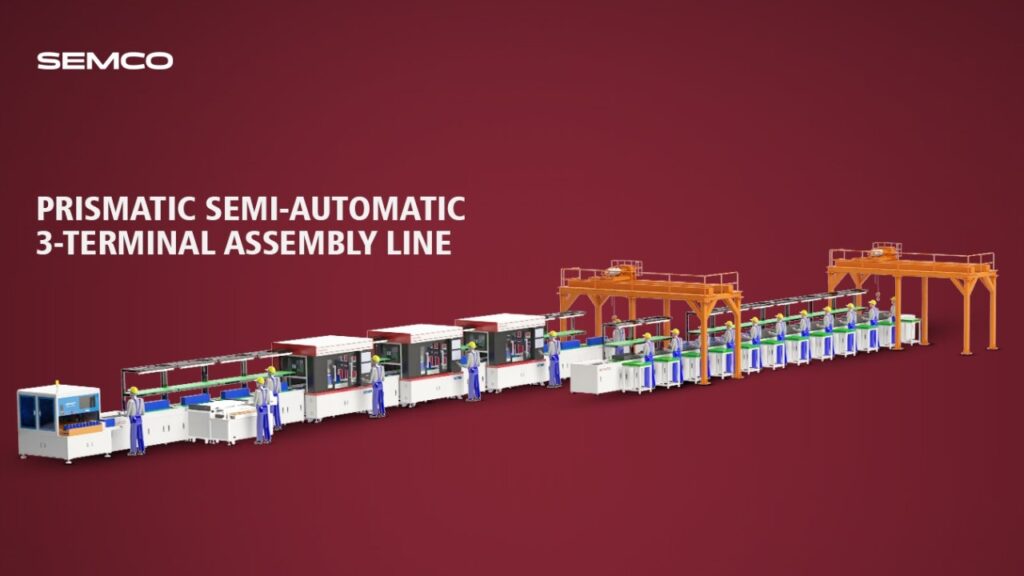
To address this need, Semco Infratech has developed a Semi-Automated 3 Terminal Energy Storage Pack Assembly Line, engineered to enhance production efficiency, ensure high-quality output, and support flexible manufacturing for various battery module configurations.
Engineered for 314Ah & 587Ah Prismatic Modules
The line is designed for liquid-cooled 1P8S, 1P13S, and 1P16S configurations, supporting.
- Module dimensions up to 977 × 182 × 218 mm
- Cell specifications for 280Ah / 314Ah / 587Ah prismatic cells
- Square aluminum shell battery compatibility
- Modular tooling adaptability for alternate cell formats

With compatibility built into fixtures, jigs, and profiling tooling, manufacturers can confidently scale or modify production models with minimal downtime.
High-Performance Production Capabilities
A key advantage of Semco’s solution is its ability to deliver consistent production output while maintaining strict quality standards.
The assembly line offers:

- Production capacity of up to 10-12 modules per minute (PPM)
- First-pass yield rate of ≥98%
- Final line yield of ≥99.5%
- Machine uptime ≥98%
- Line changeover time ≤4 hours
Intelligent Process Flow
The assembly line follows a structured and optimized production workflow that integrates cell preparation, module assembly, welding, testing, and pack integration.
Cell Processing and Sorting
Production begins with manual cell loading, where pallets of battery cells are transported to the processing station. Each cell undergoes barcode scanning and OCV testing, allowing the system to measure voltage and internal resistance while calculating performance indicators such as the K-value.

Cells are then automatically sorted into performance grades, ensuring that modules are assembled using cells with consistent characteristics.
This step significantly improves battery module consistency and long-term reliability.
Module Assembly and Compression
Once sorted, cells move into the module stacking station, where they are arranged according to the selected series-parallel configuration.
The module is then transferred to the compression and steel banding station, where:

- Adjustable compression forces between 10–1500 kgf are applied
- Modules are secured using hybrid steel-plastic straps
- Individual cell barcodes are scanned to generate a unique module ID
This process establishes full traceability from individual cell to final module assembly.
Automatic Polarity Detection & Laser Cleaning
At the entry of the automatic section, the polarity detection and laser cleaning station ensures correct orientation and surface preparation of each cell or module terminal. The roller conveyor brings the module tray into the station, where sensors detect arrival and a blocking mechanism stops it before a lifting platform raises it to the working height. A 3‑axis gantry moves a coaxial camera and laser cleaning galvanometer over the terminals, with a distance sensor continuously calibrating focus.

The vision system performs automatic polarity detection and can mark the running direction of the module, with a specified detection rate of ≥99.99%. Simultaneously, a 200 W MOPA laser cleans the terminal surfaces to remove oxides and contaminants, creating a stable base for subsequent welding. If a module fails polarity checks or other criteria, it is diverted to an NG workbench with both audible and visual alarms for corrective action. The station integrates an industrial PC, high‑precision motion system, and robust frame enclosure sized at roughly 2400 × 1700 × 2250 mm.
Manual Busbar Placement
Following cleaning, the busbar placement station supports structured manual assembly guided by sensors and fixtures. The module tray is transported in by the conveyor, positioned by a stopper, and then accessed by the operator. Operators install a profiling fixture on top of the module and place busbars according to the configured series count and cooling design. After placement, a simple release button sends the tray to the next process, minimizing handling errors.

Precision Laser Welding
One of the most critical stages of module manufacturing is busbar welding, which connects battery cells electrically. Semco’s system uses a 6 kW Raycus fiber laser welding platform, integrated with vision systems and automated positioning to ensure precise weld alignment.

Key advantages include:
• Deep penetration welding for strong electrical connections • Minimal spatter and clean weld surfaces • Real-time power monitoring with PID correction • Uniform weld depth with ±0.1 mm accuracy • Post-weld tensile strength exceeding 1000 N
These capabilities ensure durable electrical connections and improved module reliability.
Post-Weld Inspection
Once welding is complete, the module is transferred to a post‑welding inspection station where an operator visually checks weld quality and removes the profiling fixture. The workstation includes a simple start button to acknowledge inspection completion and release the module to subsequent handling or packing.
Module Line Tooling Station uses 15mm aluminum plate as the base plate, 5mm bakelite for surface insulation, and the size is 1200x600xx20mm.

Comprehensive Module Testing
After welding, each module undergoes End-of-Line (EOL) testing to verify electrical performance and safety.
Testing includes:
• Voltage measurement • Internal resistance testing • Insulation withstand tests • Leakage current analysis

All results are uploaded to the Manufacturing Execution System (MES) for digital traceability and quality documentation. This ensures that only fully compliant modules proceed to pack assembly.
Pack Assembly and Integration
Following module testing, modules are transferred to the pack assembly section, where the complete energy storage pack is constructed.
Key pack assembly processes include:

• Battery enclosure loading • Adhesive application • Module installation • Harness integration • BMS installation • Pack sealing and enclosure assembly
Each pack is assigned a unique barcode, linking it to its module and cell-level manufacturing data. Additional tests such as air-tightness verification and electrical validation ensure pack-level safety and durability.
Smart Manufacturing with MES Integration
Digitalization plays a vital role in modern battery manufacturing. Semco’s assembly line integrates a Manufacturing Execution System (MES) to monitor and control production in real time.
The MES system enables:

• Production data recording • Yield tracking and reporting • Traceability of modules and packs • Rework management and documentation • Operator-level production tracking
Even in the event of network interruptions, the MES system can operate independently and upload missing data once connectivity is restored.
Enabling the Next Generation of Energy Storage Manufacturing
As the global energy landscape evolves, battery manufacturing infrastructure must evolve with it.
Semco Infratech’s Semi-Automated Energy Storage Pack Assembly Line represents a strategic step forward in building high-performance, scalable, and digitally integrated battery production systems.

By combining advanced automation, precision welding technologies, intelligent quality control, and MES-enabled traceability, the solution enables manufacturers to produce reliable energy storage systems that meet the growing demands of the renewable energy and electrification sectors.