

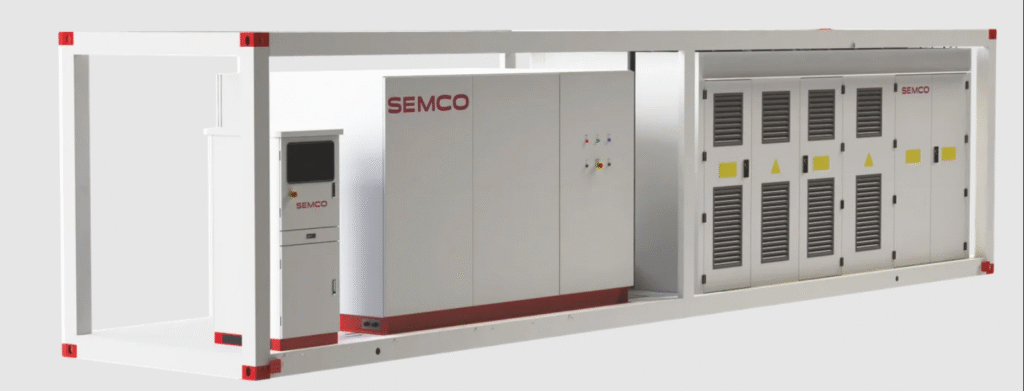
As the global battery energy storage market approaches $75 billion by 2033, manufacturers face a critical decision: continue with labor-intensive manual assembly or invest in advanced automation that promises higher throughput, better quality, and superior profit margins. The BESS Container Assembly Line has emerged as the gold standard for producers seeking competitive advantage in this rapidly expanding market.
The Automation Imperative in BESS Manufacturing
Manual assembly of battery energy storage systems is becoming economically unviable at scale. A typical energy storage container production line operating with minimal automation requires 15-20 technicians per shift to handle module placement, wiring, testing, and quality verification. Labor costs alone can account for 30-40% of total manufacturing expenses, not including the hidden costs of human error, rework, and inconsistent quality.
In contrast, a fully automated BESS manufacturing automation system reduces direct labor requirements by up to 70% while simultaneously increasing production capacity. Modern facilities equipped with robotic assembly cells, automated guided vehicles for material handling, and AI-powered inspection systems can achieve production rates of 18-20 containers per shift with just 4-6 operators focused on supervision and exception handling.
Breaking Down the Cost-Benefit Analysis
The investment in an automated battery storage container assembly equipment ranges from $5 million for a semi-automated line capable of 8-10 units per day to $25 million for a fully automated facility producing 30+ units daily. While these figures appear substantial, the return on investment typically materializes within 18-24 months for facilities operating at 70% capacity or higher.
Consider a mid-scale operation producing 3,000 BESS containers annually. Manual assembly costs approximately $8,000 per unit in direct labor, totaling $24 million annually. An automated line reduces this to $2,500 per unit ($7.5 million annually), generating $16.5 million in annual labor savings—enough to recoup a $20 million automation investment in just 14 months, even before factoring in quality improvements and throughput gains.
Quality Consistency: The Hidden Value Driver
Perhaps the most compelling argument for lithium battery container assembly automation isn’t cost reduction—it’s quality consistency. Manual assembly processes introduce variability at every step. Torque values vary between operators, wire routing differs container to container, and thermal interface material application lacks repeatability. These inconsistencies manifest as field failures, warranty claims, and damaged brand reputation.
Automated systems eliminate this variability. Every busbar connection is torqued to precisely 12 Nm. Every cable is routed through identical pathways with documented bend radii. Every thermal pad is applied with controlled pressure ensuring optimal heat transfer. The result? BESS container manufacturing automation facilities report field failure rates below 0.5%, compared to 2-3% for manually assembled systems—a quality differential that translates to millions in avoided warranty costs.
Key Technologies Driving Modern Assembly Lines
State-of-the-art ESS container assembly automation incorporates several critical technologies that weren’t economically feasible even five years ago. Vision-guided robotics now cost-effectively handle tasks like connector insertion and cable routing that previously required human dexterity. Collaborative robots work safely alongside human operators for tasks requiring judgment while automating repetitive motions.
Laser welding systems have revolutionized busbar and tab connection processes. Modern multi-axis laser welders can complete 500+ welds per container with penetration depth controlled to within 0.1mm, ensuring consistent electrical resistance and mechanical strength. This precision is impossible to achieve with manual welding techniques, even with highly skilled operators.
The Integration Challenge: Beyond Component Assembly
True battery energy storage system container assembly automation extends far beyond putting parts in boxes. The most sophisticated facilities integrate manufacturing execution systems that track every component from receiving through final test, providing complete genealogy for each container. Real-time data analytics identify process drift before it causes quality issues, while predictive maintenance algorithms minimize unplanned downtime.
The energy storage container production systems we design at Semco Infratech include integrated testing stations that perform electrical verification, thermal performance validation, and safety system checks without removing containers from the assembly line. This in-line testing approach reduces cycle time by 40% compared to offline testing while providing better data integrity since every test is timestamp-linked to specific production parameters.
Scalability and Flexibility: Building for Tomorrow
One of the most critical yet overlooked aspects of BESS Container Assembly Line design is scalability. The battery energy storage market is evolving rapidly, with new cell formats, chemistry variations, and system architectures emerging continuously. An assembly line optimized for today’s 280Ah LFP cells must also accommodate tomorrow’s 314Ah cells or potentially sodium-ion alternatives without complete redesign.
Modern BESS manufacturing automation system architecture emphasizes modularity. Robot end-effectors are designed with quick-change capabilities allowing format changes in minutes rather than hours. Fixture systems incorporate adjustable positioning that accommodates multiple container sizes. Software-defined assembly sequences allow process modifications without hardware changes, drastically reducing changeover costs and production disruptions.
Real-World Implementation: Case Studies and Lessons Learned
European manufacturers implementing automated lithium battery container assembly lines report 25-35% reductions in total manufacturing cost after the first year of operation. Asian facilities with highly optimized automation achieve even better results, with some reporting 40-50% cost reductions compared to manual assembly benchmarks.
However, automation success isn’t guaranteed. The most common pitfall is underestimating the importance of process standardization before automation. Attempting to automate a poorly defined or inconsistent manual process simply creates expensive automated chaos. Successful implementations begin with thorough process mapping, elimination of unnecessary variation, and establishment of clear quality criteria before any automation equipment is specified.
The Human Element: Reskilling Your Workforce
Transitioning to automated ESS container assembly automation doesn’t mean eliminating your workforce—it means transforming it. The most successful automation projects invest heavily in operator training, teaching troubleshooting skills, basic robotics programming, and data interpretation. Production technicians become automation specialists capable of optimizing system performance rather than simply following assembly instructions.
This workforce evolution actually enhances job satisfaction and retention. Employees appreciate the reduction in physically demanding repetitive tasks and the opportunity to develop higher-value technical skills. Progressive manufacturers report lower turnover and easier recruitment when operating advanced automated facilities compared to traditional manual operations.
Making the Investment Decision
For manufacturers evaluating whether to invest in a battery storage container assembly equipment upgrade, several factors should guide the decision. If your current or planned production volume exceeds 1,000 units annually, automation typically delivers positive ROI within two years. If product quality issues are generating warranty claims exceeding 1% of revenue, automation’s quality consistency benefits alone may justify investment.
Market positioning matters too. As the BESS industry matures, customers increasingly prefer suppliers with demonstrated manufacturing capability and quality systems. An automated BESS Container Assembly Line sends a strong signal about commitment to quality, capacity, and long-term viability—factors that often outweigh pure price considerations in enterprise purchasing decisions.
Conclusion: Automation as Competitive Necessity
The question is no longer whether to automate battery energy storage system production—it’s how quickly you can implement automation ahead of competitors. As industry leaders continue investing in advanced BESS container manufacturing, the cost and quality gap between automated and manual production will widen to the point where non-automated producers simply cannot compete on either price or reliability.
At Semco Infratech, we’ve developed comprehensive automation solutions specifically optimized for BESS container assembly, from semi-automated lines for emerging producers to fully lights-out facilities for high-volume manufacturers. Our approach emphasizes practical, proven technology rather than experimental systems, ensuring your automation investment delivers promised returns from day one.
Considering automation for your BESS production facility? Schedule a consultation with Semco Infratech’s automation specialists at www.semcoinfratech.com to explore custom solutions matched to your production volume, product mix, and growth objectives.