

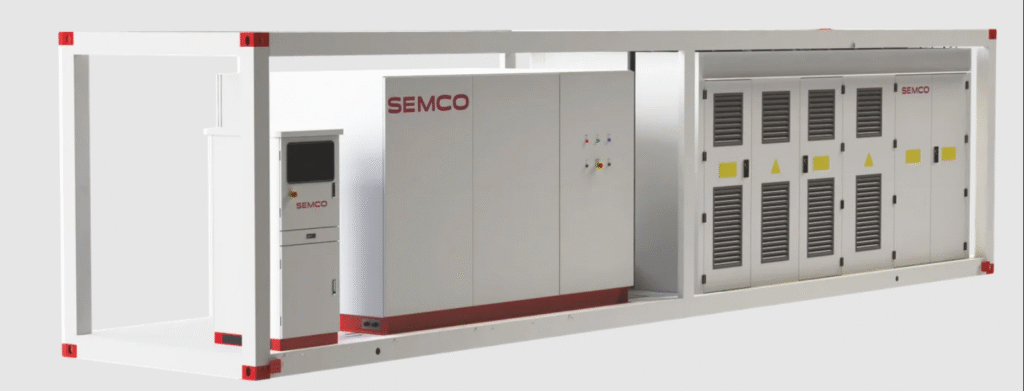
The battery energy storage industry stands at an inflection point. With global installations reaching 205 GWh in 2024 and projections suggesting 400+ GWh by 2025, the BESS Container Assembly Line technology of tomorrow must be radically different from today’s solutions. This article explores the transformative innovations reshaping how we design, manufacture, and deploy containerized energy storage systems.
The Shift Toward Modular and Stackable Architectures
The traditional 20-foot container form factor that has dominated BESS design is evolving rapidly. Industry leaders like CATL have introduced stacked configurations achieving 9 MWh capacity in a 20-foot footprint through vertical integration, while others are moving toward 10-foot modular blocks offering 3.2 MWh capacity with enhanced transportability. This architectural diversity is driving innovation in energy storage container production line design.
Modern BESS manufacturing automation systems must accommodate multiple container formats simultaneously—a challenge that requires unprecedented flexibility. Manufacturers are adopting platform-based approaches where common subsystems like power conversion, thermal management, and control systems are standardized, while container dimensions and capacity scale based on customer requirements. This modularity reduces design complexity while enabling mass customization previously impossible in energy storage.
Advanced Thermal Management: Liquid Cooling Dominance
Air-cooled BESS systems dominated early deployments due to simplicity and lower initial costs. However, as energy density increases and duty cycles intensify, liquid cooling has emerged as the clear winner for utility-scale applications. Battery storage container assembly equipment now routinely includes precision liquid cooling manifold installation, coolant fill and pressure testing, and thermal interface material application with micron-level precision.
The shift to liquid cooling presents significant manufacturing challenges. Every connection point is a potential leak source; every thermal interface affects system performance. Advanced lithium battery container assembly lines incorporate automated coolant circuit testing that verifies flow rates, pressure drops, and thermal transfer coefficients before containers leave the factory. Vision systems inspect every thermal pad placement, while robotic dispensing ensures consistent adhesive application for leak-free operation over decades of thermal cycling.
AI-Driven Quality Control and Predictive Analytics
Perhaps the most transformative innovation in BESS container manufacturing automation is the integration of artificial intelligence throughout the assembly process. Machine vision systems now identify defects invisible to human inspectors—microscopic weld porosity, insulation damage, and assembly alignment deviations measured in micrometers. These systems don’t just detect problems; they predict them by analyzing trends across thousands of production cycles.
Predictive quality systems monitor every process parameter—welding power curves, torque patterns, cycle times—and correlate them with downstream test results. When the system detects patterns suggesting an emerging quality issue, it alerts operators before a single defective unit is produced. This shift from reactive quality control to predictive quality assurance represents a paradigm change in manufacturing excellence.
Smart Factory Integration and Digital Twins
The concept of the ESS container assembly automation facility is evolving from a collection of independent workstations to a fully integrated cyber-physical system. Modern factories employ digital twin technology that maintains virtual replicas of every physical asset, production process, and even individual containers throughout their lifecycle. These digital twins enable simulation-based optimization before physical production begins, reducing trial-and-error development cycles from months to days.
Manufacturing execution systems now orchestrate material flow, equipment scheduling, and quality verification with minimal human intervention. When a production order is released, the system automatically reserves materials, schedules equipment, generates work instructions, and configures test parameters. Automated guided vehicles deliver components to assembly stations exactly when needed, while robotic arms perform prescribed assembly sequences with sub-millimeter repeatability.
Sustainability and Circular Economy Principles
The next generation of battery energy storage system container assembly technology prioritizes environmental sustainability beyond just the clean energy these systems enable. Manufacturers are redesigning assembly processes to minimize waste, incorporating recyclable materials, and planning for end-of-life disassembly from the initial design phase. This circular economy approach aligns with emerging regulatory requirements while appealing to environmentally conscious customers.
Several BESS Container Assembly Line operators have achieved zero-waste-to-landfill status by implementing comprehensive recycling programs for packaging materials, metal shavings, and even defective components. Others are exploring closed-loop battery recycling where recovered materials from end-of-life batteries feed directly back into cell production—creating truly circular value chains that reduce dependence on virgin raw materials.
The Rise of Regional Manufacturing Hubs
Geopolitical considerations and supply chain resilience concerns are reshaping the global energy storage container production landscape. While China maintains overwhelming dominance in battery cell production and system integration, North America, Europe, and emerging markets are rapidly building domestic assembly capacity to qualify for local content incentives and reduce transportation emissions.
This regionalization trend is driving demand for flexible BESS manufacturing automation systems that can be replicated across multiple facilities with minimal customization. Manufacturers want standardized production technologies that deliver consistent quality whether deployed in Texas, Germany, or India. This requirement is accelerating technology transfer and elevating manufacturing standards globally, benefiting the entire industry.
Advanced Materials and Next-Generation Chemistries
Current BESS containers predominantly utilize lithium iron phosphate (LFP) chemistry due to its excellent safety profile and cost-effectiveness. However, emerging alternatives like sodium-ion batteries and solid-state lithium technologies are approaching commercial viability. Lithium battery container assembly lines must be designed with chemistry flexibility in mind, accommodating different cell formats, voltage levels, and thermal characteristics without complete redesign.
The most forward-thinking manufacturers are implementing configurable assembly stations where cell handling, welding parameters, and test protocols can be modified through software rather than hardware changes. This chemistry-agnostic approach ensures production investments remain relevant as battery technology continues evolving at unprecedented pace.
Enhanced Safety Systems and Certification Requirements
As BESS deployments accelerate, regulatory scrutiny intensifies. Fire safety incidents, though rare, have prompted stricter certification requirements and more sophisticated safety systems. Modern BESS container manufacturing automation incorporates multi-layer fire detection using thermal imaging, smoke sensors, and gas analyzers that can identify thermal runaway in its earliest stages.
Safety system integration extends beyond just installing equipment—it requires comprehensive validation testing that simulates worst-case scenarios. Advanced facilities employ dedicated test chambers where containers undergo accelerated thermal runaway testing, verifying that detection systems activate properly and suppression systems contain events without propagation. This testing rigor provides insurers and end customers with confidence that systems will perform as designed in emergency situations.
The Workforce of the Future
Operating tomorrow’s ESS container assembly automation facilities requires a fundamentally different skillset than traditional manufacturing. The next generation of production technicians must understand robotics programming, data analytics, and advanced troubleshooting techniques. Forward-thinking manufacturers are partnering with technical colleges to develop specialized training programs that create pipelines of qualified automation specialists.
This workforce evolution creates opportunities for current employees willing to develop new skills. Many manufacturers report that their most effective automation operators are experienced assembly technicians who understand the product intimately and can identify when automated systems aren’t performing optimally. Investing in workforce development yields dividends in productivity, quality, and innovation.
Preparing for Exponential Growth
Industry forecasts project the containerized BESS market will exceed $35 billion by 2030, requiring production capacity expansion that dwarfs current capabilities. Meeting this demand necessitates not just more battery storage container assembly equipment, but smarter, more efficient production systems that can scale without proportional increases in cost, complexity, or quality risk.
The manufacturers who will dominate this future market are those investing today in flexible, scalable automation platforms; developing deep expertise in emerging battery technologies; and building organizational capabilities in data-driven manufacturing excellence. The window for establishing competitive positioning is narrowing as industry leaders pull ahead with superior production capabilities.
Conclusion: Embracing the Transformation
The BESS Container Assembly Line of 2025 and beyond will be unrecognizable compared to facilities built just three years ago. Liquid cooling, AI-driven quality control, digital twin integration, and chemistry flexibility are no longer futuristic concepts—they’re current requirements for remaining competitive. Manufacturers who view their production systems as strategic assets deserving continuous innovation will thrive; those treating assembly as a commodity function will struggle to compete.
At Semco Infratech, we’re not just responding to these trends—we’re driving them through continuous innovation in automation technology, process optimization, and manufacturing excellence. Our energy storage container production solutions are designed with the flexibility and intelligence required to adapt as the industry evolves, ensuring your production investments deliver value for decades, not just years.
The future of energy storage manufacturing is being built today. The only question is whether you’ll lead this transformation or follow it.
Want to future-proof your BESS manufacturing operations? Connect with Semco Infratech’s innovation team at www.semcoinfratech.com to explore cutting-edge assembly solutions designed for the demands of tomorrow’s energy storage market.