

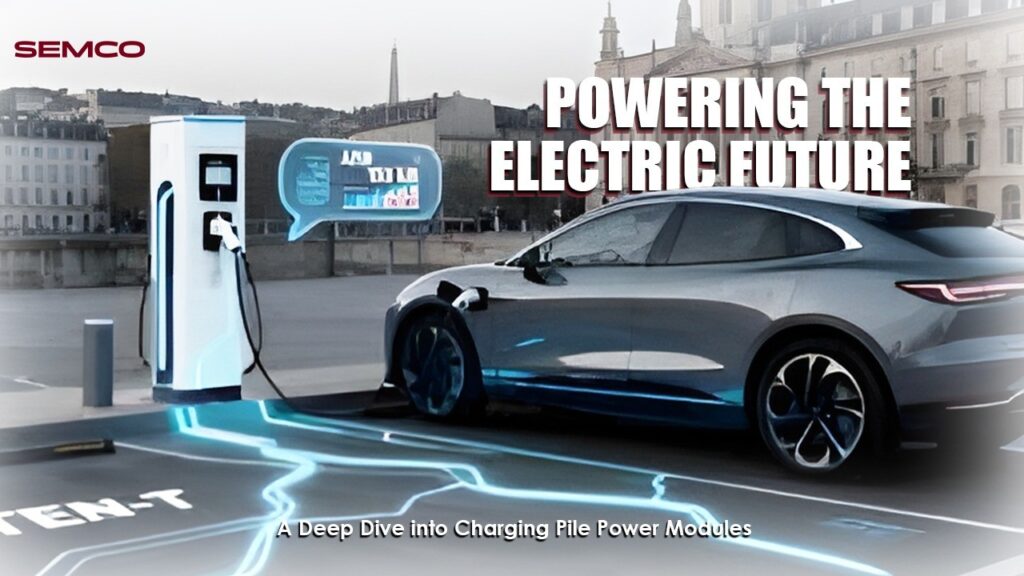
The rapid surge in electric vehicle (EV) adoption has placed significant demand on charging infrastructure. Charging piles, the essential link between the grid and EVs, rely on power modules to deliver efficient and reliable charging. These power modules, often referred to as the “heart” of charging piles, play a crucial role in converting and controlling the flow of electrical energy.
Understanding the Role of Power Modules
Power modules in charging piles perform several critical functions:
- AC-DC Power Conversion: They convert alternating current (AC) power from the grid into direct current (DC) power, which is suitable for charging EV batteries.
- Voltage Regulation: They regulate the output voltage to ensure optimal charging conditions for different battery types and charging rates.
- Current Limiting: They limit the charging current to prevent overheating and damage to the battery.
- Fault Protection: They incorporate various protection mechanisms to safeguard against overcurrent, overvoltage, and short-circuit conditions.
Key Technologies Driving Power Module Innovation
To meet the increasing demands of EV charging, power module manufacturers are continuously innovating and adopting advanced technologies:
- High-Frequency Switching: By operating at higher frequencies, power modules can reduce the size of passive components like inductors and transformers, leading to smaller and more efficient designs.
- Wide Bandgap Semiconductor Devices: These devices, such as silicon carbide (SiC) and gallium nitride (GaN), offer superior performance in terms of efficiency, power density, and thermal management.
- Advanced Control Algorithms: Sophisticated control algorithms enable precise control over the power module’s operation, optimizing performance and efficiency.
- Thermal Management Solutions: Effective thermal management is crucial to prevent overheating and ensure the reliability of power modules. Advanced cooling techniques, such as liquid cooling and forced air cooling, are employed to dissipate heat efficiently.
Challenges and Future Trends
Despite significant advancements, several challenges remain in the development of power modules for charging piles:
- Cost Reduction: Reducing the cost of power modules is essential to make EV charging more affordable.
- Reliability and Durability: Power modules must be designed to withstand harsh environmental conditions and prolonged operation.
- Efficiency Improvement: Continuous efforts are needed to improve the efficiency of power modules to reduce energy losses and lower operating costs.
To address these challenges, future trends in power module technology include:
- Modular Design: Modular power modules can be easily scaled to meet different power requirements and facilitate maintenance.
- Artificial Intelligence (AI) and Machine Learning: AI and ML algorithms can optimize the performance of power modules by analyzing real-time data and adapting to changing conditions.
- Wireless Power Transfer: Wireless charging technology can eliminate the need for physical connectors, simplifying the charging process and reducing maintenance requirements.
As the EV industry continues to grow, power modules will play a pivotal role in shaping the future of electric mobility. By addressing the challenges and embracing emerging technologies, power module manufacturers can contribute to a more sustainable and efficient energy landscape.